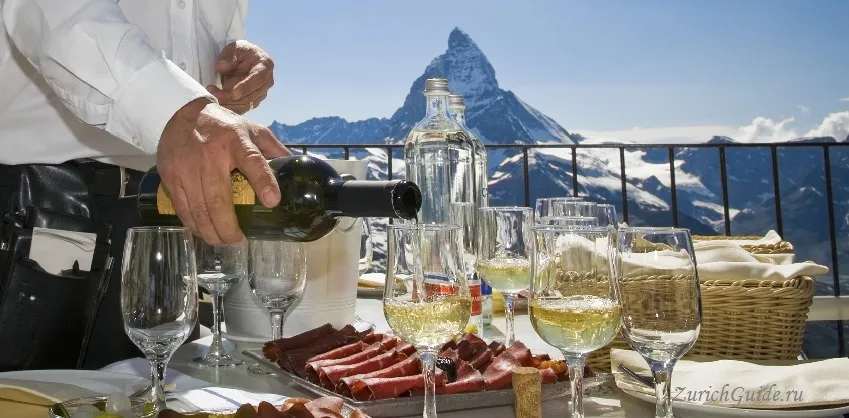
Swiss wine
Almost none of it leaves the country. What the regions make, which grapes are worth finding, and where to drink it at the source.
Switzerland makes around a hundred million litres of wine a year and exports about two per cent of it. The rest is drunk at home, which is why you have probably never had a bottle and why it costs what it does when you find one.
The vineyards are small, steep and expensive to work — some terraces in the Valais are so steep they are served by monorail — and there is no volume to sell abroad even if anyone wanted to.
The regions
Valais — a third of all Swiss wine
The Rhône valley from Martigny to Brig, the driest and sunniest part of Switzerland. See Sion.
Whites are Fendant — Chasselas under its Valais name — and, more interestingly, Petite Arvine: an indigenous grape grown almost nowhere else, dry, saline, with real acidity. Amigne and Humagne Blanche are two more locals worth trying if you see them.
Reds are Dôle, a blend of Pinot Noir and Gamay, and increasingly straight Pinot Noir and Syrah.
Vaud — Lake Geneva
Chasselas country, and the reason to take it seriously. Lavaux and La Côte around Morges produce pale, low-aromatic, stony wines that taste of the site rather than the fruit — a style almost nobody else attempts, because Chasselas is a table grape everywhere else.
The grands crus are Dézaley and Calamin. A Lavaux label that names no grape is Chasselas.
Ticino — Merlot
South of the Alps. Ticino replanted with Merlot after phylloxera and now makes some of the best outside Bordeaux and Tuscany, plus a white Merlot vinified off the skins that exists almost nowhere else. See Ticino.
Graubünden — Pinot Noir
The Bündner Herrschaft, north of Chur, makes the best Pinot Noir in the country and the wines that most often escape abroad. Small production, serious prices.
German-speaking Switzerland
Zurich, Schaffhausen, Aargau and Thurgau grow more than people expect — mostly Pinot Noir, and Räuschling, an old white grown almost exclusively around Lake Zurich.
What to order
If you are in a restaurant and the list is unfamiliar, three rules work:
- Drink the local one. Swiss wine lists are regional, and the house wine in a Valais village is a Fendant that costs a fraction of an imported bottle.
- Ask for the offen — wine by the glass or by the decilitre, which is how it is normally sold. A Zweier is 2 dl, a Dreier 3 dl.
- Try one indigenous grape while you are here: Petite Arvine, Amigne, Cornalin, Humagne Rouge or Completer. None of them will be available at home.
Where to taste
Caveaux — cellars in the wine villages where growers pour their own, open mostly Thursday to Sunday from about May to October, on a rota kept by the local tourist office. Lavaux is the easiest to do on foot between two railway stations.
Carnotzets — the rougher version: a cellar with benches and a long table, for staying put with wine, cheese and cured meat.
Open cellar days — most regions hold one weekend a year when every producer opens. The Valais one is in May.
Buying
Supermarkets carry a decent range at reasonable prices; Coop and Migros both have serious wine sections. A bottle worth drinking starts at around fifteen francs, which by Swiss standards is not much.
Taking it home is limited by the customs allowance of the country you are entering, not by Switzerland.
The other drinks
Beer — local breweries in every canton; Appenzeller Quöllfrisch travels best. Absinthe — invented in the Val-de-Travers above Neuchâtel, banned for most of a century, legal again since 2005. Kirsch and Williams — cherry and pear spirits from central Switzerland and the Valais, and the thing to have after a fondue. Rivella — made from milk whey, and better than that sounds.
Updated: