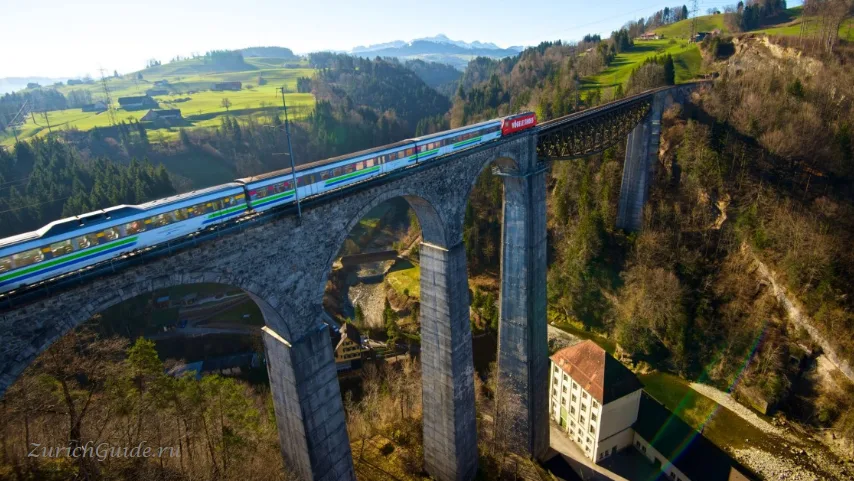
Getting around Switzerland
One timetable covers trains, buses, boats and mountain railways, and connections are built to be made rather than to look good on paper.
The Swiss public transport network is the reason this country is easy to travel in, and it works differently from most: it is one system, not several.
Trains, post buses, lake steamers, funiculars and cable cars share a single timetable, a single ticketing system and a single planning app. A journey from a city centre to a mountain hut is quoted as one door-to-door time, and the bus at the end waits for the train.
The things that surprise people
Connections are designed, not accidental. A four-minute change is a real four minutes, usually on an adjacent platform, and the system is built around it. Do not pad your day with half-hour buffers; you will waste it.
Punctuality is assumed. A train listed at 09:34 leaves at 09:34. When something is late the delay is announced in minutes and the connecting services are told to wait or not.
The yellow buses go where the trains do not. PostAuto reaches villages, mountain passes and valley heads, on the same ticket and the same timetable. Their three-note horn on blind mountain corners is a legal right of way, and the bus will not give it up.
Boats are public transport. The steamers on Lucerne, Geneva, Thun, Brienz and Zurich are scheduled services rather than excursions, and passes cover them.
Planning a journey
One app does everything: SBB Mobile. It plans door to door across every operator, sells the ticket, shows the platform, the carriage layout and how full the train is, and tells you which end of the platform to stand at for your connection.
The website sbb.ch does the same. There is no need for any other tool, and no need to book ahead for domestic travel — ordinary trains are turn-up-and-go.
Classes and seats
Second class is comfortable and entirely normal; first class buys space and quiet rather than luxury. Intercity trains have family carriages with a small play area, and quiet carriages where phone calls are not allowed — a rule enforced by the other passengers.
Reservations are optional on ordinary trains and compulsory on the panoramic services.
Tickets and inspection
Buy before you board — app, machine at the stop, or counter. There are no barriers and nobody checks as you get on, which persuades a great many visitors that the system runs on trust alone. It does not: inspectors board at random, the surcharge is heavy, and it rises sharply on a second offence.
See tickets and passes for which pass is worth buying.
Luggage
Two things worth knowing:
- Lockers at every significant station, in several sizes, paid by card. The larger stations also have staffed left-luggage counters.
- Station-to-station forwarding. Hand a bag in at one station and collect it at another, usually the next day, for a modest fee per item. It turns a day of changing trains with suitcases into a day of walking around unencumbered. Some stations also offer airport check-in for certain airlines, so the bag goes straight through.
Mountain railways and lifts
Funiculars, rack railways, gondolas and cable cars are run by dozens of separate companies, and this is where passes get complicated: some lifts are fully covered by a national pass, some only discounted, some not covered at all.
Check each one before committing to a pass, because the mountain sections are where the real money goes — the Jungfraujoch and Zermatt are the two expensive examples.
Do you need a car?
Almost certainly not, and in several places it is an active disadvantage: Zermatt, Wengen, Mürren, Saas-Fee and others are car-free, and city centres are pedestrianised with expensive parking.
A car earns its place only for remote valleys, for travelling with a lot of luggage and small children, or for reaching trailheads at awkward hours. If you do drive, read driving in Switzerland first — the motorway vignette and the speeding rules both catch people out.
Updated: