Cheese dairies you can visit
Show dairies with a viewing gallery, working alp huts above the treeline, and the difference between the two.
Cheese is the reason Swiss mountain farming exists: milk does not keep and cheese does, so the summer surplus of a high pasture was turned into wheels that could be carried down and sold. Everything about Swiss dairy — the alp huts, the herds moving up in June and down in September, the wheel sizes — follows from that.
Two quite different things are open to visitors, and it is worth knowing which you are going to.
Show dairies
Purpose-built, with a viewing gallery over the vats, an exhibition, several production runs a day and a shop. Comfortable, open all year, and good with children.
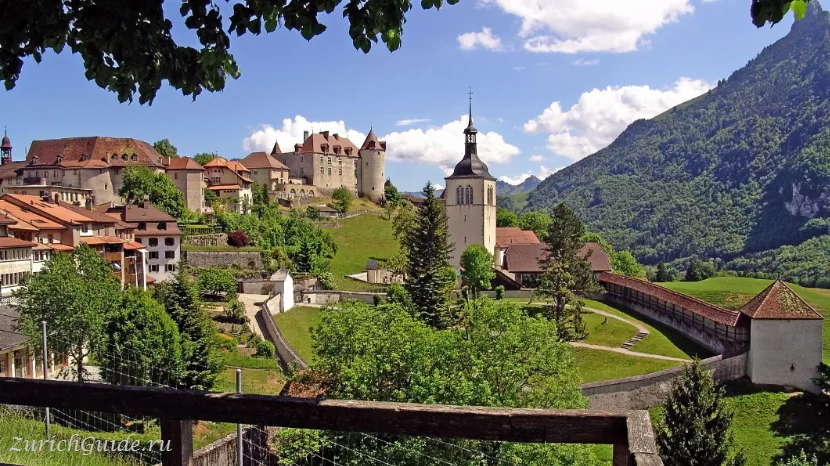
La Maison du Gruyère at Gruyères is the largest and best organised. You watch milk turn into a 35 kg wheel through glass, and the tasting includes the same cheese at three ages — six, eight and eighteen months — which is the part that teaches you something.
Emmentaler Schaukäserei at Affoltern, in the Emmental valley an hour from Bern, makes the cheese with the holes. It also demonstrates the historic methods, including cheesemaking over an open fire in a copper cauldron.
Appenzeller Schaukäserei at Stein, in the north-east, makes the pungent one, and is the one to combine with a day in Appenzell itself.
Engelberg abbey dairy — the Benedictines at Engelberg run their own Schaukäserei, which is the most agreeable of them: a working monastery dairy with a shop, and a cable car to a glacier ten minutes away.
Alp huts
The other kind: a working Alpwirtschaft above the treeline, where a family spends the summer with the herd and makes cheese every morning because that is the job.
There is no gallery and no exhibition. You arrive on foot, usually early, and if the cheesemaker has time you watch. Many sell cheese, bread and coffee, and some serve a meal.
Tourist offices in the Bernese Oberland, Graubünden and central Switzerland keep lists of huts that welcome visitors. It is a walk rather than an outing, and it is the real thing.
The cheeses, briefly
- Gruyère — hard, nutty, made in the Fribourg region. No holes; the one with holes is Emmentaler.
- Emmentaler — the holes come from carbon dioxide released by bacteria during ripening. Mild, and the wheels are enormous, up to 100 kg.
- Appenzeller — washed in a herbal brine whose recipe is a genuine trade secret. Strong.
- Sbrinz — the hardest, aged at least eighteen months, and probably the oldest Swiss cheese; the Romans may have known it.
- Raclette — semi-hard, made to be melted.
- Vacherin Fribourgeois — the other half of a proper moitié-moitié fondue. There is also Vacherin Mont-d’Or, a soft winter cheese in a spruce box, baked and eaten with a spoon.
- Tête de Moine — shaved into rosettes with a rotating blade rather than cut, which affects how it tastes.
More on eating them in eat and drink.
The cattle move
Two events worth timing a trip around, both free and both entirely genuine.
Alpaufzug in late May or June: the herds walk up to the summer pasture, the lead cows in flower headdresses and heavy bells.
Alpabzug in September: they come back down, decorated again, through villages that turn out to watch. Appenzell, the Emmental, Charmey and the Entlebuch all hold large ones, and the dates are published in advance by the tourist offices.
Practical
Show dairies charge a small entry or none at all, and most are open daily. Production runs happen in the morning — typically between about nine and eleven — so arriving in the afternoon means seeing the exhibition and not the cheese.
All four named above are reachable by train and post bus; see getting around.
Updated: