The festival calendar
A snowman is blown up in April, cows come down the mountains in September, and a million people dance through Zurich in August. Month by month.
Swiss events are mostly annual, local and genuinely old, and a good many of them are free. This is what happens when, and which ones are worth planning a trip around.
Dates that move with Lent or the weather are marked as such — check locally before booking.
January
Lauberhorn — the longest downhill race in the World Cup, at Wengen, mid-January. Fills the valley.
Vogel Gryff, Basel — a masked figure descends the Rhine on a raft, in a ritual nobody outside the city fully understands.
Solothurn Film Festival — the showcase for Swiss cinema, in Solothurn.
World Economic Forum, Davos — not a festival. Avoid that week entirely.
February and March
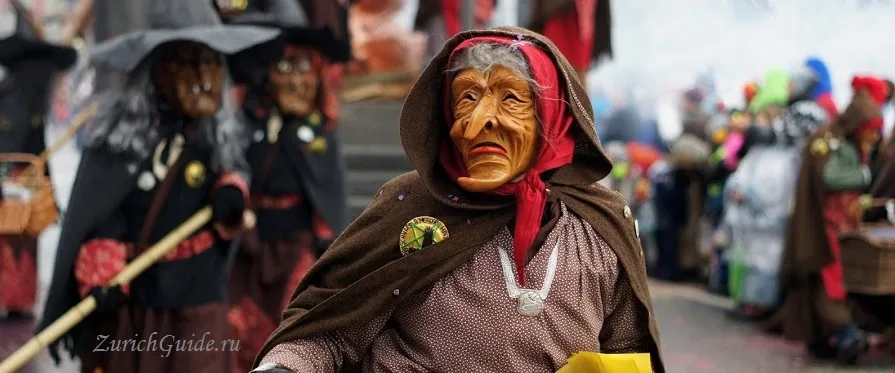
Fasnacht — carnival, and the two versions are quite different.
Basel starts at exactly four in the morning on the Monday after Ash Wednesday: every light in the city goes out and thousands of masked pipers and drummers move through the dark behind painted lanterns. It runs exactly 72 hours and is on the UNESCO list.
Lucerne starts at five in the morning on the Thursday before Lent with a cannon shot, and is louder, wilder and more chaotic. Brass bands playing deliberately out of tune.
Chalandamarz, 1 March, in Graubünden — children ring cowbells through the villages to drive out winter.
April
Sechseläuten, Zurich, third Monday — the guilds parade and then set fire to a snowman full of explosives. The time until its head explodes is taken as a forecast for the summer.
Landsgemeinde, Appenzell, last Sunday — the citizens vote in the open air by raising their hands. Not a re-enactment: this is the canton’s legislature.
Tulip festival, Morges — a hundred thousand bulbs on the lakefront, from late March.
May and June
Alpaufzug — the herds walk up to the summer pasture, lead cows in flower headdresses. Dates depend on the grass.
Art Basel, June — the art world arrives in Basel and every hotel for fifty kilometres is taken.
Vevey wine festival — but only once every twenty years; see Vevey.
July
Montreux Jazz — two weeks, and the second-largest jazz festival in the world, in Montreux.
Paléo, Nyon — the largest open-air music festival in Switzerland, six days, sells out in hours.
Verbier Festival — classical, with an orchestra of young musicians, in Verbier.
Gstaad Menuhin Festival — six weeks from July, in Gstaad.
Swiss Open tennis, on clay in Gstaad.
Avenches opera in the Roman amphitheatre; see Roman Switzerland.
1 August — the national day. Bonfires on the mountains, fireworks everywhere, and a ceremony on the Rütli meadow; see Schwyz.
August
Locarno Film Festival — eleven days, with a screen 26 by 14 metres and eight thousand seats in the Piazza Grande. One of the oldest festivals in the world.
Street Parade, Zurich, second Saturday — around a million people and thirty sound systems round the lake basin. The largest event of its kind in Europe. If it is not what you want, be somewhere else that weekend.
Zurich Openair, late August — a large rock and electronic festival on the edge of the city, and the other reason Zurich hotels vanish that month.
Fête du Jasmin, Grasse — not Swiss, but the same weekend, if you are travelling on.
Augusta Raurica Roman festival, end of August, with several hundred re-enactors.
September
Alpabzug — the cattle come down, decorated, through villages that turn out to watch. Appenzell, the Emmental, Charmey and the Entlebuch hold the largest. Free, genuine, and among the best things to see in the country.
Fête des Vendanges, Neuchâtel — the largest autumn festival in Switzerland, in a town of 33,000.
Knabenschiessen, Zurich — a shooting competition for teenagers dating from the seventeenth century, with a funfair attached.
Zurich Film Festival, late September into October.
October
Olma, St. Gallen — the Swiss agricultural fair, ten days, including a race in which people run alongside pigs.
Chestnut festivals in Ticino, through the month.
November
Zibelemärit, Bern, fourth Monday — the onion market. Starts at four in the morning, involves confetti, onion tarts and a great deal of mulled wine.
Räbechilbi, Richterswil on Lake Zurich, second Saturday — the turnip festival. Around 25 tonnes of turnips are hollowed out, carved and lit with candles, the street lights are switched off, and a procession of illuminated floats moves through the village. It is one of the strangest and best things in Switzerland and hardly any foreign visitor has heard of it.
December
L’Escalade, Geneva, weekend nearest the 11th — seventeenth-century costume, torches, and chocolate cauldrons smashed with a fist.
Christmas markets everywhere from late November: Basel and Montreux are the largest, Zurich’s main station one of the biggest indoor markets in Europe.
St. Nicholas, 6 December — processions in Fribourg and Küssnacht, where the Klausjagen involves several hundred people wearing enormous illuminated mitres.
31 December — fireworks over the lakes, and Zurich goes up Uetliberg to watch from above.
Practical
Almost all of these are free to watch. The ones that need tickets months ahead are Montreux Jazz, Paléo, Verbier, Locarno and the Lauberhorn.
Hotels vanish for Fasnacht, Art Basel, Montreux Jazz, Street Parade and the WEF. Check the dates before booking a trip that happens to overlap; see when to go.
Updated: