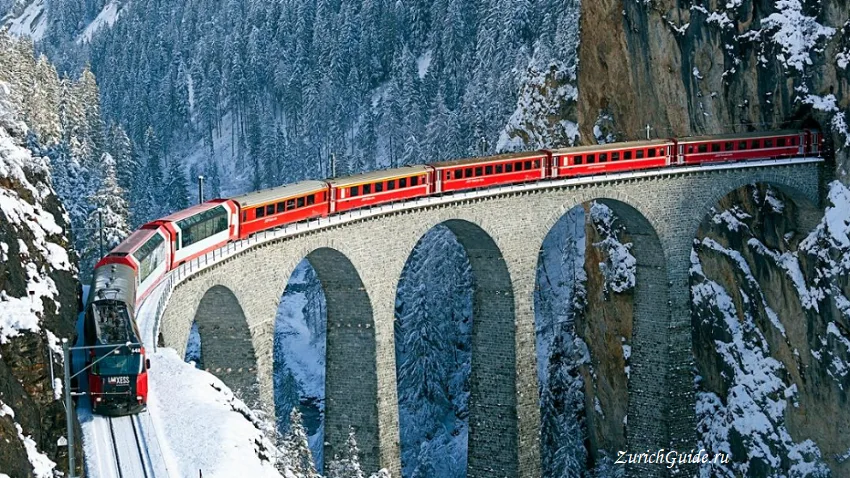
Glacier Express
Eight hours from St. Moritz to Zermatt across 291 bridges and 91 tunnels, and the honest question of whether to take it at all.
The Glacier Express runs from St. Moritz to Zermatt in about eight hours, and it markets itself as the slowest express train in the world — accurately, and rather well.
It crosses the country from the Engadin to the Matterhorn: 291 bridges, 91 tunnels, and the Oberalp Pass at 2,033 m, which it climbs on a rack. Along the way it passes through valleys with no road into them at all.
The route
St. Moritz — Chur — Andermatt — Brig — Visp — Zermatt, and you can join or leave at any of them.
The four sections are not equal, and this matters if you are short of time or money:
St. Moritz to Chur is the best of it, and by some margin. This is the Albula line: spiral tunnels stacked inside the mountain to gain height, the Landwasser viaduct curving straight into a cliff face, and the gorge below Filisur. It is UNESCO World Heritage, together with the Bernina line.
Chur to Andermatt runs through the Rhine gorge, sometimes called the Swiss Grand Canyon — white limestone walls above the young Rhine.
Andermatt to Brig climbs the Oberalp and drops into the Goms valley, which is high, wide and empty.
Brig to Zermatt is the ordinary Matterhorn Gotthard line up the Mattertal, and it is the least remarkable hour.
Should you take the branded train?
The honest answer is often not, and it depends on what you want.
The Glacier Express carriages have curved roof glass, at-seat meal service, commentary in several languages and a guaranteed seat. Reservation is compulsory and the summer departures book out weeks ahead.
But the same track carries ordinary regional trains all day, at standard fares, with no reservation. On those you can get off wherever you like, the windows open — which matters, because the panoramic glazing reflects and tints every photograph — and the cost is a fraction.
A good compromise: take the regional train on the Albula section between St. Moritz and Chur, stopping at Filisur to walk to the viewpoint over the Landwasser viaduct, and skip the rest. That is two hours instead of eight, it is the best scenery on the line, and it costs very little.
Take the branded train if you want the whole day as an event, if you are travelling with people who would rather not change trains, or if the meal is part of the appeal.
Practical
- Reserve early. July, August and the autumn colours sell out.
- Passes cover the fare, not the reservation. A Swiss Travel Pass or Half Fare Card reduces the ticket; the seat supplement is extra either way. See tickets and passes.
- Which side? It changes by section, and the staff will tell you. Broadly: right heading west from St. Moritz for the Albula, then it alternates.
- Eight hours is a long time with a fixed seat and no possibility of getting off. Doing the line over two days, with a night in Andermatt or Chur, is more pleasant than doing it in one.
- Winter runs a reduced service and is arguably better looking — snow on the Oberalp, and the low sun in the gorges.
Connecting
At St. Moritz the Bernina Express continues south to Italy, and the two together make the classic crossing of the Alps by rail. At Zermatt the line ends under the Matterhorn.
More on the other scenic routes in the panoramic trains.
Updated: