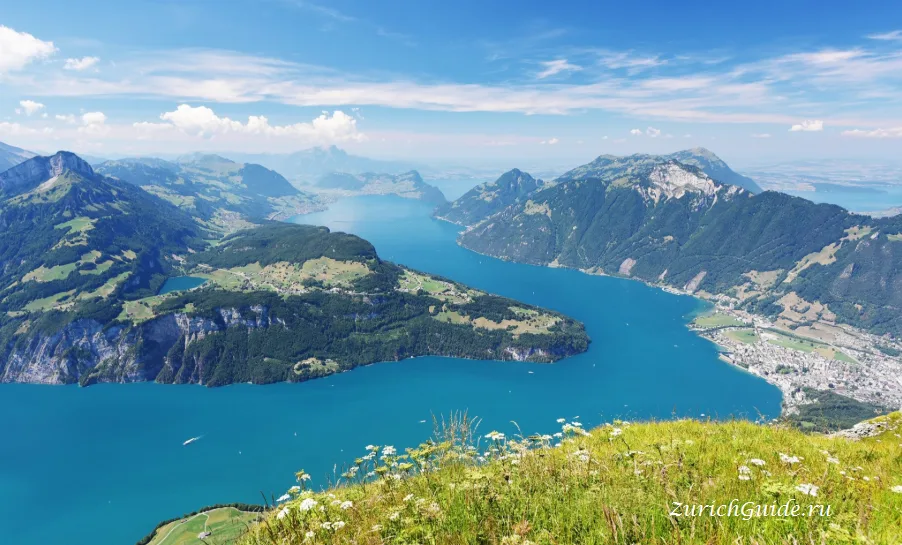
The lakes
Seven lakes worth the journey, what each is like, and the fact most visitors miss: the boats are public transport and passes cover them.
Switzerland has about 1,500 lakes, and the large ones are among the best things in the country — partly for themselves, and partly because of something visitors routinely miss:
The boats are public transport. Scheduled services, in the timetable, on the same ticket as the trains, and covered by rail passes including the Swiss Travel Pass. A lake crossing is not an excursion you buy separately; it is a leg of a journey, and often the nicest one.
Lake Lucerne
Vierwaldstättersee — the most dramatic of them. It bends between cliffs into four arms, the mountains come down to the water without a shore in places, and five paddle steamers from the 1900s still work the timetable.
It is also where the country began: the Rütli meadow on the western shore is where the three founding cantons swore their oath in 1291, and it is reachable only by boat or on foot.
The run from Lucerne to Flüelen through the narrows is the best two and a half hours on any Swiss lake, and it is the water leg of the Gotthard Panorama Express.
Lake Geneva
The largest, shared with France, and quite different at each end: Geneva and its fountain in the west, Lausanne in the middle, the Lavaux terraces and Montreux with Chillon in the east, and the Savoy Alps opposite the whole way.
Boats include a fleet of Belle Époque paddle steamers, the largest still in service anywhere.
Lake Zurich
Long, narrow and thoroughly domesticated, which is its charm — the city swims in it from public Badis five minutes from the banks.
Boats from Bürkliplatz run short round trips of an hour and a half, covered by a Zurich day pass, or down the lake to Rapperswil, which has a castle, a rose garden and a wooden footbridge across the water. See around Zurich.
Thun and Brienz
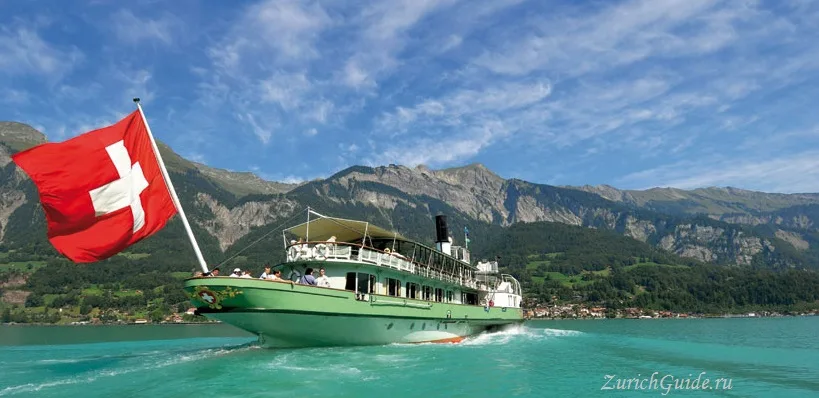
The two Oberland lakes with Interlaken between them.
Brienz is the smaller and more startling: steep sides, almost no building, and a colour that looks retouched. The Giessbach falls drop through fourteen stages beside a grand hotel, reached by the oldest funicular in Europe from its own pier.
Thun is broader, with castles along it — Spiez, Oberhofen on the water, and Thun at the end.
Lake Constance
Shared with Germany and Austria, and the flattest, warmest and most swimmable of the big lakes. The Swiss shore has Schaffhausen and Stein am Rhein on the Rhine at its western end, and boats cross to Konstanz, Lindau and the island of Mainau.
Maggiore and Lugano
South of the Alps, and Italian in temperature and manner. Maggiore at Locarno has the Brissago islands and their subtropical garden; Lugano has Gandria clinging to the cliff and Morcote at the southern tip. Both extend into Italy and the boats cross the border.
Swimming
Swiss lakes are clean enough to swim in as a matter of course, and every lakeside town has a Badi — a public bathing place, often free, sometimes a wooden pier from the nineteenth century.
Water temperature by August reaches the low twenties in the lowland lakes; the mountain ones stay cold all year. The rivers are a different matter — the Aare through Bern and the Rhine through Basel are swum daily by locals and require respect for the current.
Practical
- Timetables are in SBB Mobile alongside the trains; search a boat pier as you would a station.
- Passes — the Swiss Travel Pass covers most lake services outright. Regional and city passes cover their own lakes.
- Season — full service roughly April to October; several lakes run a reduced winter timetable and some stop entirely.
- Paddle steamers run on Geneva, Lucerne, Zurich, Thun and Brienz. They are marked in the timetable and cost no more than the modern boats.
Updated: