The mountain passes
Furka, Grimsel, Susten, Klausen, Gotthard and the rest: open roughly June to October, free, and among the best roads in Europe.
Switzerland has around forty road passes over 1,500 m, and in summer they are the best thing you can do with a vehicle in Europe. They are also free — no tolls, no vignette needed above the motorway network — and the post buses go over most of them on an ordinary ticket.
When they open
Most run roughly June to October, and the dates move with the snow. Some years the Furka opens in late May; some years it does not open until the second half of June.
Check before you set off. Every pass has a live status, and the Swiss road information service publishes them all. Signs at the bottom of each valley say OPEN or CLOSED in three languages, and they are accurate.
Out of season the alternative is a car-carrying train — you drive onto a flat wagon and are taken through a tunnel. The Furka, Lötschberg, Vereina and Simplon all run them, year-round, and in bad weather they are faster and considerably less alarming than the pass.
The good ones
Furka — 2,429 m
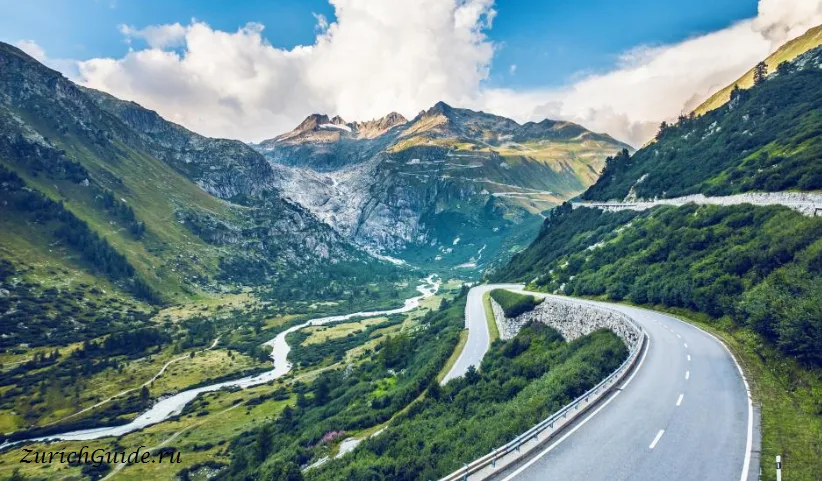
Between Andermatt and the Valais, past the Rhône glacier and its ice grotto. The pass appeared in Goldfinger, and the section above Gletsch is the one everyone photographs.
A restored steam railway runs over the old line beside the road in summer, hauled by locomotives brought back from Vietnam by volunteers.
Susten — 2,224 m
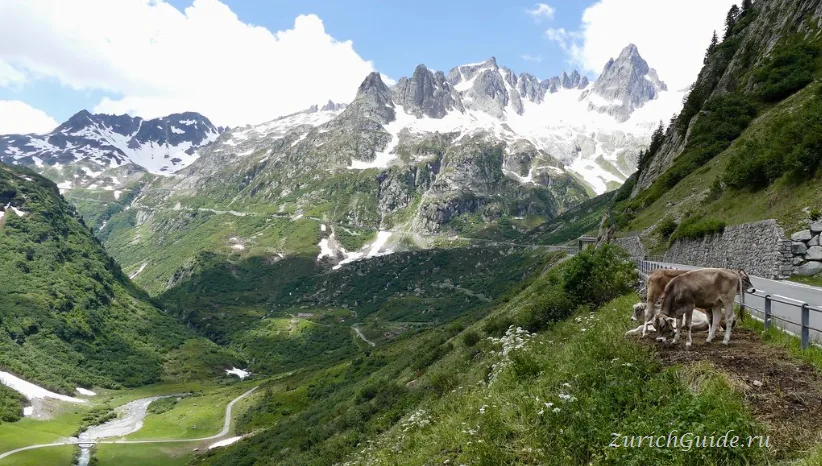
Built in the 1940s purely as a scenic road, and it shows: gentle gradients, wide curves, tunnels cut to frame the view, and the Stein glacier hanging above the eastern side. The best-engineered pass in the country and the easiest to drive.
Grimsel — 2,164 m
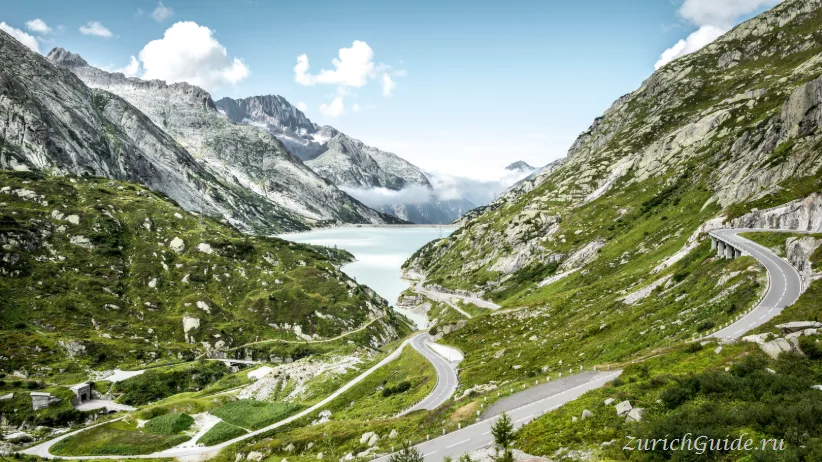
Bare granite and a chain of dark reservoirs, more austere than the others. The hydroelectric scheme underneath it can be visited on a tour through the tunnels inside the mountain.
Grimsel, Furka and Susten meet near each other, and the three can be driven as a loop in a day from Meiringen or Andermatt — which is the classic Swiss pass day.
Klausen — 1,948 m
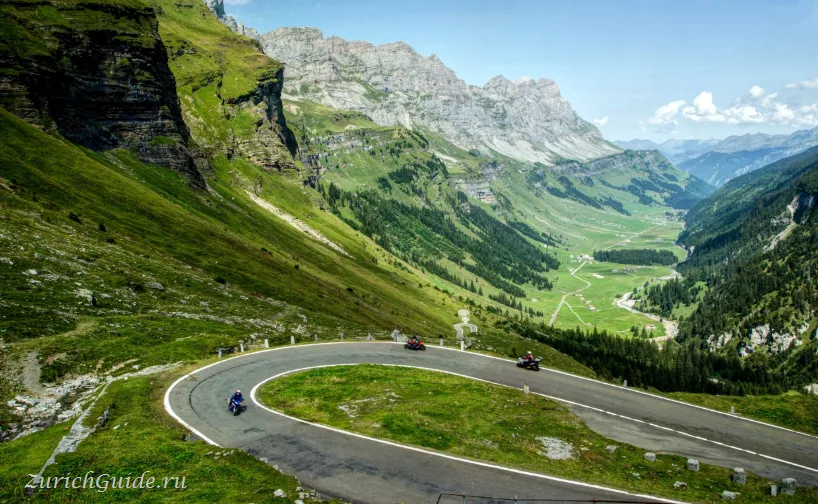
From Altdorf to Glarus, quieter than the big three, with a long green shelf of pasture on the eastern side. A favourite with motorcyclists and rarely crowded.
Gotthard — 2,106 m
The historic one. Alongside the modern road is the Tremola, the old cobbled route with 24 hairpins, still driveable and now a protected monument. It is the longest surviving cobbled road in Switzerland and rougher than it looks.
Nufenen — 2,478 m
The highest pass entirely inside Switzerland, linking the Valais to Ticino, and the emptiest of the well-known ones.
Oberalp — 2,033 m
Carries both a road and the railway used by the Glacier Express. The source of the Rhine is a two-hour walk from the top.
By post bus
You do not need a car. PostAuto runs over most of the passes in summer, on the ordinary ticket, covered by rail passes — see tickets and passes.
The buses have priority over everything on narrow sections and announce themselves on blind corners with a three-note horn taken from Rossini. When you hear it, pull in.
The Grimsel–Furka–Susten loop can be done entirely by post bus from Meiringen in a day.
Driving them
- Uphill traffic has priority on narrow stretches.
- Use engine braking on the descents. Long stretches on the brakes overheat them, and this is the most common way visitors get into trouble.
- Fuel up before you start — stations on the passes are few and expensive.
- Weather changes fast. It can snow on a 2,400 m pass in August.
More in driving in Switzerland.
By bicycle
Every pass on this page is a well-known cycling climb, and on summer weekends there are more bicycles than cars on some of them. Several close to motor traffic for one day a year for car-free cycling days, which are worth planning around if that is your thing.
Updated: