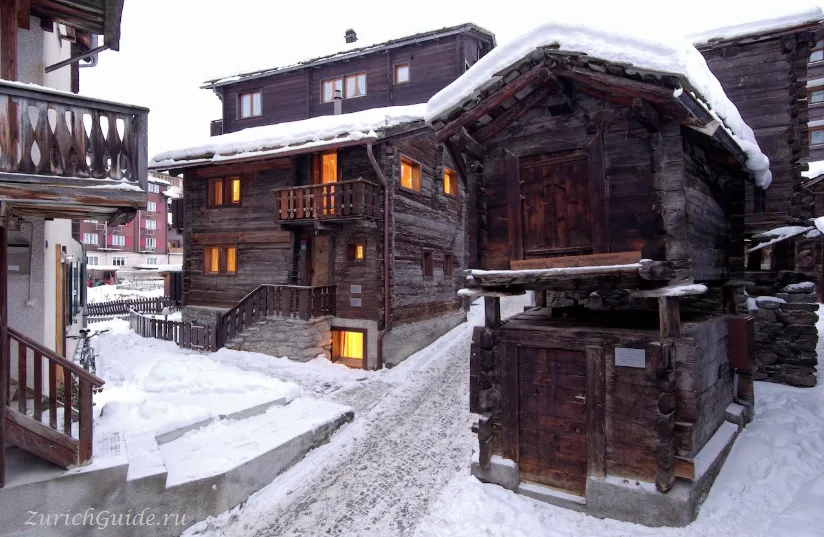
Skiing in Switzerland
The expensive ones, the ones locals use, the glacier resorts that open in October, and how to keep the cost down.
Switzerland invented the winter holiday — St. Moritz claims the specific moment, in 1864, when a hotelier bet four English summer guests that they would enjoy the place in winter and would get their money back if not.
It is also the most expensive place in the Alps to ski. What follows is how to choose, and how to spend less.
The big names
Zermatt — car-free, the Matterhorn, the highest skiing in Europe, and a link across the border to Cervinia in Italy. Snow-sure into spring and open on the glacier in summer. Expensive.
Verbier — the off-piste resort, in the Valais, with the Four Valleys area and a reputation for steep terrain and late nights. Expensive.
St. Moritz — the Engadin, high, sunny, and as much a social event as a ski resort. Two Winter Olympics, and the Cresta Run.
Davos and Klosters — very large, five separate areas, and more of a working town than a resort, which keeps prices marginally saner.
Grindelwald and Wengen — the Jungfrau region, moderate terrain, and the best scenery of any Swiss ski area: you ski with the Eiger in front of you. The Lauberhorn downhill at Wengen is the longest on the World Cup circuit.
Engelberg — the closest serious skiing to Zurich, with the Laub, a 1,000 m off-piste face that has a following among people who know.
The ones locals use
Smaller, cheaper, and perfectly good for anyone not chasing vertical:
- Adelboden-Lenk and Meiringen-Hasliberg in the Bernese Oberland
- Flumserberg and Elm, both under an hour and a half from Zurich
- Braunwald, car-free and family-oriented
- Villars and Les Diablerets in Vaud
- Andermatt, which was a quiet army town and has been substantially rebuilt, now linked with Sedrun
Season
Mid-December to mid-April for most resorts. High ones — Zermatt, Saas-Fee, Engelberg, Verbier’s top — run longer at both ends.
Glacier skiing at Zermatt and Saas-Fee runs through the summer, though it is a few pistes rather than a resort.
The expensive weeks are Christmas and New Year, the February half-terms (Swiss, German, British and French, staggered through the month) and Easter. January and the second half of March are the value weeks with the same snow.
What it costs
A day lift pass at a major resort is among the highest in the Alps. Things that reduce it:
- Multi-day passes cost proportionally much less than singles.
- The Magic Pass covers 90-odd Swiss resorts for a season and is startlingly cheap if bought in spring for the following winter. It excludes most of the big names, which is the trade.
- Smaller resorts cost roughly half the headline ones for the same snow.
- Half-board in a village down the valley rather than in the resort itself.
- Renting equipment in Switzerland costs more than bringing your own; renting in a neighbouring village costs less than renting at the lift.
Getting there without a car
The railway reaches almost every resort, and several — Zermatt, Wengen, Mürren, Saas-Fee, Braunwald — cannot be driven to at all. Trains take skis at no extra charge, and the luggage forwarding service described in getting around will move a ski bag between stations for you.
For anyone based in Zurich, Flumserberg, Engelberg and Andermatt are all day-trip distance by train.
Not skiing
Most resorts maintain winter walking paths, cleared and signposted, and sledge runs — some of them several kilometres. The Preda-Bergün run in Graubünden, taken back up by train, is the well-known one.
Thermal baths are the other winter argument; see thermal baths.
Updated: