Aarau
The capital of the canton of Aargau, twenty-five minutes from Zurich, with an old town of painted roof gables and one of the best collections of Swiss art.
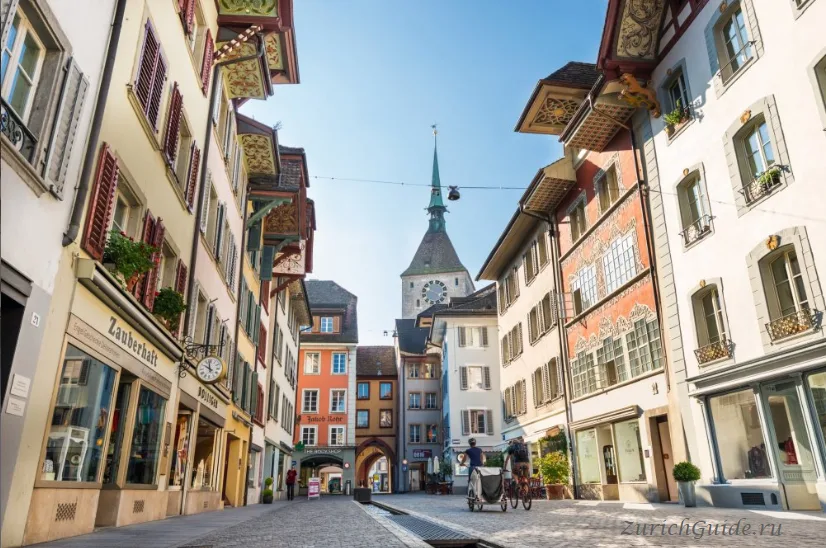
Aarau is the capital of the canton of Aargau, on the river Aare west of Zurich, only about twenty-five minutes away by fast train. It is known as the “town of beautiful gables”. Many houses in the old town have broad overhanging roofs whose undersides are painted with colourful patterns, scenes and figures. Stein am Rhein is famous for its painted façades; Aarau is the place for painted gables, a local tradition concentrated here more than anywhere else.
The old town is not tiny, and it is cosy and easy to walk round in an hour or two. Aarau combines well with a visit to Lenzburg castle, a few minutes away by train, or to Baden and its thermal baths.
What to see
The old town and its gables
The old town is roughly square, divided into four quarters, the Stöcke. Its streets follow a 16th-century layout, when almost all the medieval houses were rebuilt or enlarged. Walk along the Rathausgasse, the Kronengasse and the Halde, and look up: the painted undersides of the eaves are the town’s signature. To the south, outside the line of the old walls, is the 18th-century suburb of the Laurenzenvorstadt.
The Obertorturm, the town hall and the Schlössli
- The Obertorturm, the clock tower that was the upper gate of the town on the road from Lucerne and Bern, is the landmark of the old town.
- The town hall (Rathaus) was rebuilt in 1515 around a medieval tower, the Rore tower.
- The Schlössli, the “little castle”, is the oldest building in Aarau, a medieval stone tower. It houses the town museum, with a large collection on life in Aarau from the 16th to the 20th century.
- The Justice Fountain (Gerechtigkeitsbrunnen) dates from 1634.
The Aargauer Kunsthaus
The cantonal art museum, in a striking modern extension next to the government building, has one of the finest collections of Swiss art in the country, from the 18th century to today, and puts on several temporary exhibitions a year. It is closed on Mondays.
A little history
Aarau was founded in the 13th century by the counts of Kyburg and first recorded in 1248 as Arowe; the name comes from the river and the German Au, a water meadow. In 1415 it passed, with the rest of the Aargau, to Bern.
The town’s great moment came in 1798, when for a few months it was the first capital of the Helvetic Republic, the short-lived Swiss state set up under French rule. In 1803, by Napoleon’s Act of Mediation, the new canton of Aargau was created, and Aarau became its capital. The town walls were pulled down around 1820, though some towers and gates survive.
In 1802 the town founded its cantonal school, the first non-church secondary school in Switzerland. Its most famous pupil was Albert Einstein, who took his school-leaving exam here in 1896 after a year in Aarau that he later remembered fondly.
Getting there
Fast trains run from Zurich main station several times an hour and take about 25 minutes; the S-Bahn takes longer. Aarau is also on the main line from Zurich to Bern and Basel, so it is easy to stop off on the way. The station is a few minutes’ walk from the old town.
For fares and regional passes, see tickets and passes.
Around Aarau
Nearby
Other places on this site within easy reach, as the crow flies:
- Uetliberg — 34 km
- Basel — 39 km
- Lucerne — 43 km
- Zug — 44 km
- Winterthur — 53 km
- The Rhine Falls — 53 km
This page in Russian: Арау (Aarau)
Weather in Aarau month by month
| Month | Day | Night | Rainfall |
|---|---|---|---|
| January | +4° | -2° | 63 mm |
| February | +6° | -2° | 53 mm |
| March | +11° | +1° | 61 mm |
| April | +16° | +4° | 63 mm |
| May | +20° | +9° | 98 mm |
| June | +24° | +12° | 92 mm |
| July | +26° | +14° | 98 mm |
| August | +25° | +14° | 98 mm |
| September | +20° | +10° | 70 mm |
| October | +15° | +7° | 72 mm |
| November | +8° | +2° | 69 mm |
| December | +4° | -1° | 81 mm |
Normals for 1991–2020 from MeteoSwiss, station Buchs / Aarau, open data, version of 29 July 2026. Day and night are the average daily high and low, not records; rainfall is approximate. Current conditions from the Norwegian Meteorological Institute, CC BY 4.0.
Updated: