Aarburg
A little town on a bend of the Aare, near Olten, under one of the most dramatic castle rocks in Switzerland.
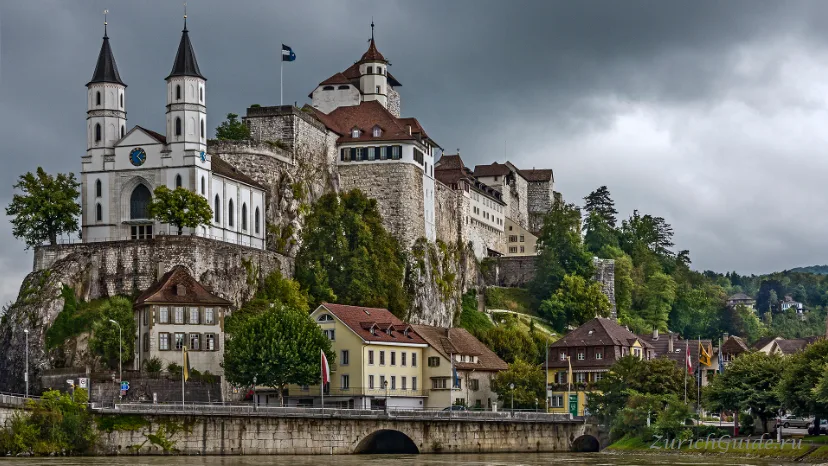
Aarburg is a small town in the canton of Aargau, on the river Aare just south of Olten. Few tourists have heard of it, and it has kept a quiet, unhurried feel. What it does have is a view: a huge fortress stretched along a narrow ridge of rock above the river, with a white church with two spires below it and the old town at its foot.
It is worth an hour or two if you are driving between Zurich, Basel and Bern, or staying nearby. You will get very good photographs of the castle, especially from the bridges over the Aare.
History
A Roman road ran past here from Olten into central Switzerland, and a hoard of Roman coins was found when a factory was built in the 20th century.
The castle controlled a narrow point on the Aare and the trade route from north to south that crossed it. It belonged to the counts of Frohburg, who sold it with the surrounding district to the Habsburgs in 1299. The settlement below the castle had become a town by around 1330. In 1415 Bern conquered the Aargau, Aarburg castle surrendered after a short siege, and from 1416 it was the seat of a Bernese bailiff.
Squeezed between two larger towns, Olten and Zofingen, Aarburg never grew much. For centuries its river port was the main source of income for its people.
What to see
The fortress
The fortress grew out of the medieval castle. In the 17th century Bern turned it into a fortress, the only one of its kind in the Bernese lands, and it later served as a prison. Since the end of the 19th century it has housed a cantonal home for young offenders, which is still there. It is a heritage site of national importance.
The fortress is not open to wander in. Public guided tours are held occasionally in the warmer months; ask at the town hall or check the town website before you go.
The Reformed church
On a terrace between the fortress and the old town stands the Reformed church, built in 1842–45 in neo-Gothic style, with its two spires facing west. It is the white building that appears in every photograph of Aarburg. Below it, on the rock, is a house built in 1726. Until the town fire of 1840, the town gate ran through its cellar.
The old town
The old town fills a triangle between the river and the rock, which protect it on two sides. The houses are grouped around a wedge-shaped square. The town wall on the north side burned in 1840 and was never rebuilt.
The river
The Aare makes a sharp bend under the town, and the walk along the bank gives the best views of the rock and the fortress.
The water looks calm here, but the Aare is fast and cold, with strong currents at the bend and around the bridge piers. Only swim at a supervised spot, never jump from the bridges, and never swim alone.
Getting there
By train. Aarburg-Oftringen station is one stop from Olten by regional train. Olten is a main rail hub with fast trains from Zurich, Basel, Bern and Lucerne.
By bus. A local bus runs from the stop outside Olten station to Aarburg in about ten minutes; it drops you by the bridge to the old town.
By car. Aarburg is just off the A1/A2 motorway junction near Olten.
See tickets and passes for train fares and regional passes.
Nearby
Nearby
Other places on this site within easy reach, as the crow flies:
- Uetliberg — 44 km
- Zurich — 49 km
- Biel/Bienne — 53 km
- Bern — 53 km
This page in Russian: Аарбург (Aarburg)
Weather in Aarburg month by month
| Month | Day | Night | Rainfall |
|---|---|---|---|
| January | +4° | -2° | 83 mm |
| February | +6° | -2° | 67 mm |
| March | +11° | 0° | 74 mm |
| April | +15° | +3° | 76 mm |
| May | +20° | +8° | 110 mm |
| June | +23° | +12° | 103 mm |
| July | +25° | +13° | 117 mm |
| August | +25° | +13° | 115 mm |
| September | +20° | +10° | 90 mm |
| October | +14° | +6° | 90 mm |
| November | +8° | +2° | 82 mm |
| December | +4° | -1° | 101 mm |
Normals for 1991–2020 from MeteoSwiss, station Wynau, open data, version of 29 July 2026. Day and night are the average daily high and low, not records; rainfall is approximate. Current conditions from the Norwegian Meteorological Institute, CC BY 4.0.
Updated: