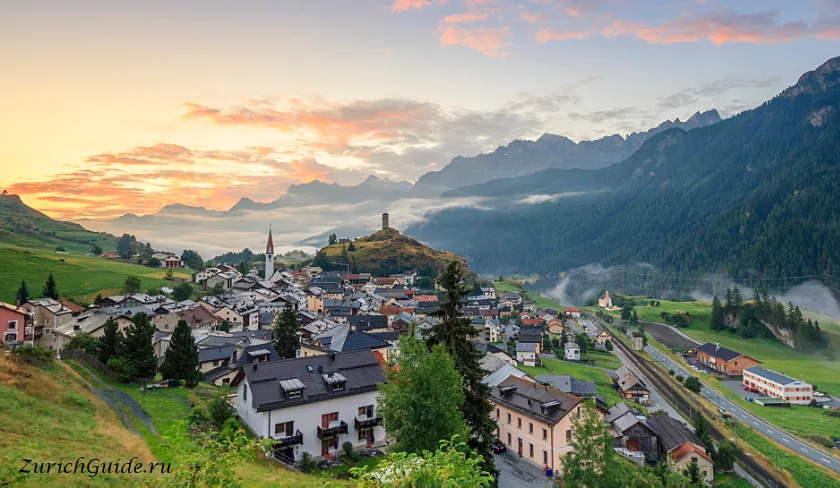
Ardez
A small Romansh-speaking village in the Lower Engadine, with some of the finest painted and sgraffito houses in Graubünden and the ruin of Steinsberg castle on a rock above the roofs.
Ardez is a village of about 400 people in the Lower Engadine (Engiadina Bassa), in the far east of Graubünden, on a sunny terrace above the river Inn at about 1,450 m. Since 2015 it has been part of the municipality of Scuol. Its people speak Vallader, the local form of Romansh, Switzerland’s fourth national language. Ardez is one of the most beautiful villages in the Engadine: its old houses, with thick walls, deep-set windows and façades decorated with sgraffito and paintings, line the village street, and above them, on a rocky hill, stands the ruined tower of Steinsberg castle.
A short history
Ardez is first mentioned in a Carolingian register of around 900. In the Middle Ages it was ruled from Steinsberg castle, first by local lords and then by the bishops of Chur, who had long disputes with the counts of Tyrol over the valley. In 1499, during the Swabian War between the Swiss and the Habsburgs, Austrian troops burned the castle and the village. In 1622, during the religious wars of the Thirty Years’ War, the Protestant village was burned again by Austrian troops. Most of the houses were rebuilt in the following decades, and the village has changed little since. In 1975, the European Architectural Heritage Year, Ardez was chosen as one of the Swiss model villages for the careful restoration of its old houses.
What to see
The Engadine houses
The great sight of Ardez is the village itself. The typical Engadine house combines the farmhouse and the barn under one large roof, with a big arched gate for the hay cart, a smaller door for people, and small, funnel-shaped windows set deep in the thick walls to keep out the cold. The façades are decorated with sgraffito, patterns scratched into two layers of plaster, and in Ardez also with painted scenes and inscriptions. The most famous house shows Adam and Eve in the Garden of Eden on its façade. Walk slowly along the main street and the lanes around the fountains to see them all.
Steinsberg castle
On a rock at the edge of the village, the ruin of Steinsberg castle (Chastè Steinsberg) is reached by a short, steep path. The square tower of the 12th century still stands, with the remains of its walls and of the chapel of Saint Lucius. From the top there is a fine view over the village, the valley of the Inn and the mountains of the Lower Engadine.
The church
The Reformed village church was built in 1576–1577 on the site of an older church first mentioned in the 12th century. Near it, the Tuor Planta-Vonzun, a medieval residential tower, was later used as the district prison.
Walks and around Ardez
- Guarda, the next village up the valley, perhaps the most beautiful in the Engadine, famous as the home of Schellen-Ursli, the boy of the children’s book; a walk of about an hour and a half on the panoramic path.
- Ftan, on its sunny terrace, and Scuol, with its thermal baths, the Bogn Engiadina, and its mineral water fountains, are a good half-day walk away along the Via Engiadina.
- The castle of Tarasp, on its hill across the valley.
- The Swiss National Park, around Zernez, the oldest national park in the Alps.
- The quiet Val Tasna, a side valley north of the village.
Safety
The path up to Steinsberg is steep and stony, and the ruin has unprotected drops: keep children close and do not climb on the walls. On the mountain paths, the weather changes quickly; take warm clothes even in summer. Cows graze on the alpine pastures in summer: walk calmly around them and keep your dog on a lead, especially near mothers with calves.
Getting there
Ardez has a station on the Rhaetian Railway line through the Vereina tunnel to Scuol. From Zurich, take the train to Landquart and change there for Scuol-Tarasp; the trip takes about two and a half hours. From Davos, change at Klosters; from St Moritz, trains run down the Engadine, usually with a change at Samedan or Zernez. By car, you can drive over the Flüela pass in summer, or take the car-carrying train through the Vereina tunnel from Klosters all year round.
For fares and passes, see tickets and passes.
This page in Russian: Ардец
Updated: