Ascona
A small, sunny and elegant town on Lake Maggiore, next to Locarno, with a car-free promenade of painted houses, an old town of narrow lanes and the curious history of Monte Verità above it.
Ascona is a small town of about 5,500 people in Ticino, on the northern shore of Lake Maggiore, a few kilometres west of Locarno at the mouth of the Maggia river. It lies at just under 200 m above sea level, only a little above the lake, which is the lowest point in Switzerland, and it has one of the warmest and sunniest climates in the country, with palms, camellias and oleanders along the shore.
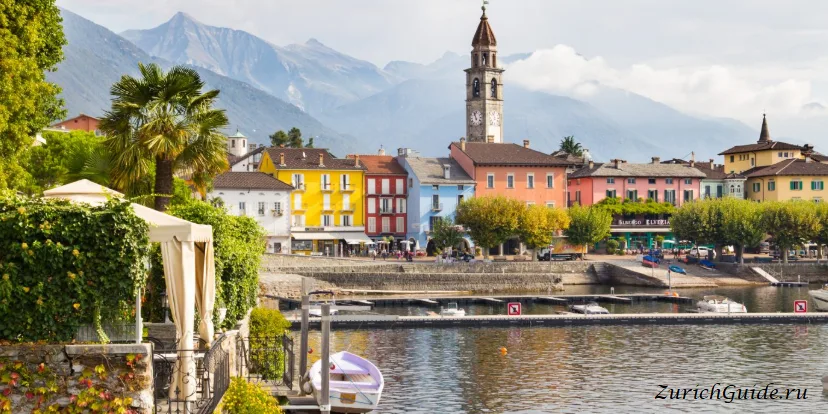
It is the postcard of Italian-speaking Switzerland: a row of colourful houses on a car-free promenade, a tall bell tower behind them and the mountains across the water. Today Ascona is an elegant, rather expensive resort of hotels, boutiques and restaurants, but behind the waterfront is a real old town, and its history is more unusual than its neat appearance suggests.
Finding your way
The old town, the Borgo, is a small knot of narrow, paved lanes between the lake and the main road. Its heart is the church of Santi Pietro e Paolo, whose campanile is the symbol of the town. On the lake side, the Piazza Giuseppe Motta is the promenade, lined with cafés and restaurant terraces in the sun. It is one of the most pleasant places to walk on Lake Maggiore, even on a sunny winter’s day.
What to see
The church of Santi Pietro e Paolo
The main church of Ascona, first mentioned in 1264, was largely rebuilt in the 16th century. Its tall campanile rises above the lakefront. Inside, the high altar has a great painting of the Coronation of the Virgin by Giovanni Serodine, a painter born in Ascona in the early 17th century and one of the most gifted followers of Caravaggio, with his dramatic light and shadow.
Casa Serodine
Next to the church, the Casa Serodine, also called Casa Borrani, was built in 1620 by the painter’s family. Its façade, covered in elaborate stucco reliefs, is one of the richest of any secular building in Switzerland.
Collegio Papio and Santa Maria della Misericordia
The Collegio Papio, a school founded at the end of the 16th century with a bequest from Bartolomeo Papio, a local man who made his fortune in Rome, has one of the finest Renaissance courtyards in Switzerland, with two storeys of arcades. Its church, Santa Maria della Misericordia, built around 1400 for the Dominicans, is covered inside with one of the largest cycles of late Gothic frescoes in the country.
The museum of modern art
The Museo Comunale d’Arte Moderna, in an old palazzo in the Borgo, holds a collection of artists who lived in or passed through Ascona in the 20th century, above all the Russian painter Marianne von Werefkin, who settled here and died in Ascona in 1938, along with works by Paul Klee, Alexej von Jawlensky and others, and temporary exhibitions.
Monte Verità
On the wooded hill above the town, Monte Verità, the “mountain of truth”, was the scene of one of the strangest experiments of the early 20th century. In 1900 a group of young idealists from northern Europe founded a colony here to live close to nature: vegetarian, sunbathing, wearing loose clothes or none at all, rejecting money and convention. Over the following decades it drew anarchists, writers, psychoanalysts and dancers, among them the writer Hermann Hesse and the dance pioneers Rudolf von Laban and Mary Wigman. From 1933, the Eranos conferences, attended by the psychologist Carl Jung, met at Ascona by the lake.
Today Monte Verità is a cultural centre with a hotel, gardens, a small tea plantation and a museum in the Casa Anatta, one of the colony’s original wooden houses, which tells its story.
Around Ascona
- The Brissago Islands (Isole di Brissago), two small islands in the lake with a botanical garden of more than 1,500 species of plants from the warm regions of the world, reached by boat from Ascona.
- Ronco sopra Ascona and Porto Ronco, a few kilometres west along the lake, villages on the steep shore with wonderful views. The writer Erich Maria Remarque lived in Porto Ronco from the 1930s and is buried in the cemetery of Ronco, by the small church.
- Locarno, with the Piazza Grande, the film festival and the sanctuary of Madonna del Sasso, a few minutes away by bus.
- The Verzasca valley with the stone bridge at Lavertezzo, and the Maggia and Centovalli valleys.
- Lugano, Bellinzona and Melide, each within about an hour.
Festivals
- JazzAscona, a festival of New Orleans jazz and other styles that fills the streets and the lakefront at the end of June and the beginning of July.
- The Settimane Musicali, the “musical weeks” of classical music, held every year from late summer into the autumn.
Safety
Lake Maggiore is large and deep, and storms can rise quickly on summer afternoons; when the storm warning lights around the lake start flashing, get out of the water and bring boats ashore. Swim at the lidos, away from boat landings. In the valleys around Ascona, especially the Verzasca, the clear rivers look inviting but are cold, with strong currents and sudden rises in water level after rain or when water is released from the dams; people drown there every summer. Swim only in calm water near the shore, never jump from rocks, and keep away from the river when the warning signs say so.
Getting there
Ascona has no railway station. From Zurich, take the train via the Gotthard Base Tunnel to Locarno, which takes about two and three quarter hours with a change in Bellinzona or Lugano, then the local bus from Locarno station to Ascona, about a quarter of an hour. Boats also link Ascona with Locarno, the Brissago Islands and other towns on Lake Maggiore, including in Italy.
For fares and passes, see tickets and passes.
Nearby
Other places on this site within easy reach, as the crow flies:
- Andermatt — 55 km
- Brig — 63 km
- Saas-Fee — 65 km
- Grindelwald — 77 km
- Meiringen and the Reichenbach Falls — 78 km
- Engelberg and Titlis — 79 km
This page in Russian: Аскона
Weather in Ascona month by month
| Month | Day | Night | Rainfall |
|---|---|---|---|
| January | +8° | +2° | 70 mm |
| February | +10° | +3° | 64 mm |
| March | +15° | +6° | 95 mm |
| April | +19° | +10° | 166 mm |
| May | +22° | +13° | 190 mm |
| June | +26° | +17° | 187 mm |
| July | +29° | +19° | 163 mm |
| August | +28° | +19° | 212 mm |
| September | +23° | +15° | 203 mm |
| October | +18° | +11° | 210 mm |
| November | +12° | +6° | 208 mm |
| December | +9° | +3° | 89 mm |
Normals for 1991–2020 from MeteoSwiss, station Locarno / Monti, open data, version of 29 July 2026. Adjusted to the elevation of the place. Day and night are the average daily high and low, not records; rainfall is approximate. Current conditions from the Norwegian Meteorological Institute, CC BY 4.0.
Updated: