Avenches
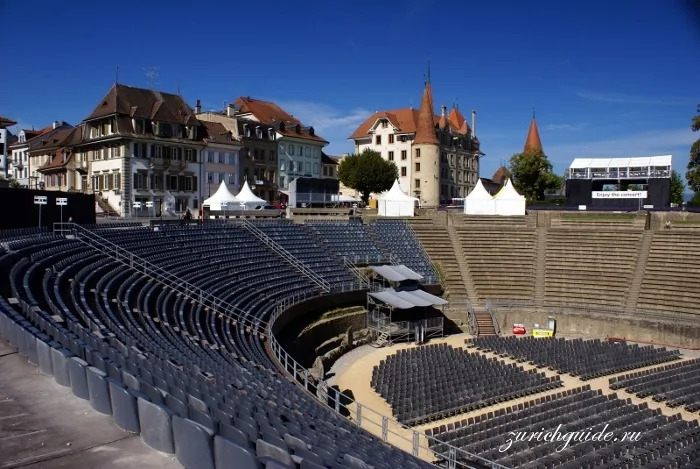
A small town near Lake Murten that was once Aventicum, the capital of Roman Switzerland, with an amphitheatre that still fills up every summer for opera under the stars.
Avenches is a quiet small town of about 4,000 people in the canton of Vaud, on a low hill a few kilometres from Lake Murten, close to the border with Fribourg. Two thousand years ago it was Aventicum, the capital of the Helvetii and of Roman Switzerland, a city of perhaps 20,000 people. Today the modern town fills only a small corner of the Roman one, and the rest is fields with ruins scattered among them: an amphitheatre, a theatre, temples, a single tall column and long stretches of the old city wall.
It is the best place in Switzerland to get a sense of a Roman town, and in summer the amphitheatre comes back to life for an opera festival.
A short history
After their defeat by Julius Caesar in 58 BC, the Helvetii made Aventicum, named after the Celtic water goddess Aventia, their main town. Around the year 72 the emperor Vespasian raised it to the rank of a Roman colony. In the 2nd century it reached its peak, with baths, temples, a theatre and an amphitheatre, and a wall about 5.5 km long with some 73 towers.
The decline began in the later 3rd century, when Germanic tribes, the Alemanni, raided the region. In the early Middle Ages Aventicum was the seat of a bishop, but when the bishop moved to Lausanne in the 6th century the town shrank to a village. Around 1074 the bishop of Lausanne founded a new town on the hill, and it slowly grew into today’s Avenches. Bern took the region in 1536 and ruled it until 1798; after a few years in the Helvetic Republic’s canton of Fribourg, Avenches became part of the new canton of Vaud in 1803.
Finding your way
From the station, walk up the hill towards the old town. The first things you see are the castle and, beside it, the amphitheatre at the eastern end of the old town. The old town itself is three parallel streets with the town hall and the church. From the amphitheatre, paths lead down through the fields past the Roman ruins to the theatre and the Cigognier column, a walk of five to ten minutes. The tourist office has a map of the Roman sites, most of which are free to visit.
What to see
The amphitheatre
The amphitheatre was built in the early 2nd century and enlarged around 165, when it could hold some 16,000 spectators for gladiator fights and animal hunts. It was abandoned in late Roman times and used as a quarry, but its shape survives, and it has been restored to host shows again. In summer it is filled with seating for the festivals.
The Roman museum
On the edge of the amphitheatre stands a medieval tower, built on the Roman seating, which houses the Roman museum (Musée romain d’Avenches). It has sculpture, mosaics, inscriptions, coins and objects of daily life from Aventicum, explained in English as well as French and German. Its most famous piece is the gold bust of Marcus Aurelius, found in 1939 in a drain of the temple precinct, one of very few Roman gold portraits to survive anywhere. The original is kept in Lausanne; Avenches shows a faithful copy.
The Cigognier and the temples
A single tall column standing in a field is all that remains upright of the Cigognier sanctuary, a huge temple begun around 98, at the start of Trajan’s reign, probably dedicated to the cult of the emperors. Its name comes from the storks’ nest (cigogne, stork) that sat on top of the column from at least the 17th century until it was restored in the 1970s. Nearby are the foundations of other temples and of the baths.
The theatre
A short walk from the Cigognier, the Roman theatre, built in the early 2nd century, could hold about 12,000 spectators on more than 50 rows. Its grassy, horseshoe-shaped tiers and stone entrance passages are among the most atmospheric Roman remains in the country, especially in the evening light.
The city wall and the Tornallaz tower
Long sections of the Roman wall survive in the fields and woods around the town, and one of its round towers, the Tornallaz, has been rebuilt to its original height.
The castle and the old town
- The castle, built by the bishops of Lausanne in the late 13th century and remodelled by the Bernese governors in the Renaissance style, with a fine entrance and courtyard.
- In the castle courtyard, a monument to Ernest Failloubaz, born in Avenches in 1892, who in 1910 became the first Swiss certified pilot, flying an aeroplane built in Switzerland by his friend René Grandjean. Their airfield was just north of the town.
- The town hall, rebuilt in the 18th century, with carvings of the emperors Vespasian, Titus and Domitian on its façade and the Moor’s head of the town’s coat of arms.
- The Reformed church of Sainte-Marie-Madeleine, of medieval origin and rebuilt in the early 18th century.
- The old towers along the Rue des Alpes, including the Benneville tower.
Festivals
- The Avenches Opera festival in July: grand opera in the Roman amphitheatre, on summer evenings under the open sky, with several thousand spectators. Performances start late and finish around midnight, and hotels in the area fill up months ahead.
- Rock Oz’Arènes, a rock and pop festival in the amphitheatre in August, held since 1992.
Around Avenches
- Murten (Morat), a walled medieval town on its lake, a few minutes by train, where you can walk along the ramparts.
- Payerne, with its great Romanesque abbey church, about ten minutes away.
- Fribourg, Neuchâtel and Bern, each within an hour.
- The other Roman sites of Switzerland, such as Augusta Raurica near Basel and Nyon on Lake Geneva; see Roman Switzerland.
Getting there
Avenches is on the regional railway line between Murten and Payerne, a short walk from the old town. From Zurich there is no direct train: change in Bern, or at Neuchâtel and Murten; the trip takes about two hours. From Bern it is just over an hour, and from Fribourg about half an hour. By car, Avenches is just off the A1 motorway between Bern and Lausanne.
For fares and passes, see tickets and passes.
Nearby
Other places on this site within easy reach, as the crow flies:
- Bulle — 29 km
- La Chaux-de-Fonds and Le Locle — 29 km
- Grandson — 31 km
- Yverdon-les-Bains — 32 km
- Biel/Bienne — 33 km
- Gruyères — 33 km
This page in Russian: Аванш
Weather in Avenches month by month
| Month | Day | Night | Rainfall |
|---|---|---|---|
| January | +4° | -2° | 50 mm |
| February | +6° | -2° | 43 mm |
| March | +11° | +1° | 52 mm |
| April | +15° | +4° | 64 mm |
| May | +19° | +8° | 85 mm |
| June | +23° | +12° | 88 mm |
| July | +26° | +13° | 92 mm |
| August | +25° | +13° | 89 mm |
| September | +20° | +10° | 74 mm |
| October | +14° | +6° | 86 mm |
| November | +8° | +2° | 66 mm |
| December | +4° | -1° | 65 mm |
Normals for 1991–2020 from MeteoSwiss, station Payerne, open data, version of 29 July 2026. Day and night are the average daily high and low, not records; rainfall is approximate. Current conditions from the Norwegian Meteorological Institute, CC BY 4.0.
Updated: