Baar
A small town next to Zug, twenty minutes from Zurich by train, best known for the Höllgrotten, the 'caves of hell', a maze of stalactites and still pools in a wooded gorge.
Baar is a town of about 25,000 people in the canton of Zug, just north of the town of Zug, between the Zugerberg and the Lorze river, twenty minutes from Zurich by train. Like Zug, it has low taxes and has become home to many international companies, and the town itself is mostly modern, with a small old centre around its church. Visitors come above all for the Höllgrotten, the “caves of hell”, a set of small but very beautiful caves in a wooded gorge a few kilometres away, which make an easy half-day trip from Zurich, especially on a rainy day.
The Höllgrotten
The Höllgrotten were discovered by chance in 1863, by workers quarrying tufa, a soft, porous limestone, in the Lorze valley. They were opened to visitors in 1887. Unlike most caves, which are carved out of the rock by water over millions of years, these grew at the same time as the rock around them: water rich in lime, flowing down the slope at the end of the last Ice Age, built up the tufa around mosses and plants and left hollows inside it, which then filled with stalactites and stalagmites.
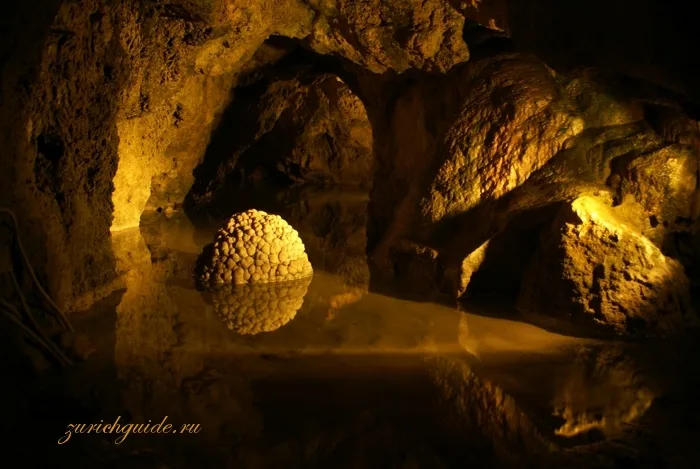
A path with steps and lighting leads through a series of chambers, with stalactites, curtains and columns, rocks shaped like cauliflowers and grapes, and still, clear pools that reflect the ceiling like mirrors. The visit takes about 45 minutes. The caves are open from spring to autumn, usually from April to October, and closed in winter. It is cool and damp inside all year, about 10 °C, so bring a jacket, and wear shoes with a good grip.
The caves are not large, and if you have seen the great caves of France or Slovenia you may find them modest, but they are charming, easy to reach and good for children.
The Lorze gorge
The caves lie in the Lorzentobel, the wooded gorge of the Lorze river between Baar and Menzingen. A pleasant walk leads along the river from the bridges at the Tobelbrücke, through the forest to the caves. Combined with the caves, it makes a good half day out.
Baar town
The old centre of Baar is small, with the church of St Martin, of medieval origin, a few old houses and the town hall. The town has little else of interest for visitors, but it has restaurants and is a convenient stop on the way to Zug.
Around Baar
- Zug, with its old town on the lake, its clock tower and its famous sunsets, a few minutes by train.
- The Zugerberg, the mountain above Zug, reached by funicular, with walking paths and views over the lake.
- Lucerne, about 25 minutes by train.
- See also around Zurich for other easy day trips.
Safety
Inside the caves the steps are wet and slippery and some passages are low; watch your head and hold the handrails, and keep small children by the hand. In the gorge, the paths along the Lorze can be muddy after rain, and the river is fast and cold.
Getting there
- By train: Baar is on the line from Zurich to Zug and Lucerne; trains from Zurich main station take about 20 minutes.
- To the caves: from Baar or Zug station, take the bus towards Menzingen to the Tobelbrücke stop, then walk about 20 minutes, following the brown signs; or walk from Baar station in about an hour.
- By car: the caves have a car park; follow the signs from Baar.
For fares and passes, see tickets and passes.
Nearby
Other places on this site within easy reach, as the crow flies:
This page in Russian: Баар
Weather in Baar month by month
| Month | Day | Night | Rainfall |
|---|---|---|---|
| January | +4° | -1° | 80 mm |
| February | +6° | -1° | 78 mm |
| March | +11° | +2° | 89 mm |
| April | +15° | +6° | 94 mm |
| May | +19° | +10° | 140 mm |
| June | +23° | +13° | 149 mm |
| July | +25° | +15° | 155 mm |
| August | +24° | +15° | 163 mm |
| September | +19° | +11° | 116 mm |
| October | +14° | +8° | 99 mm |
| November | +8° | +3° | 95 mm |
| December | +5° | 0° | 105 mm |
Normals for 1991–2020 from MeteoSwiss, station Wädenswil, open data, version of 29 July 2026. Day and night are the average daily high and low, not records; rainfall is approximate. Current conditions from the Norwegian Meteorological Institute, CC BY 4.0.
Updated: