Baden
The hottest and most mineral-rich springs in Switzerland, used since the Romans, with a new bath house and a small old town under a ruined castle.
Baden is twenty minutes from Zurich, and it sits on the hottest and most mineral-rich springs in Switzerland — water emerging at around 47 °C with a mineral content several times that of any other Swiss spa.
The Romans built baths here in the first century and called the place Aquae Helveticae. It has been in the bathing business, with interruptions, ever since.
The baths
The spa quarter went into a long decline through the twentieth century, and for years the springs ran with almost nothing built over them.
Fortyseven — named for the temperature — opened in 2021 to a design by Mario Botta, and put a proper bath house back into the town: a cluster of stone-clad volumes stepping down to the Limmat, with indoor and outdoor pools, a sauna area and views over the river.
It is the closest serious thermal bath to Zurich and reachable on an ordinary train ticket, which makes it the obvious wet-weather answer for anyone staying in the city. See thermal baths.
The old town
Small, stepped and largely intact, on a bend of the Limmat under a rocky spur.
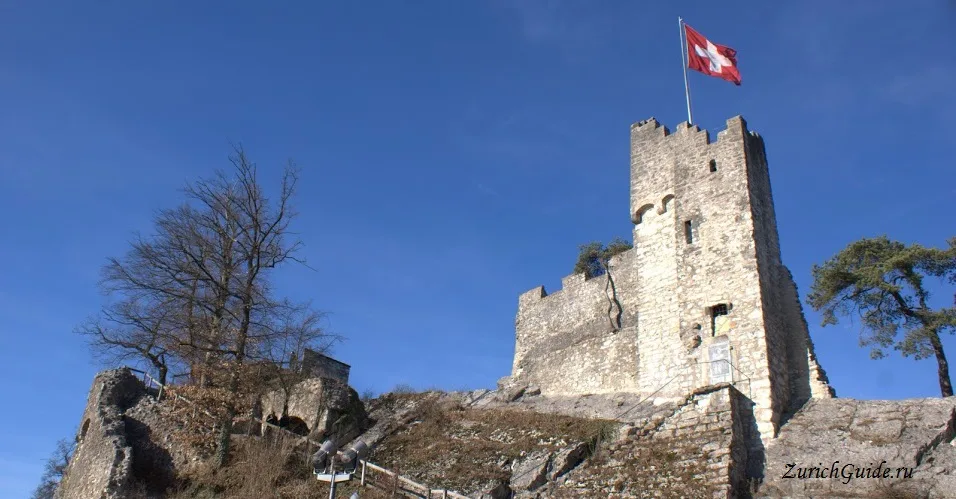
The Holzbrücke, a covered wooden bridge, crosses the river to the spa side. Above the town stand the ruins of Stein castle, blown up by the Bernese in 1415 and left as a shell with the view over the roofs.
The Landvogteischloss on the far bank was the seat of the Confederation’s bailiff for the county of Baden, which for three hundred years was jointly ruled territory — several cantons administering one district together, and the diet of the old Confederation met here.
The Museum Langmatt, in a villa, holds a good collection of French Impressionists — Renoir, Cézanne, Degas — assembled by an industrialist family.
The industry
Baden is also where Brown, Boveri & Cie was founded in 1891, which became ABB and made the town, for a long period, one of the centres of European electrical engineering. The industrial quarter has been converted rather than demolished, and there is a good deal of early-modern architecture if you look.
Getting there
- By train — Zurich HB about 15 to 20 minutes, several an hour. Zurich airport about 25 minutes.
- On foot — the old town and the baths are ten minutes downhill from the station.
When to go
Any time; the baths are the point and they are indoors and out. Winter is the better season for the outdoor pools, for the same reason as everywhere else.
Combine with around Zurich for the other short trips from the city.
Where to park in Baden
| Car park | Spaces | Fee | From centre |
|---|---|---|---|
| Tunnelgarage underground | 22 | paid | 160 m |
| Tunnelgarage (Mieter) underground | 38 | — | 160 m |
| Gstühl City underground | 189 | paid | 210 m |
| Gstühl | 12 | — | 220 m |
| Historisches Museum | 5 | paidmax 2 h | 240 m |
| Langhaus underground | 137 | paid | 260 m |
| Kanalstrasse | 17 | paidmax 3 h | 270 m |
| Parkhaus Bahnhof underground | 322 | paid | 290 m |
19 more are mapped nearby — see them on OpenStreetMap.
Data © OpenStreetMap contributors, ODbL licence, snapshot of 22 August 2026. The map is drawn by volunteers: the list is not complete, and a dash means “not recorded” — not “free” and not “no spaces”. This is not an official parking directory: when you get there, read the signs and the machine at the entrance.
Weather in Baden month by month
| Month | Day | Night | Rainfall |
|---|---|---|---|
| January | +4° | -2° | 65 mm |
| February | +6° | -2° | 56 mm |
| March | +11° | +1° | 65 mm |
| April | +16° | +4° | 70 mm |
| May | +20° | +8° | 110 mm |
| June | +24° | +12° | 102 mm |
| July | +26° | +14° | 116 mm |
| August | +25° | +13° | 108 mm |
| September | +20° | +9° | 80 mm |
| October | +15° | +6° | 82 mm |
| November | +8° | +2° | 74 mm |
| December | +5° | -1° | 80 mm |
Normals for 1991–2020 from MeteoSwiss, station Zürich / Kloten, open data, version of 29 July 2026. Day and night are the average daily high and low, not records; rainfall is approximate. Current conditions from the Norwegian Meteorological Institute, CC BY 4.0.
Updated: