Basel
Where Switzerland, Germany and France meet, and the best city in the country for anyone who cares about art.
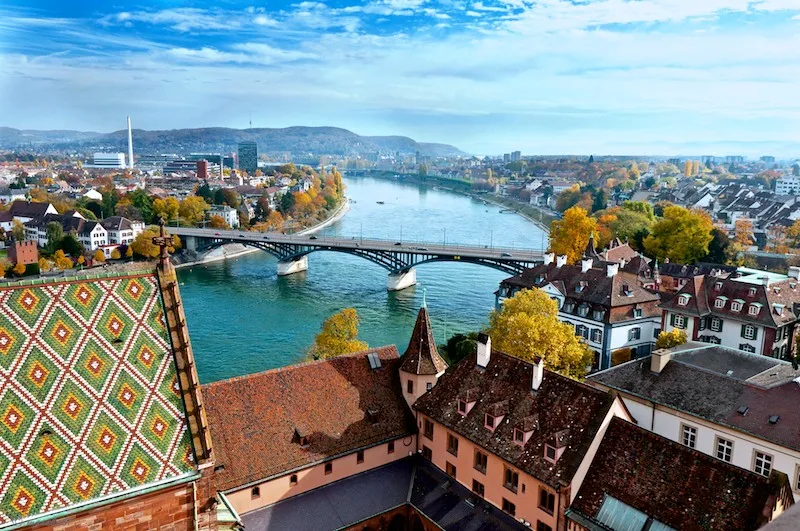
Basel sits in the corner where Switzerland, Germany and France meet — you can stand on the Dreiländereck and see all three — and it is the least Swiss-feeling of the big Swiss cities. The Rhine turns north here and becomes navigable, which made the city rich on trade and then on chemistry.
It is also, by some distance, the art capital of Switzerland: nearly forty museums for 180,000 people, the oldest public art collection in the world, and Art Basel every June.
The museums
Kunstmuseum
The Kunstmuseum Basel holds the oldest public art collection anywhere — the city bought the Amerbach cabinet in 1661, making it a municipal collection a century before the Louvre.
The holdings run from Holbein, who worked here, through the Rhine masters to Picasso, and the Picasso story is the one worth knowing: in 1967 the city held a referendum on whether public money should buy two of his paintings. The vote passed, Picasso was so pleased he donated four more, and the works are still on the walls.
Fondation Beyeler
Ten minutes out at Riehen, in a Renzo Piano building set in a park with water lilies outside the Monet room. A dealer’s private collection — Cézanne, Rothko, Giacometti, Bacon — and the best-presented gallery in Switzerland.
And the rest
The Tinguely Museum for kinetic sculpture that clanks and moves; the Antikenmuseum; the Museum der Kulturen; the Cartoon Museum. The Basel Card, given free by hotels at check-in, covers city transport and half-price museum entry.
The old town
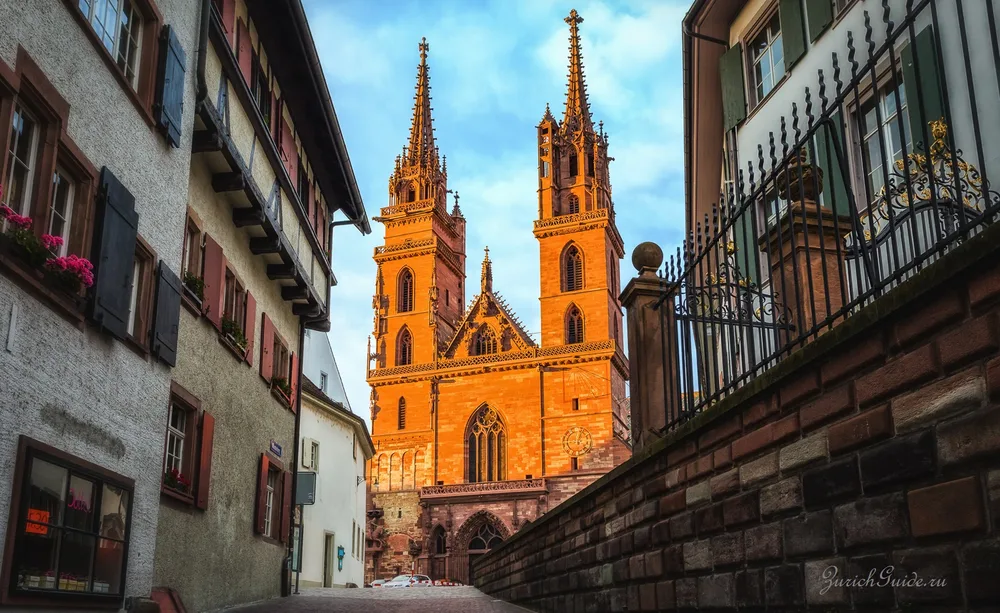
The Münster is red sandstone with two towers and a roof of patterned tiles, and the terrace behind it — the Pfalz — drops straight to the Rhine with the best view in the city. Erasmus is buried inside; he spent his last years here and Basel’s university, the oldest in Switzerland, was his reason.
The Marktplatz holds a daily market in front of the Rathaus, which is dark red, covered in frescoes and gold, and looks like a stage set rather than a working seat of government, which it is.
Inside the Münster
Worth going in for, in this order. The Galluspforte on the north side is the finest Romanesque doorway in Switzerland; the south front carries a whole cast of figures, St George putting his spear through the dragon among them. Inside there is a sandstone pulpit cut as finely as lace, a crypt holding the early bishops of Basel, and a small cloister with an arcaded gallery round it.
For a few francs you can climb a tower. One is 62 m; St George’s tower, 65 m, was finished in 1492, the previous one having come down in the earthquake of 1356. From the top the view reaches into Alsace on one side and the Black Forest on the other.
Behind the church, the Pfalz terrace drops straight to the Rhine and is the best place in the city to sit with something to eat. Walk round the building towards the river to find it.
Two more museums, two minutes apart
Follow the Münsterplatz into the Augustinergasse and you pass both.
The Museum der Kulturen is the largest ethnographic museum in Switzerland, founded in 1849 on the site of an Augustinian monastery. The collection runs from Europe and ancient Egypt to Africa, Asia, the early Americas and Oceania, and includes more than ten metres of an Abelam ceremonial house from Papua New Guinea. Only about 5% of the holdings can be shown at once, for lack of space.
Next door is the Naturhistorisches Museum, the natural history collection, and one of the cheapest tickets in the city.
Strassburger Denkmal
Two minutes from the station, on the Elisabethenanlage, stands a memorial to the Franco-Prussian war of 1870–71. It was made in 1895 by Frédéric Auguste Bartholdi — the sculptor of the Statue of Liberty — and given to Switzerland by Baron Hervé de Gruyère in thanks for what the Swiss did during the siege of Strasbourg: Basel, Bern and Zurich took in some 1,400 old people, women and children from the shelled city.
The Rhine
The river is the city’s summer. When it is warm, people finish work, walk upstream, put their clothes into a Wickelfisch — a waterproof fish-shaped dry bag invented here and sold everywhere — and swim back down with the current.
Four small ferries cross the river without engines, pulled across by the current on a cable overhead, exactly as they have been since the 1850s. They cost very little and are the most agreeable ninety seconds in Basel.
Fasnacht
Basel’s carnival is unlike any other in Switzerland, and unlike the ones in Catholic Europe generally: it starts at exactly four in the morning on the Monday after Ash Wednesday, when every light in the city is switched off and thousands of masked pipers and drummers move through the dark streets behind painted lanterns.
It runs for exactly 72 hours. It is on the UNESCO intangible heritage list. If you can be here for it, be here for it.
That opening procession is the Morgestraich, and it lasts two or three hours. Flash photography is strictly forbidden — the lanterns are the only light and the point is the dark. Restaurants stay open through it, serving the two things eaten at that hour: Mehlsuppe, a dark flour soup, and Zibelewaie, onion tart. Afterwards most people sleep before the afternoon parade.
Tuesday belongs to the children, and the streets fill with brass bands. Wednesday is the last day, with a final procession through the old town.
If you are here the Sunday before, take the train 30 minutes to Liestal for the Chienbäse: a fire parade in which burning bundles of pine are dragged through the medieval gate, followed by blazing carts. It is far less decorous than Basel and worth the trip.
Vogel Gryff
The other Basel festival, in late January, and a purely local affair: the symbolic expulsion of winter from Kleinbasel. Three figures — the griffin (Vogel Gryff), the wild man (Wilder Mann) and the lion (Leu) — dance to drums on a raft floating down the Rhine, facing the city and pointedly never turning towards Grossbasel, then dance again through the streets of the small half of town.
Getting there
- By train — Zurich to Basel SBB is under an hour, several an hour. Bern is an hour.
- The stations — Basel has a Swiss station, a French one (Basel SNCF, in the same building) and a German one (Basel Badischer Bahnhof, across the river and legally German territory). Check which one your ticket says.
- By air — EuroAirport Basel-Mulhouse-Freiburg is shared by three countries and has separate Swiss and French exits. Take the Swiss one unless you mean to go to France. The airport bus leaves from ten metres to the left of the station exit and takes 20–25 minutes.
- From further away — Lucerne about an hour, Geneva around two and three quarter hours with a change at Olten, Biel or Bern, Lugano close to four hours. Zurich and Bern trains run every 15–20 minutes, and the fare is the same whether you take a fast train or a slow one.
Around the city
Trams, buses and trolleybuses run every 7–15 minutes and reach everything; the old town on its hill around the Münster is pedestrian, and the tram takes you as far as the Marktplatz. Tickets come in three useful kinds: a short-hop ticket good for up to four stops, a one-zone ticket, and a day ticket. If your hotel has given you the BaselCard, transport is already covered.
Nearby
- Augusta Raurica — a Roman town east of the city, excavated and open as a site museum, with a theatre that still holds performances
- Alsace — direct trains leave from the French wing of Basel SBB. Colmar, Strasbourg, Obernai, Sélestat, Ribeauvillé and Mulhouse are all reachable without a car, and there is a fixed-price weekend ticket for groups of up to five. The prettiest Alsatian villages, though, need a car: the bus runs once or twice a day
- Germany and France — both are a tram ride; tram 8 goes to Weil am Rhein, where the Vitra Campus has buildings by Zaha Hadid, Frank Gehry and Tadao Ando in one field
- Schaffhausen and the Rhine Falls — an hour east along the river
- Lucerne — an hour south
When to go
June for Art Basel, if you want the art world; avoid June if you want a hotel room at a sane price. February or March for Fasnacht. Summer for the river. The city is at its best in warm weather, when it lives outdoors along the Rhine.
Where to park in Basel
| Car park | Spaces | Fee | From centre |
|---|---|---|---|
| Storchen | 142 | — | 160 m |
| Clarahuus | 52 | — | 550 m |
| Parking Kunstmuseum | 350 | — | 550 m |
| Räbgass | 250 | — | 570 m |
| Steinen | 526 | — | 640 m |
| City-Kantonsspital | 1,114 | — | 660 m |
| Claramatte | 225 | — | 820 m |
| Elisabethen | 840 | — | 830 m |
11 more are mapped nearby — see them on OpenStreetMap.
Car park data — Kanton Basel-Stadt, cantonal open data, version of August 2026. This is not an official parking directory: when you get there, read the signs and the machine at the entrance.
Weather in Basel month by month
| Month | Day | Night | Rainfall |
|---|---|---|---|
| January | +6° | -1° | 46 mm |
| February | +7° | -1° | 44 mm |
| March | +12° | +2° | 47 mm |
| April | +17° | +5° | 58 mm |
| May | +20° | +9° | 87 mm |
| June | +24° | +13° | 74 mm |
| July | +26° | +14° | 72 mm |
| August | +26° | +14° | 80 mm |
| September | +21° | +10° | 64 mm |
| October | +16° | +7° | 68 mm |
| November | +10° | +3° | 61 mm |
| December | +6° | 0° | 63 mm |
Normals for 1991–2020 from Météo-France, station BALE-MULHOUSE, Licence Ouverte 2.0, version of 7 August 2026. Day and night are the average daily high and low, not records; rainfall is approximate. Current conditions from the Norwegian Meteorological Institute, CC BY 4.0.
Updated: