Biel/Bienne
The most genuinely bilingual town in Switzerland, where conversations switch language mid-sentence, and where half the world's watches are assembled.
Biel/Bienne is the only town in Switzerland where both languages are genuinely and equally in daily use. Elsewhere on the language border one side dominates and the other is a minority — here it is roughly 60% German, 40% French, and the two run in parallel.
Everything is written twice. Officials answer in whichever language you use. Council meetings run in both without translation, because everyone understands both. Conversations in a bar switch language between speakers and sometimes mid-sentence, and nobody notices.
The town’s name is written with both forms and a slash, always.
Watches
Biel is the centre of the Swiss watch industry. Omega has been here since 1880 and its museum and factory tours are the main visitor attraction; Rolex has its largest production site here; Swatch has its headquarters in a building by Shigeru Ban made of curved timber that looks like a snake lying in the grass.
The Cité du Temps next to it holds the Omega Museum and a Swatch exhibition, and both are free.
The old town
Small, and better than its industrial surroundings suggest: arcaded streets, a fifteenth-century Gothic church, a ring of painted fountains, and the Ring, a semicircular square where the council once met in the open.
The Neues Museum Biel covers the region including the prehistoric lake dwellings.
Lake Biel
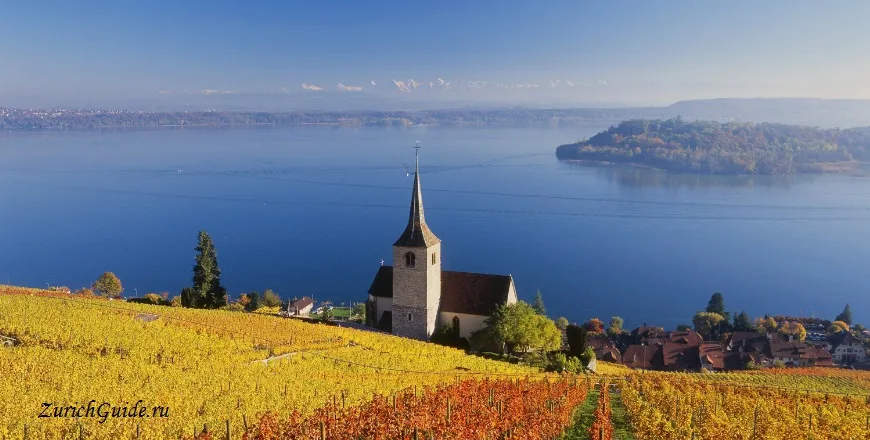
The lake begins at the edge of town, with the vine-covered slopes of the Jura on the far shore and the villages of Twann and Ligerz on a wine path between them.
St. Peter’s Island — no longer an island since the river corrections of the nineteenth century, but a wooded peninsula — is where Jean-Jacques Rousseau spent two months in 1765 and called it the happiest time of his life. The house he stayed in is a small museum and there is an inn.
Boats run there in half an hour, and the walk out along the causeway is flat and pleasant.
The three lakes
Biel, Neuchâtel and Murten are connected by canals, and the three-lakes cruise runs through all of them in a day — a slow trip through marshland and small towns that is one of the more unusual boat journeys in Switzerland. See the lakes.
Getting there
- By train — Bern 25 minutes, Neuchâtel 20 minutes, Zurich about an hour and a half, Basel an hour.
- By boat — from Neuchâtel, Murten and Solothurn.
When to go
May to September for the lake and the wine path. September and October for the grape harvest in Twann and Ligerz, when the villages hold their festivals.
Biel is not a beautiful town overall — much of it is twentieth-century industry — and it is worth going for the lake, the watches and the linguistic oddity rather than for the streets.
Where to park in Biel/Bienne
| Car park | Spaces | Fee | From centre |
|---|---|---|---|
| Museen - Musées underground | — | paid | 120 m |
| City Parking multi-storey | — | paid | 300 m |
| Manor underground | 200 | paid | 330 m |
| Altstadt Parking - Parking de la Vieille Ville underground | 273 | paid | 400 m |
| Kongresshaus Parking Palais des congrès underground | 496 | paid | 690 m |
| Bahnhof Parking - Parking de la Gare multi-storey | 325 | paid | 870 m |
| Bösigermatte / Près Bösiger | 60 | paid | 920 m |
| Centre Bahnhof multi-storey | — | paid | 1.1 km |
9 more are mapped nearby — see them on OpenStreetMap.
Data © OpenStreetMap contributors, ODbL licence, snapshot of 22 August 2026. The map is drawn by volunteers: the list is not complete, and a dash means “not recorded” — not “free” and not “no spaces”. This is not an official parking directory: when you get there, read the signs and the machine at the entrance.
Weather in Biel/Bienne month by month
| Month | Day | Night | Rainfall |
|---|---|---|---|
| January | +5° | -2° | 73 mm |
| February | +6° | -2° | 66 mm |
| March | +11° | +2° | 75 mm |
| April | +15° | +5° | 84 mm |
| May | +19° | +9° | 125 mm |
| June | +22° | +13° | 117 mm |
| July | +24° | +15° | 117 mm |
| August | +24° | +15° | 116 mm |
| September | +20° | +11° | 93 mm |
| October | +16° | +7° | 94 mm |
| November | +10° | +3° | 86 mm |
| December | +5° | -1° | 91 mm |
Averages for 1991–2020, computed from NASA POWER daily data and corrected for the elevation of the place (439 m). Day and night are the average daily high and low, not records; rainfall is approximate. Current conditions from the Norwegian Meteorological Institute, CC BY 4.0.
Updated: