Brissago Islands
Two small islands in the Swiss part of Lake Maggiore, near Ascona, where a botanical garden of plants from the warm regions of the world grows in the mildest climate in Switzerland.
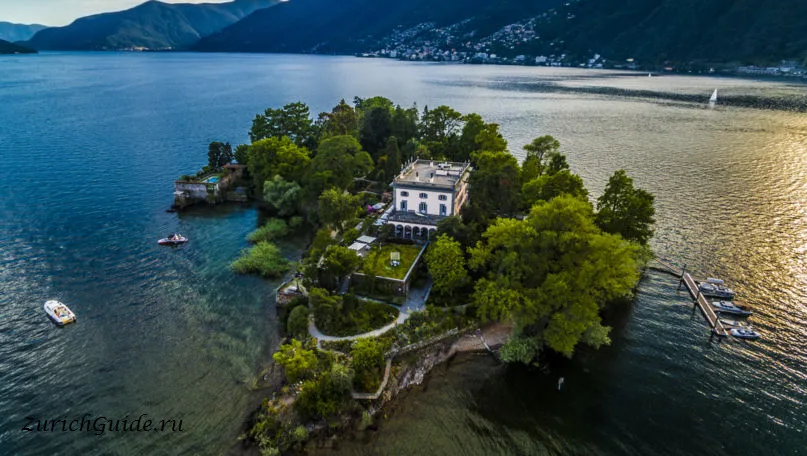
The Brissago Islands (Isole di Brissago) are two small islands in the Swiss part of Lake Maggiore, in Ticino, off the shore between Ascona and the village of Brissago, near the Italian border. The larger island, San Pancrazio (Isola Grande), is covered by a botanical garden; the smaller one, Sant’Apollinare (Isola Piccola), has been left to grow wild. Sheltered by the mountains and warmed by the lake, the islands have one of the mildest climates in Switzerland, and plants grow here that could survive nowhere else north of the Alps.
The botanical park
On San Pancrazio, the Parco botanico del Canton Ticino covers about 2.5 hectares and holds some 1,700 species of plants from the regions of the world with a Mediterranean or subtropical climate: the Mediterranean itself, South Africa, Australia, California, Chile and Asia. Among them are palms, agaves, eucalyptus, bamboos, banana plants, cork oaks, camellias, magnolias, azaleas and rhododendrons. The paths lead round the island past the different areas, with views across the water to the mountains and the shore. Spring, when the camellias, azaleas and magnolias are in flower, is a lovely time to come, but the garden is beautiful all season.
The park is open from spring to autumn, usually from late March to October, and closed in winter. Allow one to two hours for the visit.
A short history
Roman remains have been found on San Pancrazio, and in the Middle Ages it had a church and a small convent of the Humiliati, a religious order dissolved by the pope in 1571. For three centuries afterwards the islands were almost abandoned.
In 1885 they were bought by Richard Fleming Saint Léger, of an Anglo-Irish family, and his wife Antonietta, a baroness born in Saint Petersburg. They built a house on the larger island and began to create the garden, bringing earth from the mainland by boat. After her husband left in 1897, Antonietta stayed and went on developing the garden, receiving writers, musicians and artists. Ruined by bad investments after the First World War, she had to sell the islands in 1927, and died poor in 1948.
The new owner, Max Emden, a wealthy department store owner from Hamburg, replaced the old house with a large neoclassical villa with a winter garden and an outdoor pool, and lived there until his death in 1940. In 1949 the canton of Ticino, the neighbouring municipalities of Ascona, Brissago and Ronco sopra Ascona and Swiss nature and heritage organisations bought the islands from his son, and in 1950 they were opened to the public as a botanical park. The villa now houses a restaurant and seminar rooms.
Around the islands
- Ascona and Locarno, with their lakefront promenades.
- Brissago, a lakeside village by the Italian border, and Ronco sopra Ascona on the steep slope above Porto Ronco.
- The Verzasca valley and the stone bridge at Lavertezzo.
- See Swiss lakes.
Safety
The islands are reached only by boat; check the time of the last boat back, especially in spring and autumn. On summer afternoons storms can rise quickly over the lake, and the sun is strong on the water: bring a hat, sun cream and water.
Getting there
From spring to autumn, the boats of the Lake Maggiore navigation company call at the islands several times a day. The trip takes about 10 to 15 minutes from Ascona, a few minutes from Porto Ronco, about 10 minutes from Brissago and about half an hour from Locarno. Some private boat taxis also run from Ascona and Porto Ronco. To reach Locarno from Zurich, take the train via the Gotthard Base Tunnel, about two and three quarter hours.
For fares and passes, see tickets and passes.
This page in Russian: Острова Бриссаго
Updated: