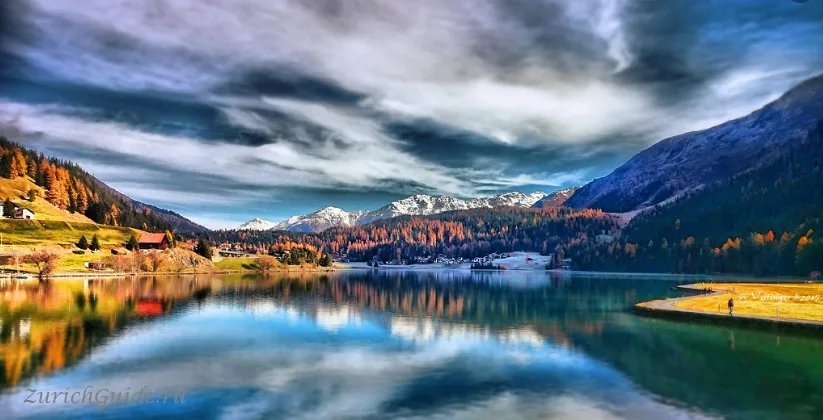
Davos and Klosters
The highest town in Europe, built as a tuberculosis cure and rebuilt as five ski areas, with a January conference that shuts the whole place.
Davos sits at 1,560 m in Graubünden and is the highest town in Europe. It does not look like a Swiss resort — it looks like a small city stretched along a valley floor, because that is what it became.
It grew as a tuberculosis cure. From the 1860s doctors sent patients to the dry, thin, sunny air here, and the town filled with sanatoria: long balconied buildings where people lay wrapped in blankets for years at a time. Thomas Mann’s wife was a patient, he visited in 1912, and The Magic Mountain came out of it.
When antibiotics ended the cure trade in the 1950s, the sanatoria became hotels and the town became a ski resort.
The skiing
Five separate areas, which is what makes Davos-Klosters one of the largest ski regions in Switzerland:
Parsenn — the big one, shared with Klosters, with long descents including the famous run down to Küblis, 12 km and 2,000 vertical metres. Jakobshorn — the snowboarders’ mountain, with the noisiest après-ski. Rinerhorn and Pischa — quieter, family-oriented. Madrisa, above Klosters — sunny and gentle.
Klosters itself is the smaller, prettier village down the valley, historically the British royal family’s resort and considerably more restrained than Davos.
Summer
Davos works better in summer than its winter reputation suggests. There are around 700 km of marked paths, the lake is warm enough to swim in by August, and the Schatzalp — a former sanatorium, reachable by funicular, and the model for the one in The Magic Mountain — has an alpine botanical garden with several thousand species.
The Jöriseen, a group of high blue lakes above the Flüela pass, are the classic day walk.
Kirchner
Ernst Ludwig Kirchner, the Expressionist, came to Davos in 1917 to recover from a breakdown after military service and stayed for the rest of his life. The mountains changed his painting completely — the harsh Berlin street scenes gave way to alpine landscapes in extraordinary colour.
The Kirchner Museum holds the largest collection of his work anywhere. He killed himself here in 1938, shortly after the Nazis condemned his work as degenerate.
The World Economic Forum
Every January, for about five days, Davos hosts the WEF and becomes a fortified enclave: several thousand delegates, road closures, snipers on roofs, and hotel prices that multiply by ten.
Do not plan a holiday for that week. The dates are published a year ahead.
Getting there
- By train — Zurich about two and a half hours via Landquart; Chur an hour and a quarter. The line up from Landquart is the Rhaetian Railway and is a scenic route in its own right.
- From Klosters the Vereina tunnel carries a car shuttle through to the Engadin, which stays open when the passes are shut; see driving in Switzerland.
When to go
December to April for skiing, July to September for walking. Avoid the WEF week in January.
May and November are the shoulder months when the town largely closes.
Where to park in Davos and Klosters
| Car park | Spaces | Fee | From centre |
|---|---|---|---|
| Parkhaus Arkaden Davos underground | — | paid | 110 m |
| Postplatz | — | paid | 380 m |
| Parkhaus Silvretta underground | — | paid | 500 m |
| Parkplatz Jakobshornbahn | — | paid | 560 m |
| Underground car park | — | paid | 710 m |
| Kongress | — | paidmax 10 h | 740 m |
| Horlauben | — | paidmax 2 h | 880 m |
| Parkhaus Migros underground | 167 | paid | 950 m |
Data © OpenStreetMap contributors, ODbL licence, snapshot of 22 August 2026. The map is drawn by volunteers: the list is not complete, and a dash means “not recorded” — not “free” and not “no spaces”. This is not an official parking directory: when you get there, read the signs and the machine at the entrance.
Weather in Davos and Klosters month by month
| Month | Day | Night | Rainfall |
|---|---|---|---|
| January | 0° | -9° | 70 mm |
| February | +2° | -9° | 52 mm |
| March | +5° | -5° | 57 mm |
| April | +9° | -2° | 54 mm |
| May | +13° | +3° | 89 mm |
| June | +17° | +6° | 129 mm |
| July | +19° | +8° | 133 mm |
| August | +19° | +8° | 150 mm |
| September | +15° | +4° | 96 mm |
| October | +11° | +1° | 77 mm |
| November | +5° | -4° | 71 mm |
| December | +1° | -7° | 68 mm |
Normals for 1991–2020 from MeteoSwiss, station Davos, open data, version of 29 July 2026. Adjusted to the elevation of the place. Day and night are the average daily high and low, not records; rainfall is approximate. Current conditions from the Norwegian Meteorological Institute, CC BY 4.0.
Updated: