Fribourg
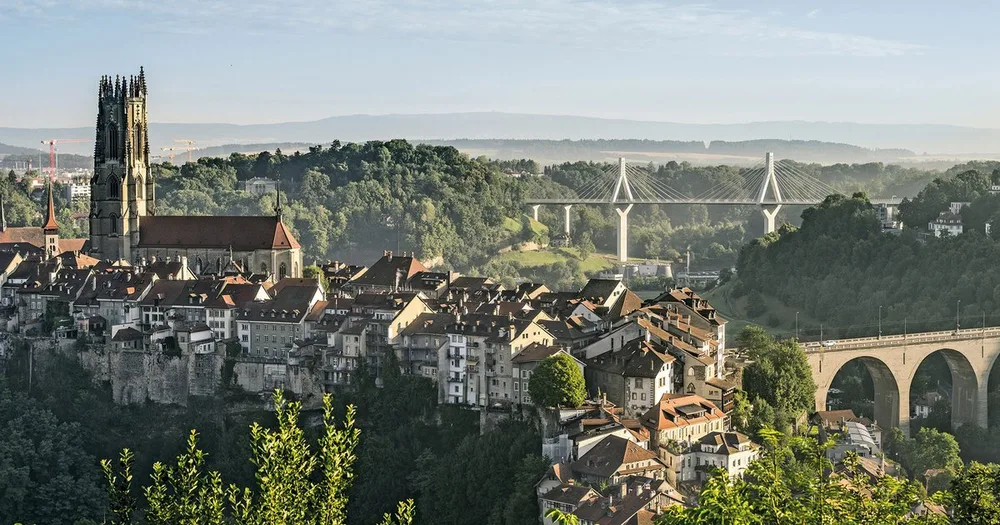
A stone medieval town falling into a river loop, where the language border runs down the middle of the water.
Fribourg is the largest genuinely bilingual city in Switzerland, and the language border does not run past it — it runs through it, along the Sarine. German on one bank, French on the other, and a great many people who switch mid-sentence without noticing.
It is also one of the best-preserved medieval towns in the country, and much less visited than it deserves. Where Bern is sandstone and orderly, Fribourg is grey molasse stone falling steeply into a river gorge, with high bridges over it. The medieval core survived almost entire, which makes this one of the largest old towns in Europe.
The city was founded in 1157, joined the Confederation in 1481, and stayed Catholic all through the Reformation while its neighbours went the other way — which is why the cathedral still has its furnishings and why the university here exists at all. A large share of the population are students, and the mixture shows in the bars along the Rue de Lausanne.
The name means free town in both languages, and it is 20 to 30 minutes south of Bern by train.
The old town
The Basse-Ville, down in the loop of the river, is the medieval core: narrow streets, the old Pont de Berne — a covered wooden bridge from the fifteenth century — and the ramparts, of which about two kilometres survive with fourteen towers. You can walk long stretches of the wall.
Above, the Cathédrale Saint-Nicolas has a 74-metre Gothic tower with 368 steps to the top and, over the west door, a Last Judgment tympanum from around 1340 that is among the best Gothic sculpture in Switzerland. Inside there is glass by the Polish Art Nouveau artist Józef Mehoffer, which is a genuine surprise.
The Espace Jean Tinguely – Niki de Saint Phalle, in a converted tram depot, holds work by both — Tinguely was from Fribourg.
The funicular
The town’s best small thing. The funiculaire connecting the upper town to the Basse-Ville has run since 1899 and is counterbalanced by waste water — the descending car fills a tank from the town’s sewage system, and its weight pulls the other car up.
It is the only funicular in Europe still working this way. It takes two minutes, it costs the price of a bus ticket, and on a warm day you can tell what powers it.
The language border
The dividing line has a name — the Röstigraben — and Fribourg sits astride it. The city is officially Fribourg/Freiburg, written both ways; the canton is two-thirds French-speaking; and the university teaches in both languages, which makes it the only bilingual university in the country.
Practically, everyone in the centre speaks French, most also speak German, and the street signs are in French with German where the population warrants it. See languages in Switzerland.
Finding your way
Most of the old town is on the west bank, around the cathedral of St Nicholas. From the station walk north-east along the Avenue de la Gare, which becomes the Rue de Romont and then the pedestrian Rue de Lausanne; that street takes you straight into the centre, and the funicular down to the Basse-Ville is signposted from the end of it.
It is all downhill on the way in and uphill on the way back, which is worth knowing before you plan the afternoon.
Getting there
- By train — Bern 25 minutes, Lausanne 45 minutes, Geneva an hour and a quarter, Zurich about an hour and a half.
- On foot — the station is in the upper town; the old town is downhill from it, and the funicular brings you back up.
Nearby
- Gruyères — 40 minutes, the castle and the cheese
- Murten/Morat — 30 minutes, a walled lakeside town, also bilingual
- Broc — the chocolate factory in the same direction as Gruyères
What to eat
Fribourg’s contribution is Vacherin Fribourgeois, and the local fondue moitié-moitié — half Vacherin, half Gruyère — which is the version most Swiss consider correct. There is also a pure-Vacherin fondue, eaten with potatoes rather than bread, that hardly exists outside the canton.
When to go
Any time. The old town is stone and works in rain, and the gorge is at its best in autumn. Mid-December brings the Saint Nicholas procession, when the saint arrives on a donkey and reads a satirical speech about the year’s local politics from the cathedral steps.
Weather in Fribourg month by month
| Month | Day | Night | Rainfall |
|---|---|---|---|
| January | +3° | -3° | 50 mm |
| February | +5° | -3° | 50 mm |
| March | +10° | 0° | 60 mm |
| April | +14° | +3° | 75 mm |
| May | +18° | +7° | 108 mm |
| June | +22° | +11° | 101 mm |
| July | +24° | +13° | 106 mm |
| August | +24° | +13° | 106 mm |
| September | +19° | +9° | 83 mm |
| October | +14° | +6° | 87 mm |
| November | +8° | +1° | 72 mm |
| December | +4° | -2° | 65 mm |
Normals for 1991–2020 from MeteoSwiss, station Fribourg / Grangeneuve, open data, version of 29 July 2026. Day and night are the average daily high and low, not records; rainfall is approximate. Current conditions from the Norwegian Meteorological Institute, CC BY 4.0.
Updated: