Grandson
A lakeside fortress where the Swiss destroyed the richest army in Europe in 1476 and took a treasure that is still turning up in museums.
Grandson is a small town on Lake Neuchâtel with a very large castle, and it is the site of one of the decisive events in Swiss history.
Origins
Grandson lies in the canton of Vaud, a few kilometres from Yverdon-les-Bains, on the shore of Lake Neuchâtel. The area was settled before Roman times, and the district was romanised, but the town itself only took shape after the year 1000, when the lords of Grandson built a castle here to control the lakeside road. The family is first recorded in the second half of the eleventh century; its sons became bishops of Basel, Lausanne, Toul and Verdun, and for generations it feuded with the nearby monastery of Romainmôtier.
The best known of the lords, Otto I of Grandson, rebuilt the castle into roughly its present form in the thirteenth century. He was a close companion of Prince Edward of England and travelled with him on crusade to the Holy Land in 1271, fought for the English crown in the conquest of Wales in 1283, and took part in the defence of Acre when it fell in 1291. He was also a trusted diplomat, employed by the Pope, the Emperor and the kings of France and England. When he died in 1328 his brother William settled in England and founded the line of the lords of Grandisson; William’s son John Grandisson became Bishop of Exeter.
The family’s fortunes did not survive him. Within a couple of generations one head of the house was condemned for forging documents and fled to England, where he died under obscure circumstances; another was accused of killing the Count of Savoy and lost a trial by combat fought to clear his name; a third was convicted of treason against the Duke of Burgundy. By the end of the fifteenth century the castle belonged to Jacques de Savoie, an ally of Charles the Bold; the Swiss Confederation seized it in 1475, and it was to recapture it that Charles gathered his army the following year.
The battle
In 1476 Charles the Bold, Duke of Burgundy, brought what was then the richest and best-equipped army in Europe against the Swiss Confederation. He took Grandson castle in February, hanged or drowned the garrison of some 400 men, and waited.
The garrison had agreed to surrender only once Charles promised to spare them. He had them killed regardless.
On 2 March the Confederate army arrived. What happened next is disputed in detail and clear in outcome: the Swiss infantry advanced in squares, the Burgundian cavalry could not break them, an attempted redeployment turned into a rout, and Charles fled with a few companions.
The fighting took place a short distance from the castle, near the village of Concise.
He left his camp standing.
The treasure
That camp contained the duke’s travelling household, and it was extraordinary: tapestries, gold and silver plate, jewels, artillery, and Charles’s own tent and personal seals. The Swiss took all of it.
The Burgundian booty — Burgunderbeute — was divided among the cantons and is still scattered across Swiss museums. Some pieces were sold cheaply by soldiers who had no idea what they were holding; three of the duke’s great diamonds ended up in European crown jewels, and one of them, the Florentine, has been missing since 1918.
A number of the captured artillery pieces survive and are on display in the museum at La Neuveville, near Neuchâtel.
Charles lost twice more that year and was killed at Nancy in January 1477. Burgundy as an independent power ended with him, its lands split between France and the Habsburgs — a redrawing of European politics that began in a field beside this lake.
The castle
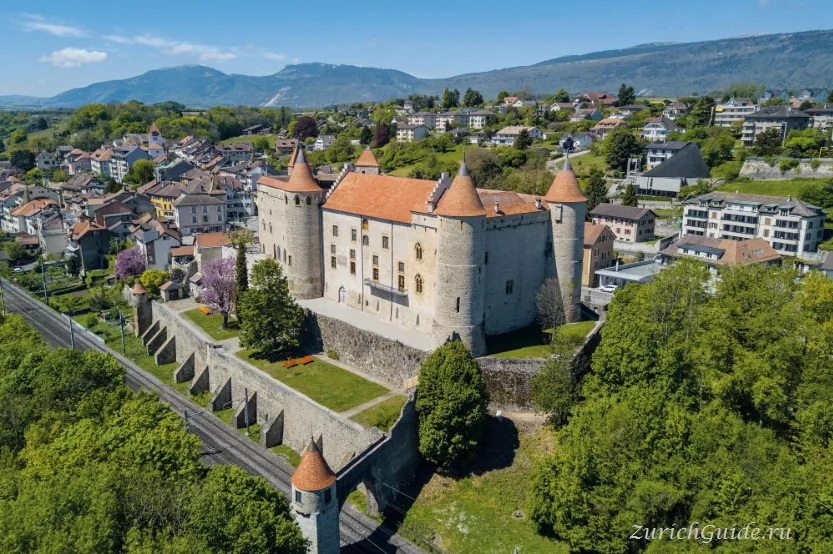
Thirteenth-century, with five round towers and a curtain wall, and among the largest surviving medieval fortresses in Switzerland. It is privately owned and open to visitors.
The castle stands on a low spur above the lake and is first recorded in 1050. The present building is a reconstruction and enlargement carried out in the thirteenth century, on an irregular, roughly square plan of a type sometimes called carré savoyard; the earthworks around it were altered again in the sixteenth century. The keep has disappeared, probably demolished when the western range was rebuilt, though traces of its tower survive on the north side. When the level of Lake Neuchâtel was lowered in the 1870s, as part of regional flood-control works, the castle lost the stretch of open water that had once guarded its south-eastern side, and it now stands some way back from the shore.
Inside: an armour collection of real quality, a hall on the battle, dungeons with the usual instruments displayed with more relish than necessary, and — unexpectedly — a vintage car museum including a white Rolls-Royce that belonged to Greta Garbo.
The knights’ hall keeps choir stalls dated 1620 and a set of Renaissance-style chairs. The armoury covers the Burgundian Wars, with crossbows and other period weapons; a separate room shows models of the castle and plans of the battle, and another is given to regional history, with particular attention to the importance of the lake. A chapel added in 1962 holds a Virgin with the Rose attributed to the sixteenth-century painter Jan Massys, and the cellar holds the old feudal court’s prison and its dungeon.
The combination is odd and rather Swiss.
The town and the lake
Small, with a Romanesque and Gothic church and a shore path. The southern end of Lake Neuchâtel is flat, reedy and full of birds, quite unlike the alpine lakes.
Boats call here on the run between Neuchâtel and Yverdon; see the lakes.
The castle and the parish church are both listed as Swiss heritage sites of national significance, and the old town as a whole is a protected national monument. Grandson also has the remains of prehistoric lake-dwellings that form part of the UNESCO World Heritage listing for prehistoric pile dwellings around the Alps.
The church, Saint-Jean-Baptiste, was built in 1178 as a monastery church on the site of a smaller, earlier building, in the Romanesque style of the Auvergne, the home region of the Benedictine monks who built it; its capitals are unusually rich, and the columns are thought to come from the Roman ruins at Aventicum, near Avenches. The choir and bell tower were rebuilt in Gothic style in the fourteenth century, and the main façade was renewed in 1896. The transept holds a richly carved late-Gothic altarpiece of 1480 and wall paintings from the fifteenth century.
Behind the church, the medieval quarter is still legible: a grid of roughly 250 by 150 metres, crossed by two streets, Rue Basse and Rue Haute, lined with town houses and patrician houses from the seventeenth and eighteenth centuries.
The former Hôtel de Ville, next to the church, was built in the 1760s by converting part of the old Saint-Jean monastery buildings; a new town hall went up in the lower town in 1891, incorporating the surviving bell tower of the former Franciscan monastery. Nearby, the Maison du Bailli is an eighteenth-century house with an open staircase and a wrought-iron balcony. Several fountains survive in the streets and squares, including one behind the church dated 1637.
In the nineteenth century the town lost its direct link to the water: an embankment built in 1858 for the Yverdon–Biel railway cut off the medieval harbour at the western edge of town, and new docks and grand houses went up further along the reshaped shore, among them an observatory built by the Vautier family.
On the road to Fiez, a menhir about 3.5 metres tall and weighing some three tonnes was discovered in 1895 and re-erected.
Getting there
- By train — Yverdon-les-Bains 8 minutes, Neuchâtel 25 minutes, Lausanne about 40 minutes.
- On foot — the castle is ten minutes uphill from the station.
- By car — about an hour from Geneva, and a little over two hours from Zurich or Basel.
Nearby
- Yverdon-les-Bains — thermal baths, the science fiction museum and the menhirs
- Neuchâtel — the ochre town and the eighteenth-century automata
- Sainte-Croix — up in the Jura, where music boxes and automata are still made
- More Swiss fortresses in castles
When to go
April to October, when the castle keeps full hours. The site works in any weather — most of the visit is indoors, and the lake in autumn mist suits it.
Weather in Grandson month by month
| Month | Day | Night | Rainfall |
|---|---|---|---|
| January | +4° | -2° | 80 mm |
| February | +5° | -1° | 70 mm |
| March | +10° | +2° | 78 mm |
| April | +14° | +5° | 84 mm |
| May | +18° | +9° | 120 mm |
| June | +22° | +13° | 113 mm |
| July | +24° | +15° | 111 mm |
| August | +24° | +15° | 110 mm |
| September | +20° | +11° | 95 mm |
| October | +15° | +7° | 101 mm |
| November | +9° | +3° | 90 mm |
| December | +5° | -1° | 99 mm |
Averages for 1991–2020, computed from NASA POWER daily data and corrected for the elevation of the place (453 m). Day and night are the average daily high and low, not records; rainfall is approximate. Current conditions from the Norwegian Meteorological Institute, CC BY 4.0.
Updated: