Gstaad
A village of wooden chalets with a pedestrian main street, a reputation for money, and gentler skiing than its neighbours.
Gstaad is in the Saanenland, the German-speaking corner of canton Bern that borders French-speaking Vaud, and it has a peculiar position in the Swiss imagination: the resort where money goes, without ever quite looking like it.
The building code is strict, so everything is a wooden chalet — including the bank, the supermarket and the luxury hotels. The main street is pedestrian and lined with the shops you would expect. The overall effect is a village that has been kept deliberately small while the money around it grew.
Julie Andrews, Roger Moore and a long list of others had houses here; the village is discreet about it, which is part of the appeal.
Glacier 3000
The excursion, and it is a good one. A cable car from the Col du Pillon climbs to 2,971 m on the Tsanfleuron glacier, into a building by Mario Botta.
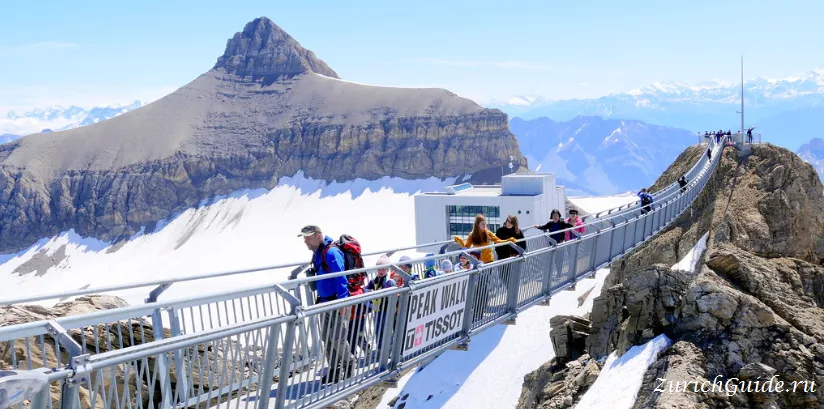
At the top is the Peak Walk — the only suspension bridge in the world connecting two mountain summits, 107 m long, crossing between the Scex Rouge peaks with a considerable drop below. There is a dog-sled run in season, a toboggan run, and skiing into early summer.
The view runs to the Matterhorn, Mont Blanc, the Eiger, Mönch and Jungfrau.
Skiing
The ski area is spread across several separate sectors around the Saanenland and into Vaud, linked by ski bus rather than continuously by lift. It is gentler than Verbier or Zermatt — mostly intermediate, tree-lined, and better for families and cruisers than for anyone chasing steepness.
Glacier 3000 provides the height and the reliability when snow is short lower down.
The festivals
Gstaad’s calendar is a large part of its identity:
Swiss Open tennis in July, played on clay in the village, and one of the more agreeable stops on the tour.
Gstaad Menuhin Festival — six weeks of classical music from July to September, founded by Yehudi Menuhin, who lived nearby, with concerts in the village churches and a tent.
Hublot Polo Gold Cup in August, on grass, at 1,000 m.
Summer walking
Around 300 km of paths, and the Saanenland is gentler country than the high Valais — pasture, forest and chalets rather than glaciers. The walk over the Col du Pillon and the paths above Rougemont are the pick.
Getting there
- By train — Gstaad is on the GoldenPass line: Montreux about an hour and a half, Interlaken about two hours via Zweisimmen. Zurich about three and a half hours.
- The GoldenPass approach from Montreux, climbing out of the vineyards into the mountains, is one of the better arrivals in Switzerland.
When to go
Late December to March for skiing, July and August for the festivals and walking.
The village works out of season too, and prices in June and October are a fraction of the peak.
Weather in Gstaad month by month
| Month | Day | Night | Rainfall |
|---|---|---|---|
| January | +2° | -6° | 95 mm |
| February | +4° | -6° | 77 mm |
| March | +8° | -2° | 86 mm |
| April | +12° | +1° | 84 mm |
| May | +16° | +5° | 129 mm |
| June | +20° | +8° | 128 mm |
| July | +22° | +10° | 145 mm |
| August | +22° | +10° | 147 mm |
| September | +17° | +7° | 102 mm |
| October | +13° | +3° | 97 mm |
| November | +7° | -1° | 97 mm |
| December | +3° | -5° | 115 mm |
Normals for 1991–2020 from MeteoSwiss, station Château-d'Oex, open data, version of 29 July 2026. Day and night are the average daily high and low, not records; rainfall is approximate. Current conditions from the Norwegian Meteorological Institute, CC BY 4.0.
Updated: