La Chaux-de-Fonds and Le Locle
Two towns in the Jura laid out on a grid designed for making watches, UNESCO-listed for town planning, and the birthplace of Le Corbusier.
La Chaux-de-Fonds sits at 1,000 m in the Jura above Neuchâtel, and it is the only town in Switzerland that is UNESCO-listed for its street plan.
The reason is watchmaking. Both this town and Le Locle, ten minutes away, burned down — La Chaux-de-Fonds in 1794 — and were rebuilt from scratch on a strict grid, with long parallel streets running east–west and buildings of a fixed height and depth.
That layout was not aesthetic. It was designed so that daylight reached the workbenches: watchmaking is close work, done by hand at a window, and the town was arranged to deliver light into every workshop in the days before electricity. Karl Marx cited La Chaux-de-Fonds in Capital as an example of a town that was itself a single manufactory.
The watch museum
The Musée International d’Horlogerie is the serious one — around 4,500 timepieces from sundials to atomic clocks, in a building sunk into a park, with a working restoration workshop you can watch.
If you have any interest in how mechanical watches actually work, this is the place in the world to go.
Le Locle has the Musée d’Horlogerie in the Château des Monts, a smaller and more atmospheric collection in an eighteenth-century house.
Le Corbusier
Charles-Édouard Jeanneret — Le Corbusier — was born here in 1887, trained at the local art school, and built his first houses in the town before leaving for Paris.
Several survive: the Villa Fallet, the Villa Jeanneret-Perret built for his parents, and the Villa Turque, commissioned by a watch manufacturer and now owned by a watch company. They are early, regional and not yet what he became, which is exactly what makes them interesting.
There is a marked walking route linking them.
The underground mills
At Le Locle, the Moulins Souterrains du Col-des-Roches: mills built inside a cave system in the seventeenth century, using an underground waterfall to drive wheels on several levels, because the plateau had no surface river to work with.
They were rediscovered under a rubbish tip in the 1970s and excavated. It is a genuinely strange place and among the more remarkable industrial sites in Europe.
Getting there
- By train — Neuchâtel about half an hour up a steep line; Biel/Bienne an hour; Zurich about two and a half hours.
- Le Locle is ten minutes further, and the two are easily combined in a day.
- The line continues into France towards Besançon.
Nearby
- The Creux du Van — a rock amphitheatre 160 m high in the Jura, an hour away and one of the best walks in the country
- Val-de-Travers — where absinthe was invented, distilled illegally for a century and legalised in 2005
- Neuchâtel — half an hour down, with the ochre old town and the automata
When to go
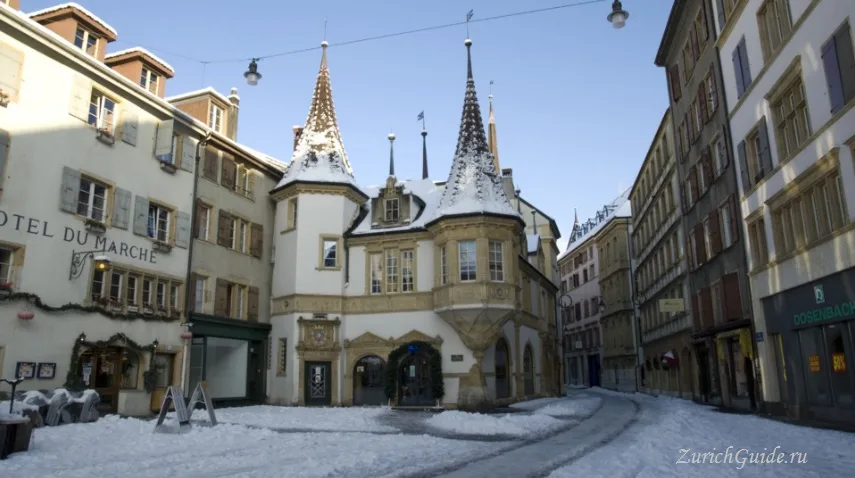
Any time; this is an indoor visit for the most part. The Jura is high and gets real winters, with a good cross-country network — and the towns look their best under snow, when the grid is picked out in white.
Where to park in La Chaux-de-Fonds and Le Locle
| Car park | Spaces | Fee | From centre |
|---|---|---|---|
| Parking Grande Fontaine | — | — | 150 m |
| Place des Marronniers | — | freemax 1 h | 230 m |
| Parc clients in coiffure | — | — | 300 m |
| Parking de la Ronde multi-storey | 450 | paid | 490 m |
| Près de la Ronde | 15 | — | 560 m |
| Les Arêtes | — | paid | 920 m |
| Hôpital | — | paid | 1.3 km |
Data © OpenStreetMap contributors, ODbL licence, snapshot of 22 August 2026. The map is drawn by volunteers: the list is not complete, and a dash means “not recorded” — not “free” and not “no spaces”. This is not an official parking directory: when you get there, read the signs and the machine at the entrance.
Weather in La Chaux-de-Fonds and Le Locle month by month
| Month | Day | Night | Rainfall |
|---|---|---|---|
| January | +1° | -5° | 80 mm |
| February | +2° | -5° | 70 mm |
| March | +6° | -2° | 78 mm |
| April | +10° | +1° | 84 mm |
| May | +15° | +6° | 120 mm |
| June | +18° | +9° | 113 mm |
| July | +20° | +11° | 111 mm |
| August | +21° | +11° | 110 mm |
| September | +16° | +7° | 95 mm |
| October | +12° | +4° | 101 mm |
| November | +5° | -1° | 90 mm |
| December | +1° | -4° | 99 mm |
Averages for 1991–2020, computed from NASA POWER daily data and corrected for the elevation of the place (996 m). Day and night are the average daily high and low, not records; rainfall is approximate. Current conditions from the Norwegian Meteorological Institute, CC BY 4.0.
Updated: