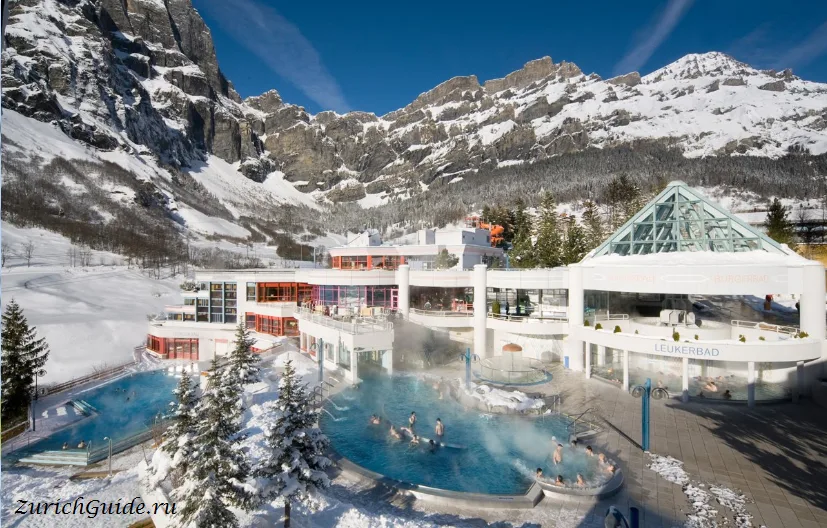
Leukerbad
The largest thermal resort in the Alps, sitting in a dead-end valley under a wall of rock, with 3.9 million litres of hot water a day.
Leukerbad sits at 1,400 m at the closed end of a side valley in the Valais, with the Gemmi wall — a rock face rising some 600 m — directly above the village. Hot water comes out of the ground here at up to 51 °C, around 3.9 million litres a day, which makes it the largest thermal resort in the Alps.
The Romans knew about it. The bishops of Sion developed it in the fifteenth century. Goethe, Mark Twain, Maupassant and James Baldwin all came — Baldwin wrote Stranger in the Village here in 1953, about being the first Black man most of the villagers had ever seen.
The baths
Two main complexes, plus hotel baths.
Leukerbad Therme is the larger, with several indoor and outdoor pools and a big sauna area.
Walliser Alpentherme is the more design-led, with a Valais sauna village and a Roman-Irish circuit.
The point of both is the same and it is a good one: sitting in hot water outdoors, in winter, with snow falling and a 600-metre cliff lit above you.
Note the sauna rules; see thermal baths.
The Gemmi
The cable car from the village goes up the wall to the Gemmi pass at 2,350 m, and the difference at the top is startling — a bare high plateau with a lake, quite unlike the enclosed valley below.
The Gemmi path down the cliff face is the historic route: a mule track cut and blasted into the rock in the 1730s, zigzagging down the wall, and one of the more remarkable pieces of pre-modern engineering in the Alps. It is a proper mountain path, exposed in places, and takes about two hours down.
From the top, paths run north to Kandersteg over the pass — a full day’s walk between two valleys that are hours apart by road.
Skiing
Torrent, on the other side of the valley, is a modest area with long runs down to the village. Leukerbad is not a serious ski destination and does not pretend to be; the combination people come for is a morning on the snow and an afternoon in the water.
Getting there
- By train and bus — the railway reaches Leuk in the Rhône valley (Sion 20 minutes, Zurich about three hours), then a post bus climbs to the village in half an hour.
- By car — the road up is good but it is a dead end; there is no through route.
Nearby
- Sion — 40 minutes, two castle hills and the oldest playable organ in the world
- Kandersteg — over the Gemmi on foot, or a long way round by train
- Zermatt — an hour and a half down the valley and up the next one
When to go
Winter is when Leukerbad is at its best — the contrast between the cold and the water is the whole experience, and the Gemmi under snow is spectacular.
June to October for the walking and the pass. The cable car runs year-round; the historic Gemmi path is a summer route only.
Where to park in Leukerbad
| Car park | Spaces | Fee | From centre |
|---|---|---|---|
| Rathaus | — | — | 60 m |
| Underground car park | — | free | 80 m |
| Leukerbad Therme Parking | — | paid | 210 m |
| Leukerbad Therme Parking Garage underground | — | paid | 220 m |
| Parkhaus Sportzentrum underground | — | paid | 230 m |
| Underground car park | — | paid | 380 m |
| Parking Torrent-Bahnen underground | — | paid | 610 m |
| Underground car park | — | paid | 610 m |
Data © OpenStreetMap contributors, ODbL licence, snapshot of 22 August 2026. The map is drawn by volunteers: the list is not complete, and a dash means “not recorded” — not “free” and not “no spaces”. This is not an official parking directory: when you get there, read the signs and the machine at the entrance.
Weather in Leukerbad month by month
| Month | Day | Night | Rainfall |
|---|---|---|---|
| January | +2° | -5° | 88 mm |
| February | +3° | -5° | 76 mm |
| March | +6° | -3° | 81 mm |
| April | +10° | 0° | 85 mm |
| May | +14° | +4° | 135 mm |
| June | +18° | +8° | 140 mm |
| July | +19° | +10° | 166 mm |
| August | +19° | +10° | 152 mm |
| September | +15° | +6° | 100 mm |
| October | +12° | +3° | 88 mm |
| November | +6° | -1° | 87 mm |
| December | +3° | -4° | 105 mm |
Normals for 1991–2020 from MeteoSwiss, station Adelboden, open data, version of 29 July 2026. Adjusted to the elevation of the place. Day and night are the average daily high and low, not records; rainfall is approximate. Current conditions from the Norwegian Meteorological Institute, CC BY 4.0.
Updated: