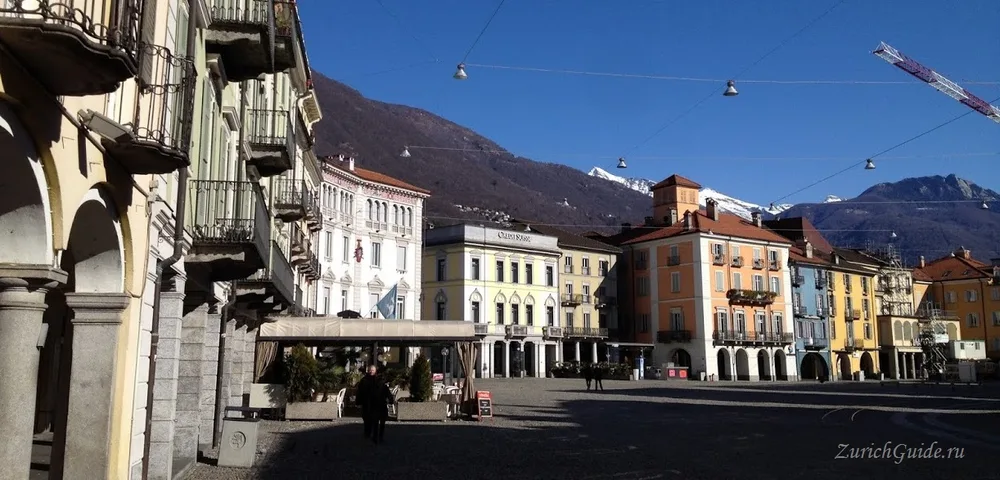
Locarno and Ascona
The lowest and warmest place in the country, with a pilgrimage church on a cliff and a film festival that fills the main square with eight thousand seats.
Locarno stands on Lake Maggiore at 196 m above sea level — the lowest point in Switzerland — and it has the warmest climate in the country. Palms, camellias, magnolias and lemon trees grow outdoors, and the town claims more hours of sun than anywhere else in Switzerland.
Next door, four kilometres round the bay, Ascona is smaller, prettier and more expensive.
Piazza Grande
The arcaded square in the middle of Locarno, and one of the best public spaces in Switzerland — pink and ochre buildings, cafés under the arches, and a market on Thursday mornings.
For eleven days every August it becomes the Locarno Film Festival: a screen 26 by 14 metres goes up at one end, eight thousand seats fill the square, and films are shown outdoors every night. It has run since 1946, it is one of the oldest festivals in the world, and the atmosphere in the square at eleven at night is the reason to plan a trip around it.
Madonna del Sasso
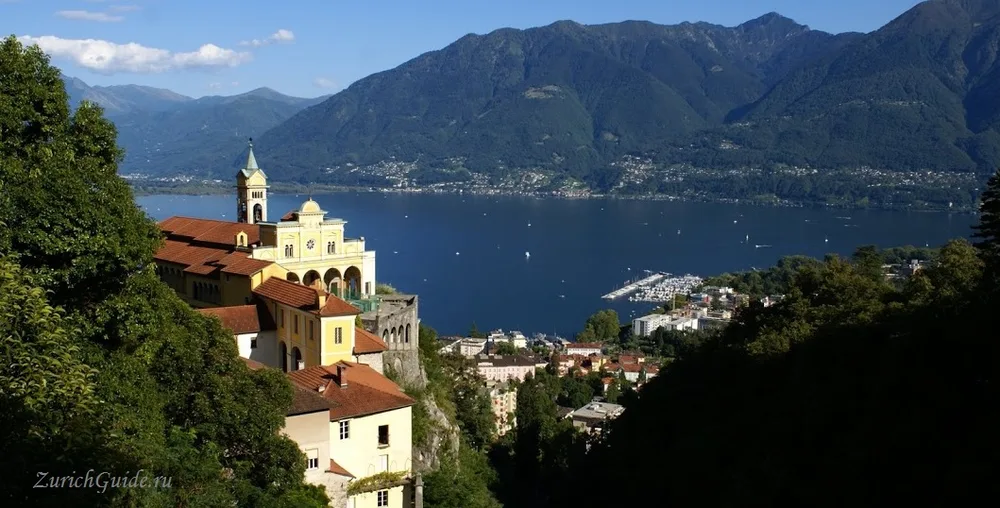
The pilgrimage church on the cliff above the town, founded in 1480 after a Franciscan reported a vision of the Virgin on the rock. The building is a stack of chapels, terraces and painted vaults clinging to the slope, and the terrace gives the lake, the town and the Italian shore beyond.
A funicular goes up in five minutes, or you walk the old pilgrim path through the chapels of the Way of the Cross in about half an hour. The walk is better.
From the top, a cable car continues to Cardada and a chairlift to Cimetta at 1,670 m — where you can, in principle, ski in the morning and swim in the afternoon.
Ascona
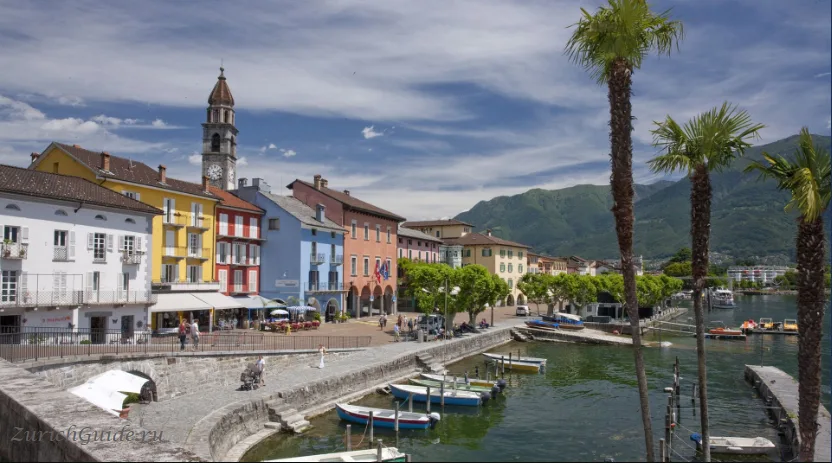
A row of painted houses along a lakefront promenade closed to cars, with a knot of narrow lanes behind and the mountains across the water. It is the postcard of Italian Switzerland and it knows it.
Ascona has an unlikely history: Monte Verità, the hill above, was a colony of vegetarians, anarchists, theosophists and nudists from 1900, and over the following decades Hermann Hesse, Carl Jung, Isadora Duncan and Rudolf Steiner all turned up. The buildings survive as a museum and hotel, and the story is stranger than the tidy village below suggests.
The valleys
The reason to stay rather than pass through. Three side valleys run north into the mountains, each reachable by post bus:
Verzasca is the famous one: green-grey granite scoured smooth by the river, water of an improbable clarity, and the double-arched Ponte dei Salti at Lavertezzo. The dam at the mouth of the valley is where the bungee jump at the start of GoldenEye was filmed, and you can still do it.
Maggia is broader, with waterfalls and stone villages.
Centovalli carries a railway to Domodossola in Italy through a hundred valleys of chestnut forest — a scenic line that costs an ordinary fare and is on nobody’s list.
The Brissago islands
Two small islands in the lake with a botanical garden of subtropical planting, reachable by boat in half an hour. The microclimate lets things grow that would not survive anywhere else in Switzerland.
Getting there
- By train — Zurich about two and three quarter hours via the Gotthard Base Tunnel; Lugano about an hour; Bellinzona twenty minutes.
- By boat — services along Lake Maggiore, including into Italy.
When to go
April to June and September to October. July and August are hot, humid and full, and the film festival takes the middle of August.
Spring is the best of it: camellias in March, everything green, and the valleys running full with snowmelt.
Nearby
Other places on this site within easy reach, as the crow flies:
- Melide and Swissminiatur — 27 km
- Andermatt — 54 km
- Brig — 64 km
- Saas-Fee — 67 km
- Grindelwald — 77 km
- Meiringen and the Reichenbach Falls — 78 km
This page in Russian: Локарно (Locarno)
Where to park in Locarno and Ascona
| Car park | Spaces | Fee | From centre |
|---|---|---|---|
| Underground car park | — | paid | 280 m |
| Underground car park | — | paid | 300 m |
| Parking Centro underground | 300 | paid | 340 m |
| Parcheggio Centro Castello multi-storey | 372 | — | 420 m |
| Multi-storey car park | — | paid | 470 m |
| Parcheggio Sant'Antonio | — | paid | 600 m |
| Multi-storey car park | 45 | paid | 870 m |
| Behinderten Parkplatz | — | — | 890 m |
6 more are mapped nearby — see them on OpenStreetMap.
Data © OpenStreetMap contributors, ODbL licence, snapshot of 22 August 2026. The map is drawn by volunteers: the list is not complete, and a dash means “not recorded” — not “free” and not “no spaces”. This is not an official parking directory: when you get there, read the signs and the machine at the entrance.
Weather in Locarno and Ascona month by month
| Month | Day | Night | Rainfall |
|---|---|---|---|
| January | +8° | +2° | 70 mm |
| February | +11° | +3° | 64 mm |
| March | +15° | +7° | 95 mm |
| April | +19° | +10° | 166 mm |
| May | +22° | +13° | 190 mm |
| June | +26° | +17° | 187 mm |
| July | +29° | +19° | 163 mm |
| August | +28° | +19° | 212 mm |
| September | +23° | +15° | 203 mm |
| October | +18° | +11° | 210 mm |
| November | +12° | +7° | 208 mm |
| December | +9° | +3° | 89 mm |
Normals for 1991–2020 from MeteoSwiss, station Locarno / Monti, open data, version of 29 July 2026. Adjusted to the elevation of the place. Day and night are the average daily high and low, not records; rainfall is approximate. Current conditions from the Norwegian Meteorological Institute, CC BY 4.0.
Updated: