Lucerne
The best-looking town in Switzerland, on the most theatrical of its lakes, with two mountains standing directly behind it.
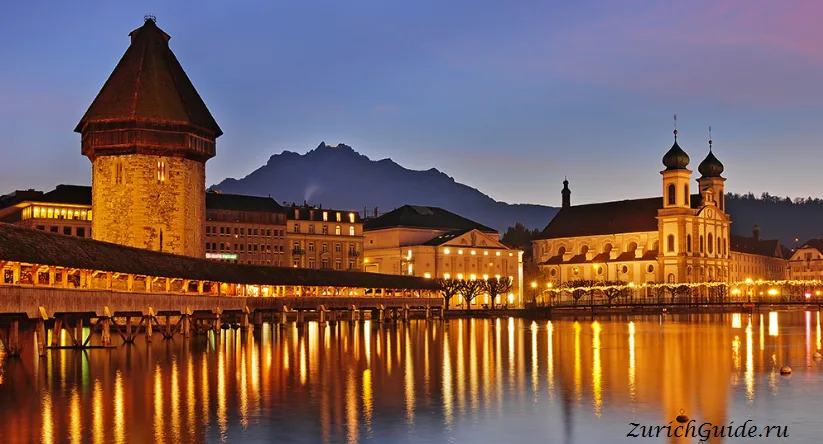
Lucerne is the town that ends up on the cover, and it deserves to. A painted old town on a green river, a covered wooden bridge crossing it at an angle, a lake running deep into the mountains, and the serrated ridge of Pilatus standing behind the whole arrangement.
It is 45 minutes from Zurich, which makes it the easiest good day trip in the country — and a better base than Zurich if mountains are what you came for.
The Kapellbrücke
The Chapel Bridge is the oldest surviving covered wooden bridge in Europe, built about 1365 as part of the town’s defences, crossing the Reuss diagonally with the octagonal Wasserturm beside it.
Under the roof are painted triangular panels from the seventeenth century, showing the history of the town and the lives of its patron saints. A fire in 1993 destroyed most of the bridge and around two thirds of the paintings; it was rebuilt within a year, and the surviving panels are noticeably darker than the replacements — you can read the fire in the ceiling as you walk.
Downstream, the Spreuerbridge is the less photographed one and the more affecting: its panels are a complete Dance of Death cycle from the 1620s, and they are original.
The Lion Monument
A dying lion, ten metres long, carved into a rock face above a pool in 1821, in memory of the Swiss Guards killed defending the Tuileries in 1792.
Mark Twain called it the saddest and most moving piece of stone in the world, and the description has stuck to it for a century and a half because it is accurate. It takes ten minutes to see and it is free.
The old town
Small, walkable and almost entirely painted: house fronts covered in frescoes around the Weinmarkt and the Hirschenplatz, two stretches of the medieval Musegg wall with towers you can climb for free, and a clock on the Zytturm that is permitted to strike one minute before all the others in town.
The lake
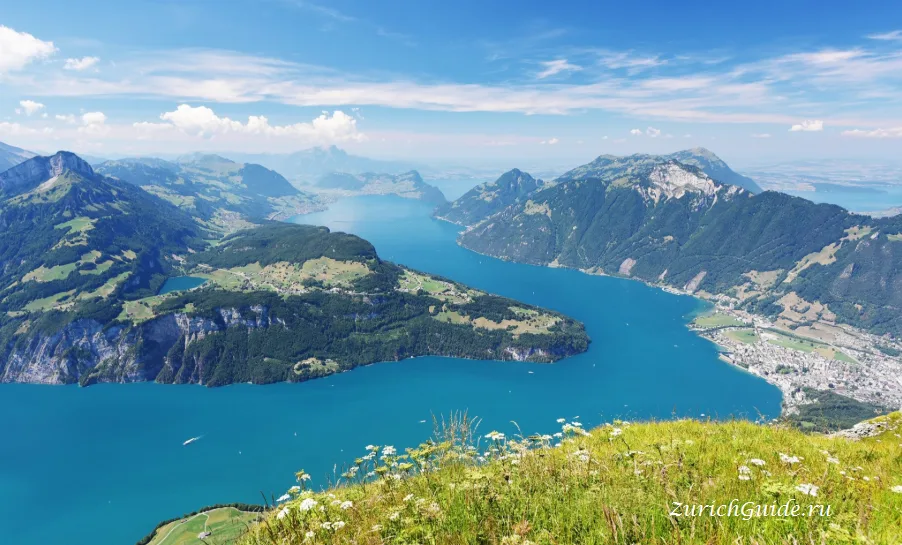
Lake Lucerne — Vierwaldstättersee, the lake of the four forest cantons — is the most dramatic in the country: it bends between cliffs into four arms, and the mountains come down to the water without a shoreline in places.
Scheduled boats, including five paddle steamers from the 1900s, leave from beside the station. They are public transport, covered by rail passes, and the run down to Flüelen through the narrows is one of the best afternoons in Switzerland. This is also the water leg of the Gotthard Panorama Express.
The lake is bound up with the founding myth: the Rütli meadow on the western shore is where the three cantons are said to have sworn the oath in 1291, and the chapel at Tellsplatte marks where Wilhelm Tell supposedly leapt from the boat.
The two mountains
Pilatus, 2,128 m, is reached by the steepest rack railway in the world — a gradient of 48% — from Alpnachstad, or by gondola and cable car from Kriens. The classic circuit is the “golden round trip”: boat, rack railway up, cable car down, bus back. The railway runs only from about May to November.
Rigi, 1,798 m, is gentler and older: the first mountain railway in Europe, opened in 1871, reached by boat and then cog railway. It has been a tourist mountain since the eighteenth century and there are thermal baths on the way up.
Both give the same view of the lake from opposite sides. Pilatus is more dramatic; Rigi is easier and open all year.
Fasnacht

Lucerne’s carnival begins at five in the morning on the Thursday before Lent with a cannon shot, and for the next five days the town belongs to masked figures and Guuggenmusigen — brass bands playing deliberately, gleefully out of tune.
It is louder, wilder and more chaotic than Basel’s, and the two are very different events. If you want the drums in the dark, go to Basel; if you want a party, come here.
Getting there
- By train — Zurich 45 minutes, Bern an hour, Interlaken two hours on the scenic Brünig line. The station is on the lake, beside the boat pier.
- By panoramic train — Lucerne is the northern end of both the GoldenPass and the Gotthard Panorama Express.
- Day trip or base — as a day trip from Zurich it works comfortably. As a base it is better than Zurich for the mountains and worse for everything else.
When to go
May to October, when the boats run at full frequency and Pilatus is open. February or March for Fasnacht. Winter is quiet and often under low cloud in the town — which is the argument for taking the railway up Rigi and getting above it.
Where to park in Lucerne
| Car park | Spaces | Fee | From centre |
|---|---|---|---|
| Parkhaus Flora underground | — | paid | 250 m |
| Schwanenplatz | 3 | — | 270 m |
| Seehof underground | — | paid | 300 m |
| Parkhaus Kesselturm multi-storey | 350 | paid | 380 m |
| Park and ride | 5 | paid | 430 m |
| Schweizerhof underground | — | paid | 460 m |
| Kasernenplatz underground | — | paid | 500 m |
| Parkhaus Altstadt multi-storey | 456 | paid | 500 m |
18 more are mapped nearby — see them on OpenStreetMap.
Data © OpenStreetMap contributors, ODbL licence, snapshot of 22 August 2026. The map is drawn by volunteers: the list is not complete, and a dash means “not recorded” — not “free” and not “no spaces”. This is not an official parking directory: when you get there, read the signs and the machine at the entrance.
Weather in Lucerne month by month
| Month | Day | Night | Rainfall |
|---|---|---|---|
| January | +4° | -2° | 56 mm |
| February | +6° | -2° | 61 mm |
| March | +11° | +2° | 75 mm |
| April | +15° | +5° | 96 mm |
| May | +19° | +9° | 149 mm |
| June | +23° | +13° | 164 mm |
| July | +25° | +15° | 166 mm |
| August | +24° | +14° | 170 mm |
| September | +20° | +11° | 109 mm |
| October | +14° | +7° | 88 mm |
| November | +8° | +2° | 78 mm |
| December | +5° | -1° | 78 mm |
Normals for 1991–2020 from MeteoSwiss, station Luzern, open data, version of 29 July 2026. Day and night are the average daily high and low, not records; rainfall is approximate. Current conditions from the Norwegian Meteorological Institute, CC BY 4.0.
Updated: