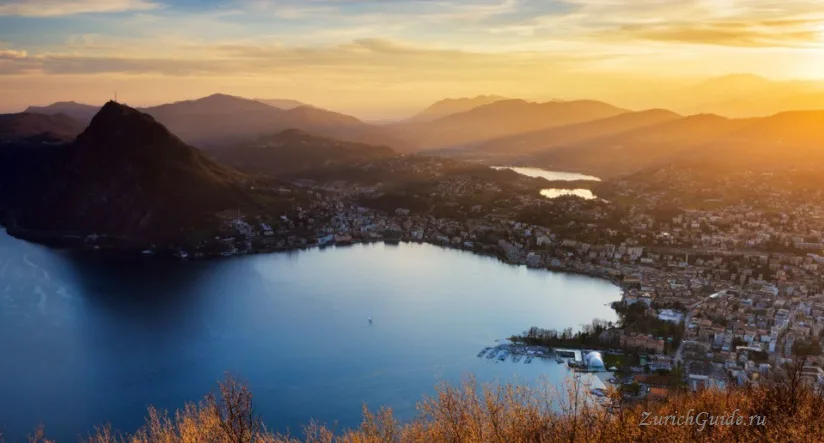
Lugano
Palm trees, piazzas and Italian spoken everywhere, on the southern side of the Alps and still in Switzerland.
Lugano is on the wrong side of the Alps, and that is the entire point. Cross the Gotthard and the language becomes Italian, the architecture becomes Lombard, the roofs go flat, palms and camellias appear, and the temperature rises several degrees.
It is the largest town in Ticino, the Italian-speaking canton, and the third financial centre of Switzerland after Zurich and Geneva — which is why a town of 65,000 has the shops it does.
Milan is under an hour away. Switzerland is behind the mountains. It does not feel like the same country as Zurich, because in most respects it is not.
The town
The station sits above the town; the centre and lake are downhill, either on foot down the old stepped lanes — the route that passes the Cathedral — or by funicular from the station forecourt to the main shopping streets, a short walk from the water.
The centre is small and made for walking: arcaded streets, a couple of piazzas where the town sits outside in the evening, and Piazza della Riforma with the neoclassical town hall on one side.
Santa Maria degli Angioli, by the lake, is a plain little sixteenth-century church containing a very large fresco of the Crucifixion by Bernardino Luini, a pupil of Leonardo. It fills the whole wall and it is the best thing in Lugano.
The Cathedral (Cattedrale di Lugano) keeps a dense run of old frescoes and painted statuary, in places overpainted centuries later by unrelated figures — on one pillar, the legs of an older fresco survive below a much newer image with no connection to it. It stands out against the plainer Protestant churches found elsewhere in Switzerland.
LAC — Lugano Arte e Cultura — is the modern cultural centre on the waterfront, with the art museum and a concert hall.
The lakefront promenade runs several kilometres under plane trees and magnolias, past the Parco Ciani and out along the water. This is what people come for.
The two mountains
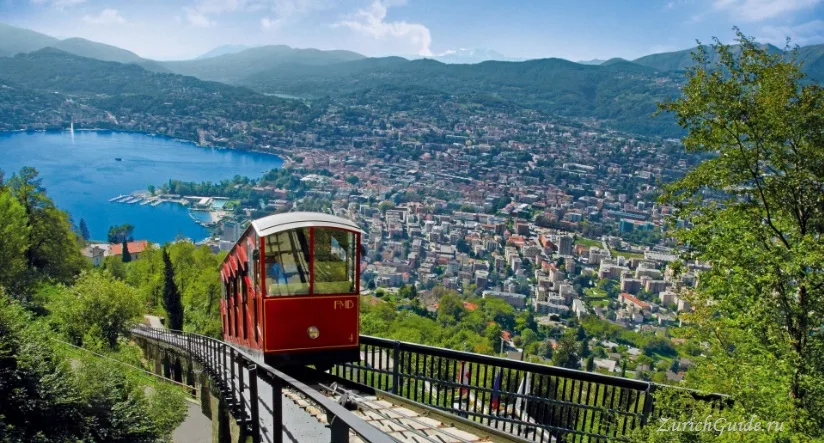
Monte Brè, 933 m, east of the town, is reached by funicular and claims to be the sunniest mountain in Switzerland. There is a small village at the top with an artists’ trail through it.
San Salvatore, 912 m, on the other side, is the pointed one you see from everywhere, also by funicular, with a chapel on the summit and the better view — the whole lake, the bay, and the Alps closing the north.
Both are half a morning. San Salvatore if you only do one.
Around the lake
Gandria is the village worth the boat: a cluster of houses stacked on the cliff at the water’s edge, no road through it, reached in twenty minutes from Lugano. The path back along the shore takes about an hour.
Villa Favorita, on the shore toward Gandria, once held what was said to be the second most valuable private art collection anywhere; around 800 of its paintings are now in Madrid.
Morcote, at the southern tip of the peninsula, is arcaded and steep, with a long stair up to a church above the roofs. It regularly wins the prize for the prettiest village in Switzerland.
Monte San Giorgio, across the water, is a UNESCO World Heritage site — not for scenery but for fossils: the mountain is the best record anywhere of marine life in the Middle Triassic, and the museum at Meride shows what came out of it.
Boats run to all of these from the Lugano pier and are covered by rail passes.
Melide, on the lake south of town and reached by train, is home to Swissminiatur, a park of the country’s landmarks built at 1:25 scale — Bern’s clock tower and Zurich’s Grossmünster among them. Mendrisio, further south near the Italian border, has the country’s largest outlet mall, with the main European fashion brands and, unusually for Switzerland, Sunday opening.
Museums
Lugano has several museums worth a wet afternoon: the Museo Cantonale d’Arte, showing contemporary Ticino painters; the Museum of Modern Art, in the Villa Malpensata; and, popular with children, the Alprose chocolate museum at nearby Caslano, which covers the history of chocolate and shows it being made.
Festivals
Lugano makes its own claim to the title of Switzerland’s jazz capital, rivalling Montreux, with an open-air jazz festival each July on the lakeside piazzas. In late August and early September the same streets fill for Blues to Bop, with free open-air concerts. Lugano also hosted the first Eurovision Song Contest.
Getting there
- By train — Zurich to Lugano is about two hours through the Gotthard Base Tunnel, the longest railway tunnel in the world at 57 km. You go in near Altdorf and come out in a different climate, which is a strange experience the first time.
- The scenic alternative — the old Gotthard line over the mountain, with its spiral tunnels, is slower and far better looking; the Gotthard Panorama Express runs it from Lucerne.
- By air — Milan Malpensa is about an hour and a half by coach, and often cheaper to fly into than Zurich.
What to eat
Ticinese food is northern Italian with a Swiss accent: risotto, polenta, luganighe sausage, and the lake fish. Eat in a grotto — a rustic country restaurant, originally a cool cellar cut into the rock, with granite tables under the trees and wine served in a boccalino, a small ceramic jug.
The local wine is Merlot, which Ticino planted after phylloxera and now does properly, including a white Merlot that exists almost nowhere else.
When to go
April to October. Spring is the best of it — camellias in March, everything green, and the summer crowds from over the Alps not yet arrived. July and August are hot and humid, and the Swiss come south in numbers.
Winter is mild but quiet, and a good share of the boats and funiculars run reduced timetables.
Lugano also keeps more winter sun than places north of the Alps, so a clear day in December is more likely here than elsewhere in Switzerland.
Where to park in Lugano
| Car park | Spaces | Fee | From centre |
|---|---|---|---|
| Piazza Riziero Rezzonico | — | paid | 80 m |
| Autosilo Motta multi-storey | 165 | paid | 150 m |
| P+Rail Lugano South | — | paid | 300 m |
| Casino | — | paid | 320 m |
| Autosilo San Giuseppe multi-storey | — | paid | 350 m |
| Autosilo Balestra multi-storey | 426 | paid | 460 m |
| Autosilo Piazza Castello underground | 242 | paid | 490 m |
| Autosilo Bettydo underground | 96 | paid | 540 m |
14 more are mapped nearby — see them on OpenStreetMap.
Data © OpenStreetMap contributors, ODbL licence, snapshot of 22 August 2026. The map is drawn by volunteers: the list is not complete, and a dash means “not recorded” — not “free” and not “no spaces”. This is not an official parking directory: when you get there, read the signs and the machine at the entrance.
Weather in Lugano month by month
| Month | Day | Night | Rainfall |
|---|---|---|---|
| January | +7° | +1° | 66 mm |
| February | +9° | +2° | 61 mm |
| March | +13° | +5° | 76 mm |
| April | +17° | +8° | 138 mm |
| May | +21° | +12° | 178 mm |
| June | +25° | +16° | 172 mm |
| July | +27° | +18° | 158 mm |
| August | +27° | +18° | 158 mm |
| September | +22° | +14° | 165 mm |
| October | +17° | +10° | 150 mm |
| November | +12° | +6° | 167 mm |
| December | +8° | +2° | 80 mm |
Normals for 1991–2020 from MeteoSwiss, station Lugano, open data, version of 29 July 2026. Day and night are the average daily high and low, not records; rainfall is approximate. Current conditions from the Norwegian Meteorological Institute, CC BY 4.0.
Updated: