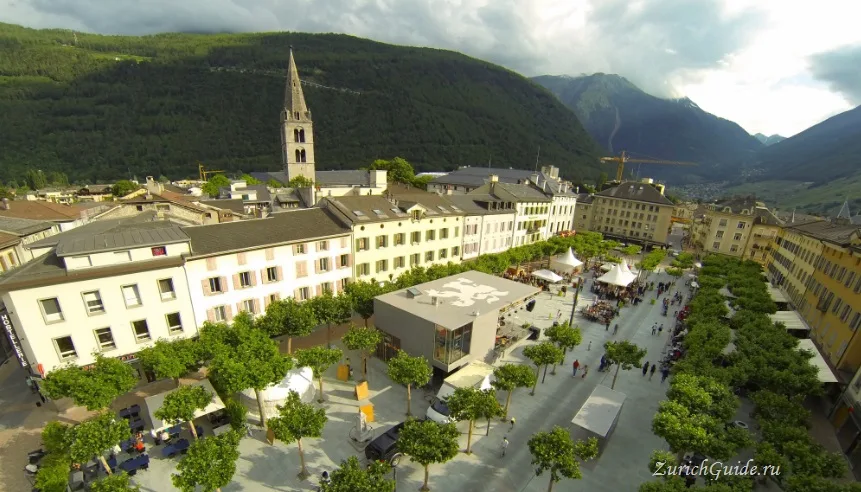
Martigny
A small town at the bend of the Rhône in Valais, where the road to the Great Saint Bernard begins, with a Roman amphitheatre, an art museum of international standing and a museum of the famous mountain dogs.
Martigny is a town of about 20,000 people in the French-speaking part of Valais, where the Rhône makes its great bend to the north towards Lake Geneva. It has always been a crossroads: here the road from the Rhône valley meets the routes over the Great Saint Bernard pass to Italy and the Col de la Forclaz to Chamonix. The Romans built a town here, and the medieval bishops, the dukes of Savoy and Napoleon all passed through.
Today it is a pleasant, lively small town with a shady main square, the Place Centrale, and three good reasons to stop: one of the best art museums in Switzerland, the remains of a Roman town, and the Saint Bernard dogs. It is also the gateway to Verbier.
What to see
Fondation Pierre Gianadda
In 1976 the engineer Léonard Gianadda found the remains of a Gallo-Roman temple while preparing to build on his land. Soon afterwards his brother Pierre died in a plane crash, and Léonard created a foundation in his memory, built around the ruins. It has become one of the most visited museums in Switzerland, known for its major art exhibitions, usually several a year, with loans from the great museums of the world.
The building also houses a Gallo-Roman museum with finds from the excavations at Martigny and a museum of vintage cars, and the garden around it is a sculpture park with works by Rodin, Miró, Henry Moore and many others.
The Roman town
Martigny was the Roman Forum Claudii Vallensium, the capital of Roman Valais. Around the town you can see:
- The amphitheatre, which held about 5,000 spectators and was restored in 1978. In early October, during the Valais fair, it hosts the final of the famous cow fights, in which Hérens cows, a local breed, push each other head to head to decide the queen of the herd.
- The remains of a temple precinct, baths and houses near the Rue du Forum, and a Mithraeum, a sanctuary of the god Mithras.
See Roman Switzerland for the other Roman sites in the country.
Barryland: the Saint Bernard dogs
The Saint Bernard dogs were bred by the monks of the hospice on the Great Saint Bernard pass, who used them for centuries to find travellers lost in the snow. The most famous of them, Barry, is said to have saved more than forty lives in the early 1800s. The Barryland museum, in an old arsenal next to the amphitheatre, tells their story, and you can meet the dogs themselves in a park next door. It is a favourite with children.
In summer the dogs also spend time at the hospice on the pass itself, about an hour’s drive south, at almost 2,500 m.
The old town and the Bâtiaz castle
- The Château de la Bâtiaz, a medieval castle on a rock above the town, with a round keep and fine views over the Rhône valley. Visits are by guided tour.
- The covered wooden bridge of La Bâtiaz over the Drance.
- The church of Notre-Dame-de-la-Visitation, one of the best Baroque churches in Valais, and the chapel of Notre-Dame-de-Compassion at La Bâtiaz, with a Baroque altar and a collection of votive paintings.
- The Maison Supersaxo, from the 15th century, said to be the oldest house in town, and the old village of Martigny-Bourg, with its square and old houses.
- The Moulin Semblanet, a restored late-18th-century mill.
Around Martigny
- The Gorges du Trient, a narrow, deep gorge a few kilometres away near Vernayaz, with a walkway along the torrent, open roughly from May to October. Nearby, the Pissevache waterfall drops more than a hundred metres beside the main road.
- The Great Saint Bernard pass and its hospice, open to cars in summer; see mountain passes.
- Verbier, the big ski resort, up the Val de Bagnes.
- Sion, the capital of Valais, half an hour by train up the valley.
- The vineyards on the slopes around Martigny, part of the largest wine region in Switzerland; see Swiss wine.
Mountain roads such as the Great Saint Bernard and the Forclaz can close early in autumn and stay closed into late spring, and gorge walkways close when there is a risk of rockfall. Check before you go.
Getting there
- By train from Geneva: direct trains run along the lake and up the Rhône valley, taking about an hour and a half from Geneva and a little more from Geneva Airport.
- From Zurich: change at Lausanne or, via the Lötschberg tunnel, at Visp; the trip takes about three hours.
- Mont-Blanc Express: a narrow-gauge train runs from Martigny over the mountains to Chamonix.
- The station is a short walk from the centre.
For fares and passes, see tickets and passes.
This page in Russian: Мартиньи (Martigny)
Updated: