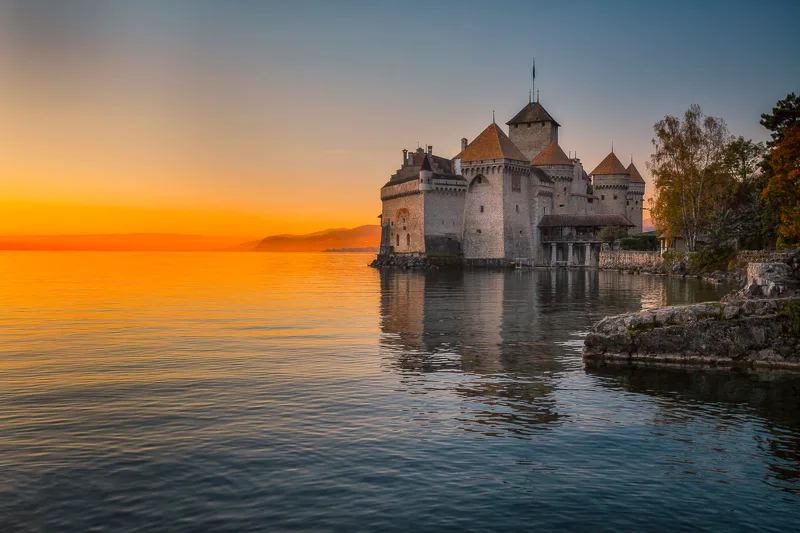
Montreux
A mild strip of lakefront where palm trees grow at the same latitude as Vienna, with a thirteenth-century castle on the water at one end.
Montreux sits at the eastern end of Lake Geneva, in a fold of hills that shelters it from the north wind. The result is a microclimate mild enough for palm trees, magnolias and cypresses to grow outdoors at the latitude of Vienna, which is why the nineteenth century built a row of Belle Époque hotels along the water and called it the Swiss Riviera.
The town itself is a strip: a promenade several kilometres long, hotels on one side, lake on the other, and mountains rising behind. Most of what you come for is on that strip or a short walk from it.
Beyond Chillon and the lakefront walk, Montreux itself is thin on sights: much of what fills the days here is lake cruises, vineyard excursions and time spent in expensive hotels and restaurants.
Château de Chillon
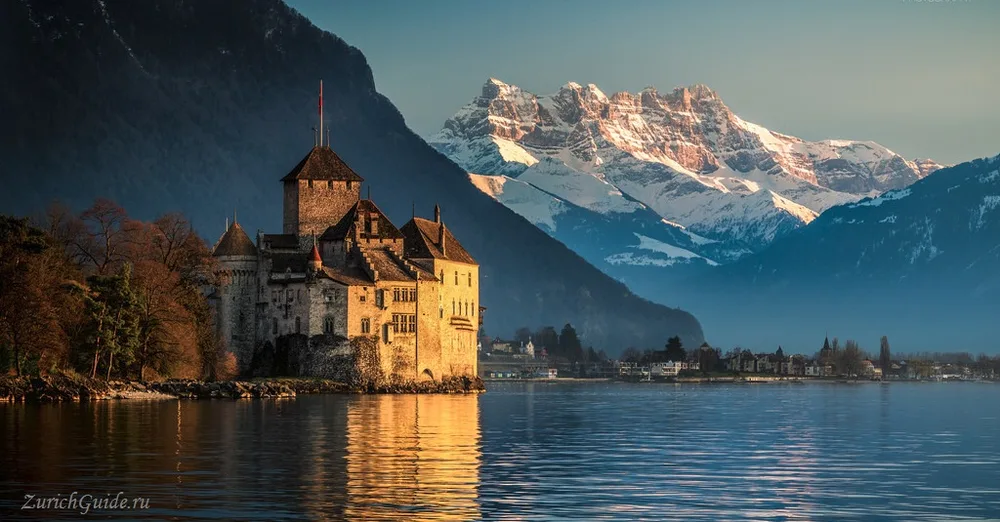
The most visited historic building in Switzerland, and it earns it.
Chillon stands on a rock in the lake connected to the shore by a bridge, three kilometres from the centre of Montreux. There has been a fort here since the Bronze Age; the castle as it stands was built by the Counts of Savoy from the twelfth century to control the road between northern Europe and Italy, which had to pass along this shore.
The castle’s position, squeezed between the lake and the mountainside, let its owners collect tolls from traffic on the road below for centuries, and its outward appearance has changed little since the middle of the thirteenth century.
Inside, some twenty-five buildings around four courtyards: the great halls with painted ceilings, the chapel, the bedchambers, and — the reason most people come — the vaulted underground dungeons cut into the rock, with the lake on the other side of the wall.
François Bonivard was chained down there for four years in the 1530s for supporting Geneva’s independence. Byron visited in 1816, wrote The Prisoner of Chillon, and carved his name into a pillar. The graffito is still there and is now itself an exhibit, which Byron would have enjoyed.
Getting there: bus 201 along the shore, the boat from Montreux pier, or a 45-minute walk along the lakeside path — the last of which is the best, and free.
From the station, an escalator by one of the hotels leads straight down to the lakefront and the small port, where the boats leave and the tourist office is based. Facing the lake, the castle is off to the left. As an alternative to walking, a suburban train (line S1) runs roughly every half hour to Veytaux-Chillon, one stop short of the castle.
The lakefront
A promenade runs from Vevey to Villeneuve, planted with subtropical trees and sculptures, and walking a stretch of it is the main activity in Montreux.
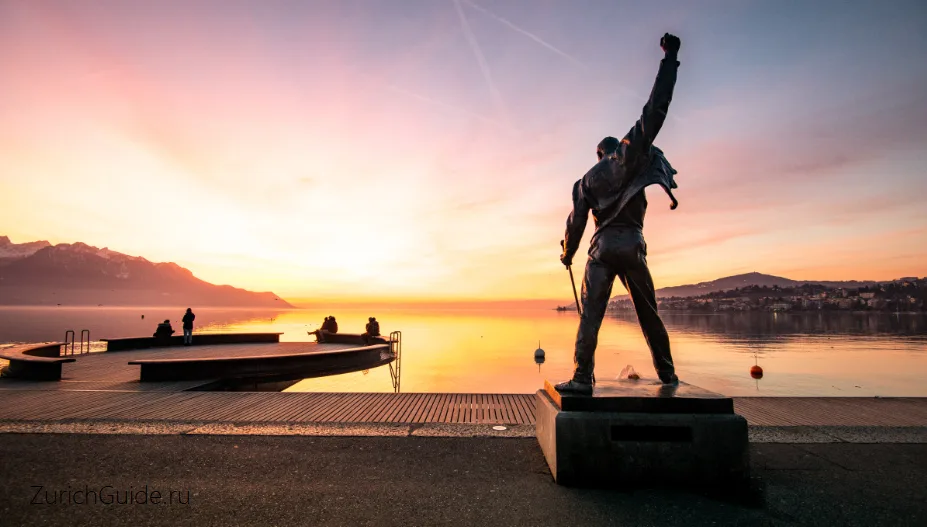
Freddie Mercury lived in Montreux for the last years of his life and recorded here; Queen owned Mountain Studios in the casino building. The statue on the quay, three metres of him with a fist in the air facing the lake, has become the town’s second landmark — there are usually flowers at the base. The studio is preserved as a free exhibition inside the casino.
Mercury is said to have chosen Montreux for its quiet. He recorded Queen’s last album with him, Made in Heaven, at the studio here, and died in 1991. Each September, fans still gather in the town to mark the anniversary.
Vladimir Nabokov
Vladimir Nabokov spent his last years at the Montreux Palace, one of the town’s grandest hotels, which now keeps a small exhibition and a monument to him. His family left Russia after the 1917 revolution; he lived afterwards in Germany, then France, then the United States, before settling in Montreux for good in 1961.
Montreux Jazz Festival
Two weeks in early July, and the second-largest jazz festival in the world — though “jazz” stopped being accurate decades ago and the bill now runs from blues to hip-hop to whatever is large that year.
It fills the town completely: paid concerts in the halls, free stages along the lakefront, and every hotel bed for thirty kilometres taken. If you want to go, book in the winter. If you do not, avoid those two weeks entirely — prices double and you will not get a table.
Above the town
The Rochers-de-Naye cog railway climbs from Montreux to 2,042 m in an hour, through vineyards and forest to a bare summit with the whole lake below and Mont Blanc across it. There is an alpine garden at the top, and a marmot enclosure that exists mainly for children.
The summit also looks out over the Jura mountains on the far side of the lake. The alpine garden, La Rambertia, grows more than a thousand species of plants and is free to visit in summer, when it is open; the marmot enclosure has a free, year-round exhibition alongside it. In winter the same slopes become a small ski area.
The old town
Musée de Montreux, at the edge of the old town on the site of the former village of Sales, occupies a row of seventeenth-century winegrowers’ houses that count among the architectural treasures of the canton of Vaud. Its collections cover the town’s history — coins, flat-irons, carpenters’ tools, household items — with a notably large holding of embroidery thimbles and lace-making equipment. A further display covers four regional themes: history, land, tourism and hospitality, and three rooms recently restored with the help of donations are given over to the writers, musicians and other artists who have lived in the region.
Maison Visinand, also in the old town, is a listed building that now houses a cultural centre with an exhibition hall and rooms used for classes, workshops and conferences.
Getting there
- By train — Geneva about an hour, Lausanne 25 minutes, Bern an hour and a half, Zurich about three hours.
- By boat — the Lake Geneva steamers call here from Lausanne, Vevey and Geneva; the paddle steamers are the pleasant way to arrive.
- By panoramic train — Montreux is the southern terminus of the GoldenPass from Lucerne and Interlaken.
- From the airport — if Montreux is the main destination, Geneva’s airport is much closer than Zurich’s; the journey takes a bit over an hour, sometimes with a change at Lausanne.
Saving money
Hotels, and some private schools and clinics, hand out the Montreux Riviera Card free to their guests. It gives free travel on the local VMCV bus and boat network, a discount on regional trains and boats, and reduced entry to many museums and parks.
Travellers covering more ground can buy a regional pass covering the area from Lake Geneva to the Alps, valid on trains, boats, buses and funiculars: a few days of unlimited travel followed by further days at half price. It is sold at tourist offices, stations and the lake ports, with a cheaper version for children.
What to combine it with
Montreux sits at one end of a very good day:
- Lavaux — the UNESCO vineyard terraces begin immediately west of here, and the walk between the wine villages is the best thing on this shore
- Vevey — ten minutes along the lake, with a good market square and the Chaplin museum in the house where he spent his last 25 years
- Geneva — an hour, at the other end of the lake
- The Chocolate Train — a scenic service from Montreux through Gruyères and Broc, into the cheese-and-chocolate country of canton Fribourg
- Villeneuve — a small, quiet town right at the eastern tip of the lake, where the promenade ends
- Aigle — inland in the Rhône valley, known for its vineyards and a castle that now houses a wine museum
Vevey itself was once a favoured retreat of the Russian aristocracy; a small Orthodox church near the station is what remains of that period.
When to go
May, June and September — warm, the promenade in flower, and no festival crowds. December brings one of the largest Christmas markets in Switzerland along the lakefront. July is the festival, which is either the reason to come or the reason not to.
Winter is mild by Swiss standards and the lake rarely looks better than under low cloud with the Alps showing through.
Where to park in Montreux
| Car park | Spaces | Fee | From centre |
|---|---|---|---|
| Marché-Forum underground | — | — | 280 m |
| Multi-storey car park | — | paid | 500 m |
| Parking de la Gare de Montreux multi-storey | — | paid | 510 m |
| Open car park | 39 | paid | 560 m |
| Open car park | 28 | paid | 1.1 km |
Data © OpenStreetMap contributors, ODbL licence, snapshot of 22 August 2026. The map is drawn by volunteers: the list is not complete, and a dash means “not recorded” — not “free” and not “no spaces”. This is not an official parking directory: when you get there, read the signs and the machine at the entrance.
Weather in Montreux month by month
| Month | Day | Night | Rainfall |
|---|---|---|---|
| January | +5° | -2° | 68 mm |
| February | +7° | -2° | 58 mm |
| March | +11° | +1° | 63 mm |
| April | +15° | +4° | 65 mm |
| May | +19° | +9° | 94 mm |
| June | +23° | +12° | 96 mm |
| July | +25° | +14° | 118 mm |
| August | +25° | +13° | 110 mm |
| September | +20° | +10° | 80 mm |
| October | +15° | +6° | 77 mm |
| November | +10° | +1° | 75 mm |
| December | +6° | -1° | 80 mm |
Normals for 1991–2020 from MeteoSwiss, station Aigle, open data, version of 29 July 2026. Day and night are the average daily high and low, not records; rainfall is approximate. Current conditions from the Norwegian Meteorological Institute, CC BY 4.0.
Updated: