Morges
A small lakeside town between Geneva and Lausanne, with a spring tulip festival, a castle full of toy soldiers, and the village where Audrey Hepburn lived for thirty years.
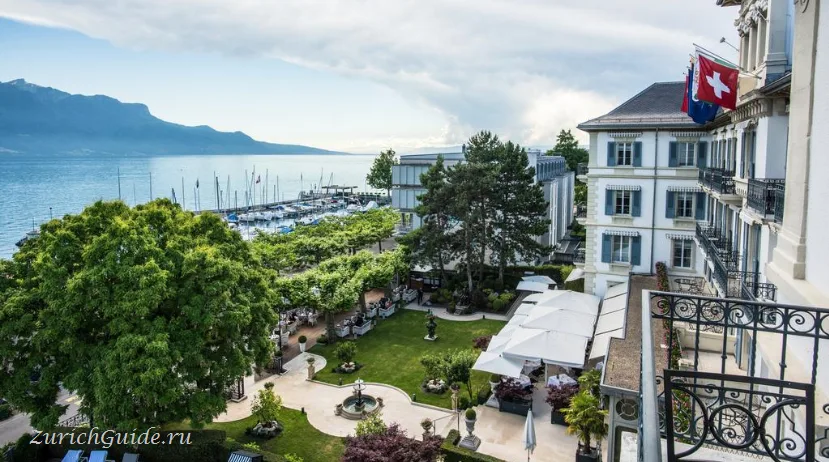
Morges sits on Lake Geneva between Geneva and Lausanne, in the wine country of La Côte, and it is the quiet alternative to both — a small town with an arcaded main street, a harbour, and Mont Blanc filling the view across the water.
The lakefront
The lake promenade, the Quai du Dahlia, runs for about a kilometre along the water, and between it, the hotels and the restaurants, Morges counts as one of the better places to break a journey along this shore of the lake. The harbour is now a stopping point for yachts from around the world; the site is said to have held a port here since prehistoric times.
The tulips
The Fête de la Tulipe runs from about the end of March into early May in the Parc de l’Indépendance on the lakefront, with something over a hundred thousand bulbs in several hundred varieties.
It has been held since 1971 and it is free. For a few weeks in spring it is the reason to come, and it lines up with the blossom on the vineyard slopes behind.
The castle
Château de Morges, thirteenth-century, square with round corner towers, standing at the edge of the water. It was built by the Savoy dukes as part of the same chain as Chillon.
Inside are four museums, and the one that surprises people is the figurine museum — around ten thousand model soldiers arranged into historical battles, which is either eccentric or wonderful and is certainly unexpected.
There is also the Vaud military museum and an artillery collection.
It was built in 1286 for the House of Savoy, originally ringed by a moat, to guard against the bishops of Geneva. From 1536 to 1798 it served as the residence of the Bernese bailiffs who governed the area on Bern’s behalf. The Vaud military museum’s own collection spans the fifteenth century to the present.
The old town
From the station, Rue de la Gare runs down to the castle, with the old town on the left and the lake straight ahead. The old town’s main street, Grand-Rue, crosses the whole centre, from Rue de la Gare at one end to a white-fronted church at the other.
The Musée Alexis Forel, on Grand-Rue, occupies a fifteenth-century townhouse and shows a private collection of prints, seventeenth- and eighteenth-century furniture, eighteenth-century silver and glass, old pottery and antique dolls, set out as a furnished home rather than a conventional museum.
A market sets up on Grand-Rue every Wednesday and Saturday, selling local fruit, vegetables and other produce.
Audrey Hepburn
Hepburn lived at Tolochenaz, a village on the edge of Morges, from 1963 until her death in 1993, and is buried in the small cemetery there. She chose the place for privacy and got it — the village made no fuss then and makes little now.
There is a plaque, a rose named for her in the town, and a modest permanent display. It is not a shrine, which is presumably why she stayed.
In January 1969, at the age of thirty-nine, she married the Italian psychiatrist Andrea Dotti in Morges itself.
Velcro
The nearby Château de Saint-Saphorin-sur-Morges was for a time a home of the Mestral family. Georges de Mestral (1907–1990), a Swiss engineer, is said to have hit on the idea for Velcro in 1948 after a trip to a shooting range in the Jura mountains, when he noticed how long it took to pick burrs out of the fur on his dog’s ears. He patented the idea and began manufacturing nearby, at Aubonne. The name comes from the French velours (velvet) and crochet (hook), and has since become the generic term for hook-and-loop fastener.
La Côte
The vineyard slopes behind the town are the largest wine region of canton Vaud — larger than Lavaux along the lake to the east, though less dramatic and far less known. Chasselas again, and a marked path runs through the villages with cellars open at weekends in season.
A signed cycling route runs the length of the vineyards. Bicycles can be hired at the station, and the tourist office has maps and route advice.
Getting there
- By train — Lausanne 10 minutes, Geneva 25 minutes. It is on the main line, and trains are frequent.
- By boat — the lake steamers call here.
- On foot — the castle, the harbour and the park are all within five minutes of the station.
- From Zurich — a little over two hours by direct train, or around two hours twenty minutes changing onto the lakeshore line at Lausanne or Geneva, which runs at least every half hour.
- Passes — a regional pass covering trains, boats, buses and funiculars between the lake and the Alps can be bought at the tourist office or any station; see tickets and passes.
Nearby
- Saint-Prex — a medieval walled village on a promontory, ten minutes west
- Aubonne and the arboretum — a large collection of trees above the town
- Lausanne — ten minutes, and the cathedral
- Lavaux — half an hour east, on the other side of Lausanne
- La Sarraz — a castle and a small museum devoted to horses
- L’Isle — a modest castle by the source of the river Venoge
- Parc jurassien vaudois — a nature park in the Jura foothills of canton Vaud
Aubonne, above, also has a castle of its own alongside the arboretum.
When to go
April for the tulips, which is the town’s moment. May to September for the lake and the wine. Out of season it is a quiet residential town and there is not a great deal to detain you.
Nearby
Other places on this site within easy reach, as the crow flies:
This page in Russian: Морж (Morges)
Where to park in Morges
| Car park | Spaces | Fee | From centre |
|---|---|---|---|
| Parking des Charpentiers underground | — | paid | 150 m |
| Parking du Temple | 30 | paidmax 2 h | 210 m |
| Navigation | 11 | paidmax 30 min | 260 m |
| Dufour | — | paid | 260 m |
| Underground car park | — | paid | 260 m |
| P+R Morges underground | 426 | paid | 300 m |
| Underground car park | — | paid | 670 m |
| La Blancherie | — | paid | 750 m |
2 more are mapped nearby — see them on OpenStreetMap.
Data © OpenStreetMap contributors, ODbL licence, snapshot of 22 August 2026. The map is drawn by volunteers: the list is not complete, and a dash means “not recorded” — not “free” and not “no spaces”. This is not an official parking directory: when you get there, read the signs and the machine at the entrance.
Weather in Morges month by month
| Month | Day | Night | Rainfall |
|---|---|---|---|
| January | +5° | +1° | 75 mm |
| February | +6° | +1° | 64 mm |
| March | +11° | +4° | 72 mm |
| April | +15° | +7° | 84 mm |
| May | +19° | +11° | 113 mm |
| June | +23° | +15° | 107 mm |
| July | +26° | +17° | 103 mm |
| August | +25° | +17° | 110 mm |
| September | +20° | +13° | 98 mm |
| October | +15° | +10° | 111 mm |
| November | +9° | +5° | 99 mm |
| December | +6° | +2° | 98 mm |
Normals for 1991–2020 from MeteoSwiss, station Pully, open data, version of 29 July 2026. Adjusted to the elevation of the place. Day and night are the average daily high and low, not records; rainfall is approximate. Current conditions from the Norwegian Meteorological Institute, CC BY 4.0.
Updated: