
Murten
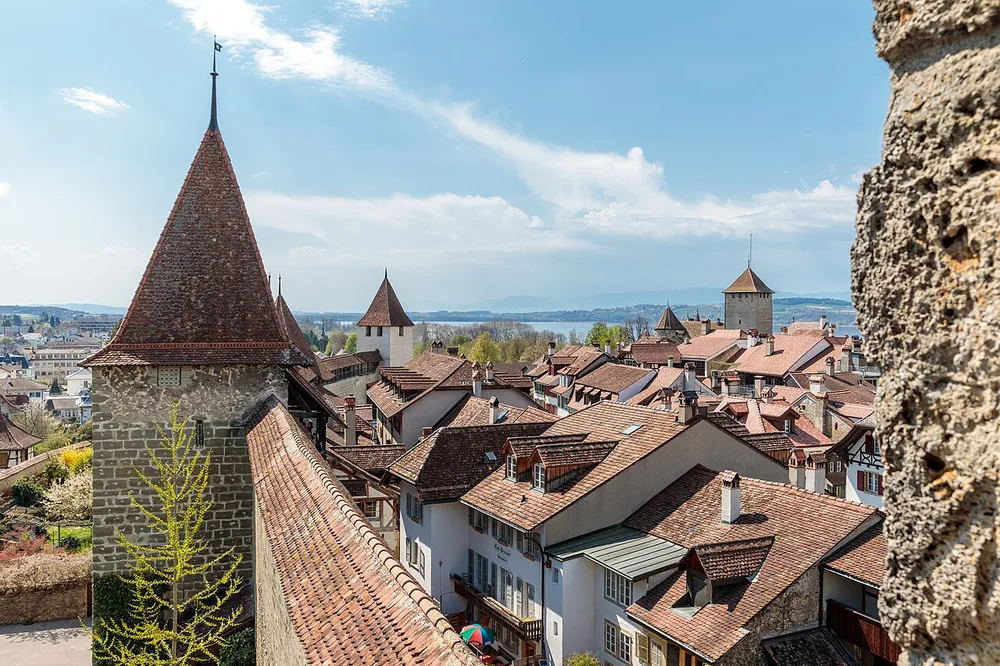
One of the best-preserved medieval towns in Switzerland, on the shore of Lake Murten on the language border, where you can walk the whole length of the town walls and look out over the roofs to the lake and the Jura.
Murten, in French Morat, is a small town on the eastern shore of Lake Murten, in the canton of Fribourg, right on the border between German- and French-speaking Switzerland; it is officially bilingual, with a German-speaking majority. Its old town, still entirely enclosed by its medieval walls, is one of the best preserved in the country, and it is small enough to see in an hour or two, which makes it an easy and very pretty day trip from Bern, Fribourg or Neuchâtel, and even from Zurich.
A short history
The name comes from a Celtic word meaning “fortress by the lake”. The dukes of Zähringen founded the town in the 12th century on a regular plan, which it has kept ever since, and in the 13th century it passed to the counts of Savoy, who built the castle.
Murten is famous above all for the battle of Murten in 1476. Charles the Bold, Duke of Burgundy, besieged the town, held by a Bernese garrison, and on 22 June the army of the Swiss Confederates fell on his camp and crushed his army, many of his soldiers drowning in the lake as they fled. It was one of the great victories of the old Confederacy. Afterwards Bern and Fribourg ruled the town together for more than three centuries, until it became part of the canton of Fribourg in 1803. The anniversary is still celebrated every year around 22 June with the Solennität, a festival of the town’s children and young people.
What to see
The ramparts
The great sight of Murten is its town wall, built between the 12th and 15th centuries, with its towers. A covered wooden walkway runs along the inside of the wall, and you can climb up and walk a long stretch of it, looking out over the roofs of the old town to the lake and the hills of the Jura on one side, and the countryside on the other. It is free and open all day.
The old town
The old town is laid out along three parallel streets. The main street, the Hauptgasse, is lined with arcades and with houses of the 16th to 18th centuries, with colourful shutters, shops, cafés and restaurants; with its arcades it looks like a small, painted version of the old town of Bern. At its eastern end stands the Bern Gate (Berntor), rebuilt in the Baroque style in the 18th century, with an old clock. Near the lake side of the town are the town hall and the French church, from whose terrace there is a fine view over the lake.
The castle and the museum
At the western end of the old town, the castle, built by Peter II of Savoy in the 13th century, has a courtyard you can enter, with a view over the lake. Below it, by the lake, the Museum Murten, in an old mill with water wheels, tells the history of the town and of the battle, with finds and weapons from the 15th century.
The lake
From the old town, steps lead down to the lakeside, with a promenade, a beach and a harbour. In summer, boats sail across the lake and, through canals, on to the lakes of Neuchâtel and Biel: the three-lakes cruise is one of the most relaxing boat trips in Switzerland. Across the water rises the Mont Vully, a hill covered with vineyards on its southern slope, with walks and views over the three lakes. See Swiss lakes.
What to eat
Try the Nidelkuchen, or gâteau du Vully, the local cake, a thin, flat yeast dough covered with sweet cream and sugar and baked until golden. The vineyards of the Vully, across the lake, produce fresh white wines from the Chasselas grape and red wines; the lake gives perch and whitefish.
Around Murten
- Avenches, the Roman capital of Switzerland, a few minutes by train, with its amphitheatre and Roman museum.
- Fribourg, a bilingual medieval town on a bend of the Sarine, about half an hour away.
- Neuchâtel and Biel, by train or by boat across the three lakes.
- Payerne, with its great Romanesque abbey church.
Safety
Swim only at the beaches and bathing places, well away from the harbour and the routes of the boats. Storms can rise quickly over the lake on summer afternoons: when the storm warning lights around the lake start flashing, get out of the water and bring boats ashore. On the ramparts the stairs are steep and narrow; hold the handrail and keep an eye on small children.
Getting there
- By train: from Zurich, take a train to Bern, Fribourg or Neuchâtel and change there for Murten; the trip takes about an hour and three quarters to two hours. From Bern, regional trains run to Murten in about 35 minutes. The station is a short walk from the old town.
- By boat: in summer, from Neuchâtel and Biel across the three lakes.
- By car: Murten is just off the A1 motorway between Bern and Lausanne. Leave the car in the car parks outside the walls; the old town is best seen on foot.
For fares and passes, see tickets and passes.
This page in Russian: Муртен
Updated: