Neuchâtel
A town built in ochre limestone on its own lake, with the purest French in Switzerland and the birthplace of mechanical watchmaking above it.
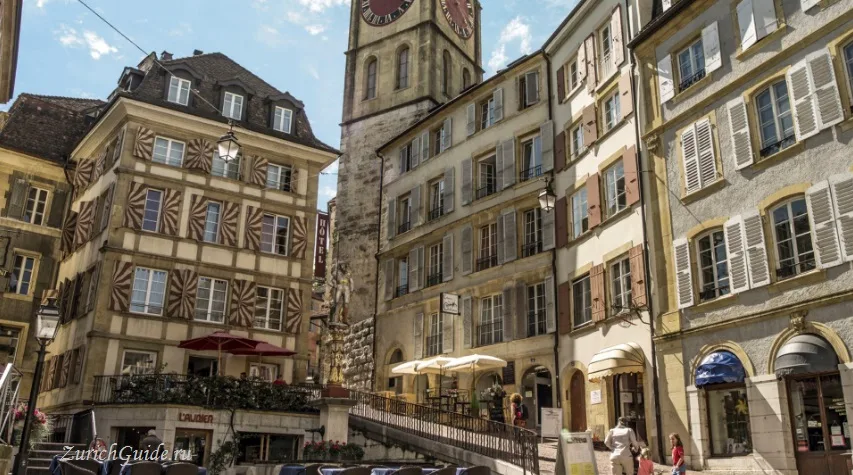
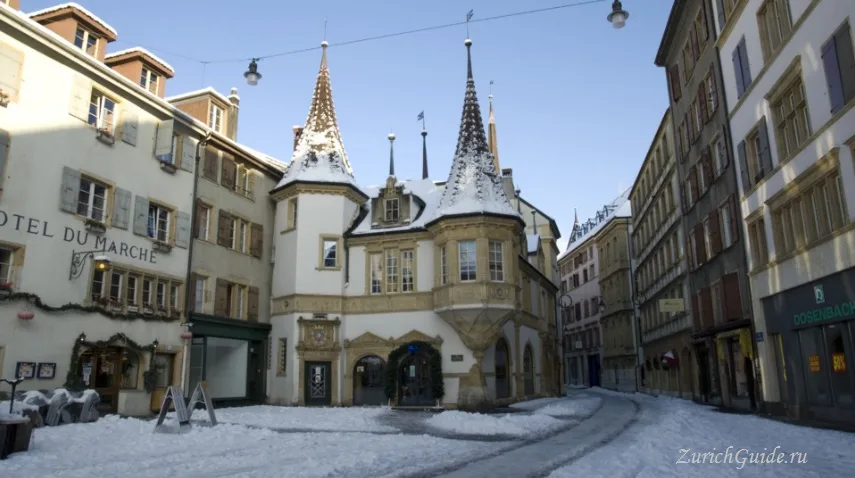
Neuchâtel is built out of a local yellow limestone, which gives the whole old town a warm ochre colour unlike anywhere else in Switzerland — Alexandre Dumas described it as a town carved out of butter, and the description has followed it ever since.
It sits on the largest lake entirely inside Switzerland, in the French-speaking west. Local pride holds that the purest French in the country is spoken here, and the claim is repeated often enough that it may as well be true.
The canton was created in 1815, when a Prussian principality centred on the town joined the Swiss Confederation at the Congress of Vienna. Neuchâtel itself means “new castle” — Neuenburg in German. The population is largely Protestant, and the town is one of the sources of Swiss watchmaking: Abraham-Louis Breguet, founder of the watch house that still carries his name, was born here.
The old town
Compact, steeply stacked and almost entirely in that yellow stone.
At the top sit the castle and the collegiate church together. The castle is twelfth-century, still the seat of the cantonal government, and free to walk into. The church next to it holds the cenotaph of the Counts of Neuchâtel — fifteen painted figures from 1372, the most important Gothic monument of its kind north of the Alps.
Below, the Maison des Halles stands in the market square, and the streets are punctuated by fountains, of which the Fontaine du Banneret is the one to find.
From the station, Avenue de la Gare runs downhill into the old town, with the castle ahead and the lake to the left; a funicular also drops to the lakeshore, passing the Musée d’Art et d’Histoire.
The yellow stone came from quarries near the village of Hauterive, along the lake, and was valued for being workable yet durable. Those quarries are now closed, and what remains of the stone is kept in reserve for restoring buildings such as the collegiate church.
The castle’s oldest part, the west wing, dates from the twelfth century; the rest was added across the fifteenth to seventeenth centuries, and stretches of the ramparts give a wide view back over the old town. The collegiate church next to it was built mostly in the twelfth and thirteenth centuries, though its west tower — the most visible part from below — is a nineteenth-century addition from a full restoration. A statue of William Farel, who brought the Reformation to the town, stands at the entrance.
West of the old town, the Hôtel du Peyrou, a grand town house of 1764, was built for a friend and publisher of Jean-Jacques Rousseau.
The Tour des Prisons, a surviving tower from the old fortifications, held the town’s prisoners until 1850 and gives a wide view from the top. Among the old town’s other fountains, look for the Fontaine du Griffon (1664), near the steps up to the castle, and the Fontaine de la Justice, at the corner of Rue de l’Hôpital and Grand-Rue, carved in the 1540s by Laurent Perroud.
The automata
The single most remarkable thing in the town, and hardly anyone outside Switzerland has heard of it.
In the 1770s Pierre Jaquet-Droz and his son built three clockwork figures: a boy who writes any text of up to forty characters, a draughtsman who draws four different pictures, and a musician who plays a real organ, follows her fingers with her eyes and breathes.
They still work. They are in the Musée d’Art et d’Histoire, and they are demonstrated on the first Sunday of the month. The writer is programmable by a set of cams — which is why they are routinely described as the ancestors of the computer, and why the museum is worth timing a visit around.
Other museums
Three more museums are worth knowing about. The Natural History Museum covers the animals and birds of Switzerland in reconstructed habitats and keeps a vivarium. The Ethnography Museum holds collections from ancient Egypt and the Himalayas, including Bhutan and Tibet. The Centre Dürrenmatt, on the hillside above the town, is devoted to the Swiss writer and painter Friedrich Dürrenmatt, who moved to Neuchâtel in 1952 and spent the last thirty-eight years of his life there; the building holding his paintings and archive was designed by the Ticino architect Mario Botta.
The lake
Lac de Neuchâtel is 38 km long, the largest lake wholly within Switzerland, and much quieter than Geneva or Lucerne. Boats run along it and through canals to the neighbouring lakes of Biel and Murten — the three-lakes cruise is a full and pleasant day.
The shore is flat, which makes the lakeside cycle path easy, and the southern side is a nature reserve of marshland and reeds full of birds.
Above the town: watch country
The Jura rises behind Neuchâtel, and the valleys up there are where the modern watch industry was made. La Chaux-de-Fonds and Le Locle, half an hour up, are UNESCO World Heritage — not for beauty but for town planning: both burned down and were rebuilt on a strict grid designed around watchmaking workshops, with streets aligned to bring daylight into the benches.
Le Corbusier was born in La Chaux-de-Fonds, and the town has several of his early buildings.
The Musée International d’Horlogerie there is the serious watch museum of Switzerland.
Further along the valley is the Val-de-Travers, where absinthe was invented in the 1790s, banned in 1910, distilled illegally for most of a century, and legalised again in 2005. The distilleries are open to visitors and take the history lightly.
The village of Motiers, further up the valley, has one of the distilleries open to visitors, along with a small castle and a local-history museum.
Creux du Van, a horseshoe of cliffs around 200 metres high and close to a kilometre across, is the valley’s other reason to come up from the lake — a rock amphitheatre cut by glacial erosion, reachable on foot from Noiraigue or by the hourly train.
Day trips
Chaumont, the ridge above the town at 1,100 metres, gives a panorama across the Bernese Alps, Mont Blanc and the Jura’s three lakes; a funicular covers most of the climb.
Valangin, a small castle two kilometres out, keeps period furniture, weapons and local lace inside its walls.
A cruise to Murten, a walled medieval town on its own lake, said to be one of the best-preserved old towns in the country, makes a full and easy day out.
Getting there
- By train — Zurich about an hour and a half, Bern 35 minutes, Geneva an hour and a quarter.
- By boat — from Biel and Murten in season.
- Other direct trains — to La Chaux-de-Fonds, to Fribourg changing at Murten, and to Lausanne changing at Yverdon.
What to eat and drink
The lake fish, particularly perch fillets. The local white wine is Chasselas, as in Lavaux, and the region also makes Œil-de-Perdrix, a pale rosé of Pinot Noir that was invented here.
And absinthe, which is served properly with a slotted spoon and iced water and is stronger than it tastes.
Fondue neuchâteloise — gruyère and emmental melted together — is the reference version of the dish elsewhere in Switzerland. A lighter option is tomme neuchâteloise chaude, a baked disc of local goat’s cheese served as a starter.
When to go
Late September for the Fête des Vendanges, the wine harvest festival — the largest autumn festival in Switzerland, with a corso of flowers and several hundred thousand visitors in a town of 33,000.
Earlier in the year there is a smaller jazz festival, the Fête de la Chandeleur, in February, and FestiNeuch, an open-air festival of jazz, pop and rock, in June.
Otherwise May to October. Winter has its own argument: the ochre stone under snow, and the lake fogs that leave the Jura above in sunshine.
Where to park in Neuchâtel
| Car park | Spaces | Fee | From centre |
|---|---|---|---|
| Administration communale | 15 | paid | 300 m |
| Place Alexis-Marie Piaget | — | paid | 380 m |
| Parking de l'Ecluse underground | — | paid | 440 m |
| Parking du Port underground | 428 | paid | 440 m |
| Parking du Seyon multi-storey | — | paid | 460 m |
| Parking de la Gare underground | — | paid | 860 m |
| Zürich underground | 30 | paid | 1.1 km |
| Pourtalès | 83 | — | 1.3 km |
2 more are mapped nearby — see them on OpenStreetMap.
Data © OpenStreetMap contributors, ODbL licence, snapshot of 22 August 2026. The map is drawn by volunteers: the list is not complete, and a dash means “not recorded” — not “free” and not “no spaces”. This is not an official parking directory: when you get there, read the signs and the machine at the entrance.
Weather in Neuchâtel month by month
| Month | Day | Night | Rainfall |
|---|---|---|---|
| January | +4° | 0° | 69 mm |
| February | +6° | 0° | 58 mm |
| March | +11° | +3° | 63 mm |
| April | +15° | +6° | 67 mm |
| May | +19° | +10° | 87 mm |
| June | +23° | +14° | 87 mm |
| July | +26° | +16° | 92 mm |
| August | +25° | +16° | 99 mm |
| September | +20° | +12° | 77 mm |
| October | +14° | +8° | 88 mm |
| November | +8° | +4° | 76 mm |
| December | +5° | +1° | 92 mm |
Normals for 1991–2020 from MeteoSwiss, station Neuchâtel, open data, version of 29 July 2026. Adjusted to the elevation of the place. Day and night are the average daily high and low, not records; rainfall is approximate. Current conditions from the Norwegian Meteorological Institute, CC BY 4.0.
Updated: