Sils Maria
A quiet village between two lakes where Nietzsche spent seven summers and wrote most of what he is known for, and where cars are largely kept out.
Sils Maria sits at 1,800 m between the lakes of Sils and Silvaplana, at the quiet end of the Upper Engadin, twenty minutes from St. Moritz and about a century removed from it in atmosphere.
The village is small, largely traffic-free in its centre, and has been a place people come to think since the nineteenth century.
Nietzsche
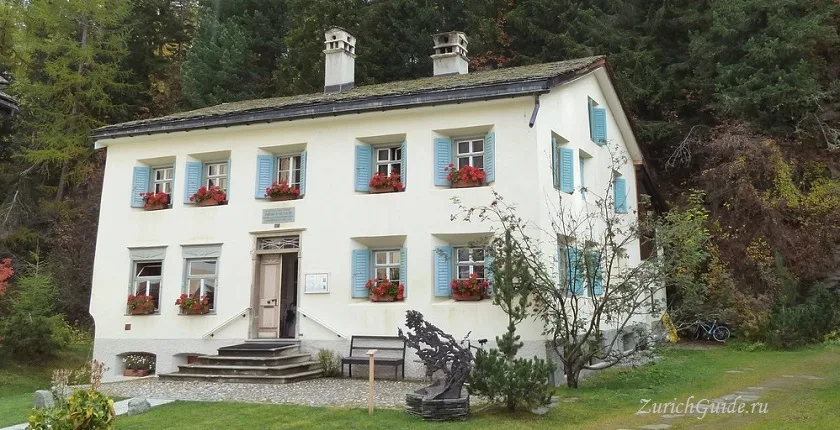
Friedrich Nietzsche spent seven summers here between 1881 and 1888, in a simple room in a house on the main street, paying very little and eating badly.
He wrote most of what he is remembered for in this valley: Thus Spoke Zarathustra, Beyond Good and Evil, The Genealogy of Morals. The idea of eternal recurrence came to him, by his own account, on a walk by the lake at Surlej near a large pyramidal rock — there is a plaque on it now.
The Nietzsche-Haus is preserved as a small museum: his room, more or less bare, with a bed and a table, and an exhibition downstairs. It is affecting precisely because it is so plain.
Others followed him here — Rilke, Hesse, Adorno, Thomas Mann, Anne Frank’s family before the war, Marcel Proust’s translators. The village has a habit of collecting people who write.
The lakes and the walk
The Chastè peninsula juts into Lake Sils and is the walk Nietzsche took daily — flat, half an hour round, through larch and stone pine, with the lake on both sides. There is a stone with lines from Zarathustra carved into it at the far end.
Val Fex, the side valley behind the village, is closed to cars and reached on foot or by horse-drawn carriage, with a chapel and a glacier at the end.
The Maloja wind
Every afternoon in summer, reliably enough to set a watch by, a wind gets up from the Maloja pass and runs down the lakes. It is the reason Silvaplana is one of the main windsurfing and kitesurfing centres in Europe despite being at 1,800 m in the middle of the Alps.
If you are not surfing, it is the reason to do the walking in the morning.
Getting there
- By train and bus — St. Moritz is the railhead (Zurich about three and a half hours via Chur), then a post bus in twenty minutes.
- The Maloja pass road continues south over into Italy and the Val Bregaglia, which is a beautiful and much less travelled route.
Nearby
- St. Moritz — twenty minutes, and a different world
- Pontresina — half an hour, and the Bernina glaciers
- Soglio and the Val Bregaglia — over the Maloja, where the Giacometti family came from
- Corvatsch — the cable car above Silvaplana to 3,303 m
When to go
July to September for walking, late September for the larches turning, and winter for cross-country skiing on the frozen lakes — the Engadin Ski Marathon passes through in March.
The Upper Engadin is high, dry and exceptionally sunny, and the light is the reason painters keep coming.
Where to park in Sils Maria
| Car park | Spaces | Fee | From centre |
|---|---|---|---|
| Chesa da parker Val Fex underground | 400 | paid | 180 m |
| Fainera | — | paid | 470 m |
| Open car park | 21 | — | 710 m |
| Furtschellas | 200 | paid | 840 m |
Data © OpenStreetMap contributors, ODbL licence, snapshot of 22 August 2026. The map is drawn by volunteers: the list is not complete, and a dash means “not recorded” — not “free” and not “no spaces”. This is not an official parking directory: when you get there, read the signs and the machine at the entrance.
Weather in Sils Maria month by month
| Month | Day | Night | Rainfall |
|---|---|---|---|
| January | -1° | -13° | 48 mm |
| February | 0° | -13° | 34 mm |
| March | +3° | -9° | 47 mm |
| April | +6° | -4° | 62 mm |
| May | +11° | +1° | 90 mm |
| June | +15° | +4° | 113 mm |
| July | +18° | +6° | 109 mm |
| August | +17° | +6° | 127 mm |
| September | +13° | +3° | 97 mm |
| October | +9° | -1° | 106 mm |
| November | +3° | -5° | 104 mm |
| December | 0° | -10° | 56 mm |
Normals for 1991–2020 from MeteoSwiss, station Segl-Maria, open data, version of 29 July 2026. Day and night are the average daily high and low, not records; rainfall is approximate. Current conditions from the Norwegian Meteorological Institute, CC BY 4.0.
Updated: