
Thurgau
A green, rural canton in the north-east of Switzerland, between Zurich and Lake Constance, known for its apple orchards, its lakeshore towns and its quiet, gentle countryside.
Thurgau is a canton of about 290,000 people in the north-east of Switzerland, between the canton of Zurich and Lake Constance (the Bodensee), with Germany across the water. Named after the river Thur, it is a land of rolling hills, farms and, above all, orchards: it is the largest apple-growing canton in Switzerland, which has earned it the nickname Mostindien, “Cider India”. Its capital is Frauenfeld, and its language is German. Thurgau joined the Swiss Confederation as a full canton in 1803, after centuries as a territory ruled jointly by the other cantons.
It is not a canton of grand sights, but it is a pleasant, peaceful region for cycling, walking and boat trips, with small old towns along the lake and the Rhine, and it is easy to reach from Zurich for a day.
Frauenfeld and Ittingen
Frauenfeld, the cantonal capital, about 35 minutes from Zurich by train, has a small old town and a castle with a 13th-century tower, which houses the historical museum of Thurgau.
A few kilometres north, the Kartause Ittingen is a former Carthusian monastery set among vineyards, orchards and gardens. Founded in the 12th century and rebuilt after a fire in the 16th century, it was a monastery until 1848. Today it is a hotel, restaurant and cultural centre with two museums: the museum of the monastery, with the monks’ cells and a fine Baroque church, and the cantonal art museum. Its farm produces wine, cheese, trout and vegetables.
Lake Constance and the Untersee
The Swiss shore of Lake Constance runs along the whole north of Thurgau, with a lakeside cycle path and boat services. See Lake Constance.
- Arbon, the Roman Arbor Felix, with a castle, an old town and a long lakeside promenade.
- Romanshorn, a port with ferries across the lake to Friedrichshafen in Germany.
- Kreuzlingen, which merges with the German city of Konstanz across the border, with the Baroque church of Saint Ulrich and a lakeside park.
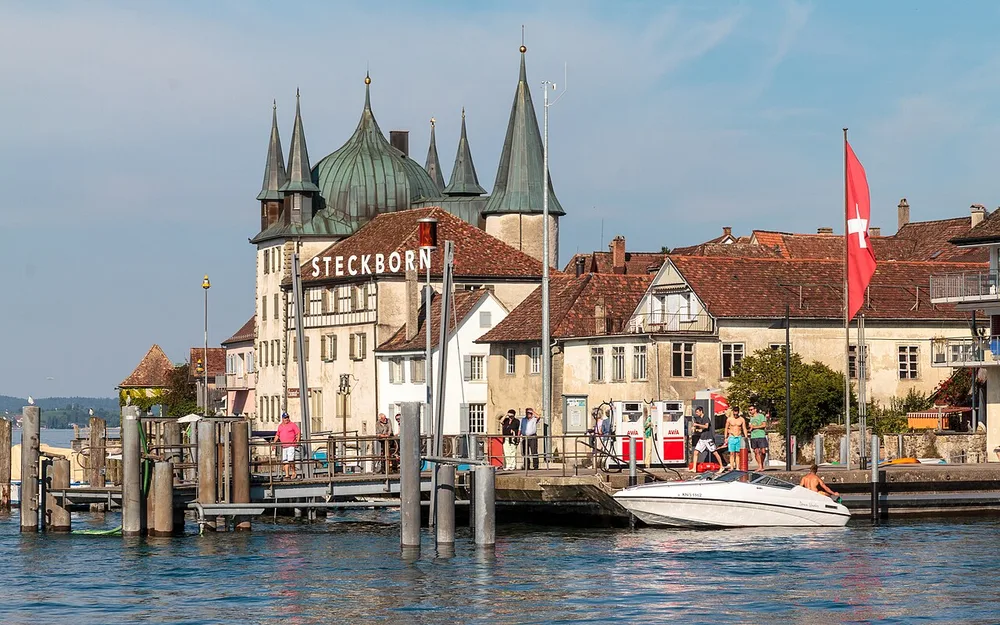
- On the Untersee, the western arm of the lake, the small towns of Steckborn, with its turreted Turmhof by the harbour, Ermatingen and Gottlieben, a tiny village of half-timbered houses on the Rhine, famous for its wafer rolls.
- Across the water from Steckborn, the German island of Reichenau, with its UNESCO-listed Romanesque churches.
The Rhine
West of the Untersee, the Rhine flows out of the lake towards Stein am Rhein and Schaffhausen. On its banks, Diessenhofen is a small walled town with a covered wooden bridge across the river to Germany.
Apples, cider and cycling
In spring the orchards of Thurgau are a sea of white blossom, and in autumn farm shops sell apples, pears, cider (Most), juice and spirits. The canton is crossed by signposted cycle routes, including the route around Lake Constance through Switzerland, Germany and Austria, and by easy walking paths through the hills of the Seerücken above the lake.
Safety
On Lake Constance, storms can rise quickly in summer: when the storm warning lights around the lake start flashing, get out of the water and bring boats ashore. Swim only at the lidos and bathing places, away from the harbours and the routes of the ships. The Rhine below the lake has strong currents.
Getting there
From Zurich, trains run to Frauenfeld in about 35 minutes, and to Kreuzlingen, Romanshorn and Arbon in about an hour to an hour and a quarter. Boats link the towns on the lake and run along the Untersee and the Rhine to Schaffhausen in summer. Nearby are Winterthur and St. Gallen.
For regional passes, see tickets and passes.
This page in Russian: Кантон Тургау
Updated: