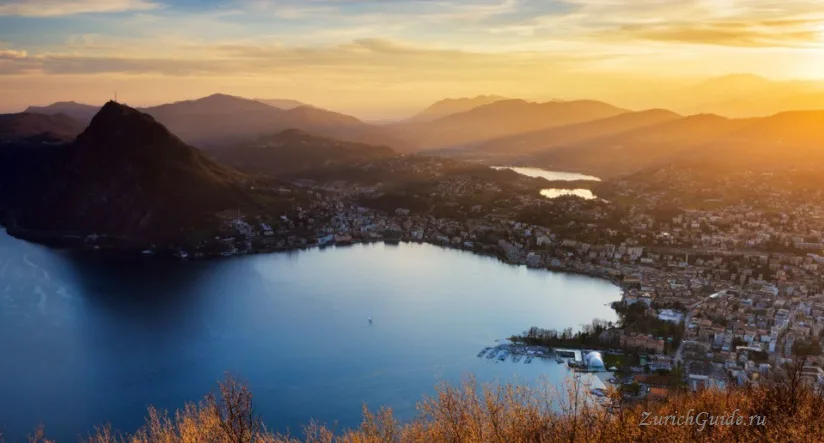
Ticino
The canton south of the Alps: Italian-speaking, Lombard-built, several degrees warmer, and still unmistakably Swiss where it counts.
Ticino is the only canton entirely south of the Alps, and crossing into it is the most abrupt change of scene in Switzerland. The tunnel takes twenty minutes; at the far end the language is Italian, the roofs are flat, the walls are stone, the vegetation is subtropical and the temperature has risen several degrees.
It has been Swiss since 1803, and Italian-speaking for far longer — the Confederation took these valleys as subject territory in the fifteenth and sixteenth centuries, which is why Ticino speaks Italian but was never part of Italy.
About 350,000 people live here, and the canton is squeezed between two Italian borders, with Milan closer than Zurich.
The towns
Lugano — the largest, the financial one, arcaded and set on its lake, with two funicular mountains either side.
Locarno — at 196 m the lowest point in Switzerland and the warmest, with the Piazza Grande, the pilgrimage church on the cliff, and a film festival that fills the square every August. Ascona next door is the pretty one.
Bellinzona — the capital, with three castles and a wall across the valley, UNESCO-listed, and skipped by almost everyone.
Melide — for Swissminiatur, the whole country at one twenty-fifth scale.
The valleys
The reason to stay rather than pass through. Side valleys run north from the lakes into granite country, each with a post bus:
Verzasca — grey-green rock scoured smooth by a river of improbable clarity, and the double-arched Ponte dei Salti at Lavertezzo. The dam at its mouth is the bungee jump from the opening of GoldenEye.
Maggia — broader, with waterfalls and stone-roofed villages.
Bavona — the wildest, with hamlets that still have no mains electricity.
Centovalli — carries a scenic railway to Domodossola in Italy through chestnut forest, on an ordinary fare.
Grotti
The local institution. A grotto was originally a cool cellar cut into the rock for storing wine and cheese; it became a country restaurant with granite tables under the trees.
You eat polenta, risotto, luganighe sausage, braised meats and cheese, and you drink the local wine from a boccalino, a small ceramic jug. Prices are lower than anywhere else in Switzerland and the setting is half the point.
Wine
Ticino planted Merlot after phylloxera destroyed the old vineyards in the early twentieth century, and it now makes some of the best Merlot outside Bordeaux and Tuscany. There is also a white Merlot, vinified off the skins, which exists almost nowhere else.
See eat and drink.
What is still Swiss about it
Trains to the minute. Prices in francs and Swiss in level. Clean, orderly and quiet after ten at night. Ticinesi are firm that they are Swiss and not Italian, and mildly tired of being asked.
Getting there
- By train — Zurich to Lugano about two hours through the Gotthard Base Tunnel, the longest railway tunnel in the world at 57 km.
- The scenic way — the old Gotthard line over the mountain, with its spiral tunnels, on the Gotthard Panorama Express from Lucerne.
- By air — Milan Malpensa is often closer and cheaper than Zurich.
When to go
April to June and September to October. Spring is the best of it — camellias in March, the valleys running full with snowmelt, everything green and nobody there.
July and August are hot, humid and busy with Swiss from over the Alps, and the film festival takes the middle of August.
Nearby
Other places on this site within easy reach, as the crow flies:
- Andermatt — 59 km
- Sils Maria — 63 km
- Laax and Flims — 71 km
- St. Moritz — 71 km
- Pontresina — 75 km
- Brig — 81 km
Weather in Ticino month by month
| Month | Day | Night | Rainfall |
|---|---|---|---|
| January | +7° | -3° | 72 mm |
| February | +9° | -2° | 62 mm |
| March | +14° | +2° | 87 mm |
| April | +18° | +6° | 158 mm |
| May | +22° | +10° | 197 mm |
| June | +26° | +14° | 178 mm |
| July | +28° | +15° | 156 mm |
| August | +27° | +15° | 194 mm |
| September | +22° | +11° | 196 mm |
| October | +17° | +7° | 202 mm |
| November | +11° | +2° | 214 mm |
| December | +7° | -3° | 90 mm |
Normals for 1991–2020 from MeteoSwiss, station Magadino / Cadenazzo, open data, version of 29 July 2026. Day and night are the average daily high and low, not records; rainfall is approximate. Current conditions from the Norwegian Meteorological Institute, CC BY 4.0.
Updated: