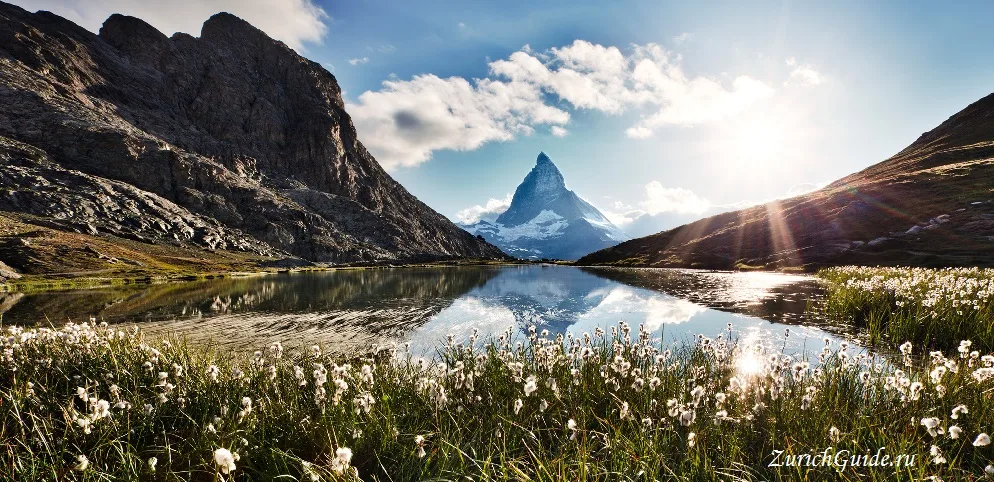
Valais
The Rhône valley from Lake Geneva to the Furka, with 45 of Switzerland's 48 four-thousand-metre peaks, a language border in the middle and the country's largest vineyard.
The Valais is the Rhône valley: a single deep trench running from the Furka pass west to Lake Geneva, with side valleys climbing south into the highest mountains in the Alps.
Forty-five of Switzerland’s forty-eight peaks over 4,000 m are here, including the Matterhorn and the Dom, the highest mountain entirely within Switzerland. So is the Aletsch, the longest glacier in the Alps.
It is the driest part of Switzerland — parts of the valley floor get less rain than some Mediterranean regions, which is why the slopes have been irrigated for six centuries by bisses, wooden channels carrying meltwater along the mountainsides.
And it is split in two by language: French in the west, German in the east, with the border running through the middle of the valley near Sierre.
The places
Zermatt — car-free, the Matterhorn, and the Gornergrat, which is the best mountain view in the country.
Saas-Fee — the next valley, car-free, thirteen four-thousanders in a ring and summer skiing on the glacier.
Verbier — the off-piste resort and the Four Valleys.
Sion — the capital, with two castle hills and the oldest playable organ in the world.
Leukerbad — the largest thermal resort in the Alps, under a 600-metre cliff.
Brig — the junction at the eastern end, with the Stockalper palace and the Simplon route to Italy.
The Aletsch — the cable cars from Mörel and Betten to Riederalp and Bettmeralp, car-free villages on a sunny shelf, and the Bettmerhorn looking straight down twenty kilometres of ice, for a fraction of what the Jungfraujoch costs on the other side.
The wine
The Valais makes about a third of all Swiss wine, more than any other canton, on terraces so steep some are worked with monorails.
Whites are Fendant — Chasselas under its local name — and Petite Arvine, an indigenous grape grown almost nowhere else. Reds are Dôle, Pinot Noir and Syrah, and there are half a dozen local varieties that never leave the canton: Cornalin, Humagne, Amigne. See Swiss wine.
The bisses
The irrigation channels are the canton’s quiet pleasure. Many have a footpath running alongside them, level, shaded and following the contour, and they make some of the best easy walks in Switzerland — you gain no height and the view stays with you for hours.
The tourist offices publish a map of the accessible ones.
Getting there
- By train — Zurich to Brig about two and a quarter hours through the Lötschberg base tunnel; Geneva to Sion about an hour and a half along the valley.
- The Glacier Express runs the length of it from Brig to Zermatt.
- Car shuttles through the Lötschberg and Simplon tunnels when the passes are shut; see driving.
When to go
July to September for the high mountains and the bisses. December to April for skiing. The valley floor is hot in summer and the wine harvest is late September.
The Valais also has the driest, clearest autumn weather in Switzerland, which makes October a good month here when it is grey elsewhere.
Weather in Valais month by month
| Month | Day | Night | Rainfall |
|---|---|---|---|
| January | +5° | -3° | 52 mm |
| February | +7° | -2° | 40 mm |
| March | +13° | +2° | 37 mm |
| April | +17° | +5° | 34 mm |
| May | +21° | +9° | 52 mm |
| June | +25° | +13° | 48 mm |
| July | +27° | +14° | 62 mm |
| August | +26° | +14° | 60 mm |
| September | +22° | +10° | 38 mm |
| October | +17° | +6° | 43 mm |
| November | +10° | +1° | 50 mm |
| December | +5° | -3° | 68 mm |
Normals for 1991–2020 from MeteoSwiss, station Sion, open data, version of 29 July 2026. Day and night are the average daily high and low, not records; rainfall is approximate. Current conditions from the Norwegian Meteorological Institute, CC BY 4.0.
Updated: