Vaud
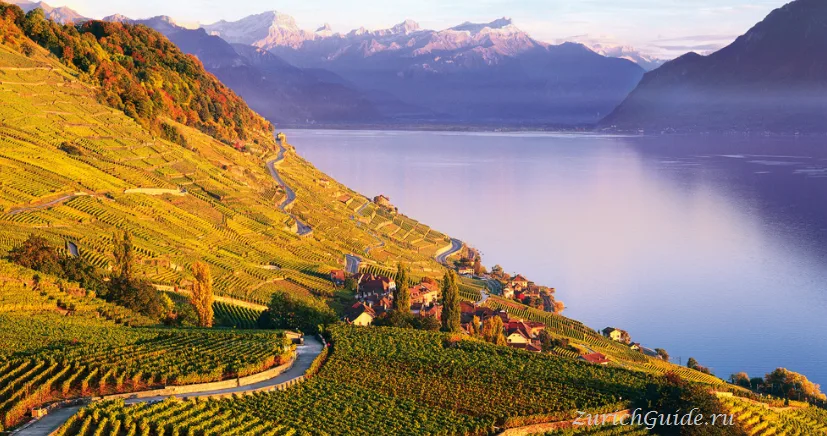
The French-speaking shore from Geneva to Montreux, with terraced vineyards, a castle on the water, and the Alps beginning behind it.
Vaud is the largest of the French-speaking cantons, running from Lake Geneva up into the Jura and back into the Alps. It has the mildest climate in Switzerland, the second-largest vineyard area, and a shoreline that has been a resort since the eighteenth century.
It was Bernese territory from 1536 until 1798 — conquered, Protestant-ised and administered from Bern for two and a half centuries, which is why a French-speaking canton is full of Bernese castles.
The lakeshore
Lausanne — the capital, steep, with the finest Gothic cathedral in the country, a night watchman who still calls the hours, and the only metro in Switzerland.
Montreux — palms, the jazz festival, Freddie Mercury, and the Château de Chillon on its rock in the water.
Vevey — Chaplin’s last home, a market square opening onto the lake, and a giant fork in the water.
Morges — the tulip festival and a castle full of model soldiers.
Nyon — Roman, with a white castle and the Paléo festival.
Lavaux
The terraced vineyards between Lausanne and Vevey are the canton’s UNESCO site and the best walk on the lake: 30 km of dry-stone terraces worked since the eleventh century, with a railway station every few kilometres and cellars open at weekends.
Chasselas, taken seriously, and the reason to pay attention to Swiss white wine at all. See Swiss wine.
Inland
Yverdon-les-Bains — thermal water, a castle, standing stones and Europe’s only public science fiction museum.
Grandson — a lakeside castle and the site of the 1476 battle where the Swiss destroyed Charles the Bold of Burgundy and took a legendary treasure. See castles.
Avenches — Roman Aventicum, once the capital of Helvetia; see Roman Switzerland.
Romainmôtier — a Cluniac abbey church of the tenth century in a hamlet, and one of the oldest Romanesque buildings in Switzerland.
The mountains
Villars, Les Diablerets and Leysin — the Vaud Alps, a family ski region above the Rhône valley, with Glacier 3000 and its suspension bridge between two summits at the top.
The Jura on the other side — gentler, forested, with cross-country skiing and the Vallée de Joux, where the complicated watches are made.
Getting there
- By train — Geneva to Lausanne 35 minutes; Zurich to Lausanne about two hours ten; the lakeshore line is frequent and fast.
- By boat — the CGN steamers along the whole shore, including into France; see the lakes.
When to go
May to September for the lake, September and October for the harvest, and December for the Montreux Christmas market.
The lakeshore is mild enough to work in winter, when the mountains behind it are white and the palms in front of it are not.
Weather in Vaud month by month
| Month | Day | Night | Rainfall |
|---|---|---|---|
| January | +5° | -2° | 92 mm |
| February | +6° | -1° | 78 mm |
| March | +10° | +2° | 84 mm |
| April | +14° | +5° | 86 mm |
| May | +18° | +10° | 114 mm |
| June | +22° | +13° | 108 mm |
| July | +25° | +16° | 102 mm |
| August | +25° | +16° | 98 mm |
| September | +21° | +12° | 99 mm |
| October | +16° | +8° | 110 mm |
| November | +10° | +3° | 106 mm |
| December | +5° | 0° | 112 mm |
Averages for 1991–2020, computed from NASA POWER daily data and corrected for the elevation of the place (463 m). Day and night are the average daily high and low, not records; rainfall is approximate. Current conditions from the Norwegian Meteorological Institute, CC BY 4.0.
Updated: