Zurich streets and squares
Bahnhofstrasse, Lindenhof, Niederdorf, Schipfe, Paradeplatz and the rest, and why each is worth five minutes.
Zurich’s old town is small enough that the streets are the sight. This is what each one is, in the order you would meet them walking from the station to the lake and back — the route set out in one day in Zurich.
Bahnhofstrasse
The main axis, running 1.4 km from the station to the lake, built in the 1860s on the line of the filled-in city moat — which is why it is straight in a town where nothing else is.
One of the most expensive shopping streets in the world, and the gold vaults of the big banks are literally under your feet along the southern half. Walk it once end to end for the sense of the city’s wealth; the shops worth entering are on the side streets.
Paradeplatz
Halfway down, and the financial centre of Switzerland: UBS on one side, Credit Suisse’s old headquarters on the other, and Sprüngli’s café on the corner, which is where Zurich goes for a Luxemburgerli.
It is also the hub of the tram network, and standing at the edge watching six lines converge and separate without a hitch is a reasonable summary of the country.
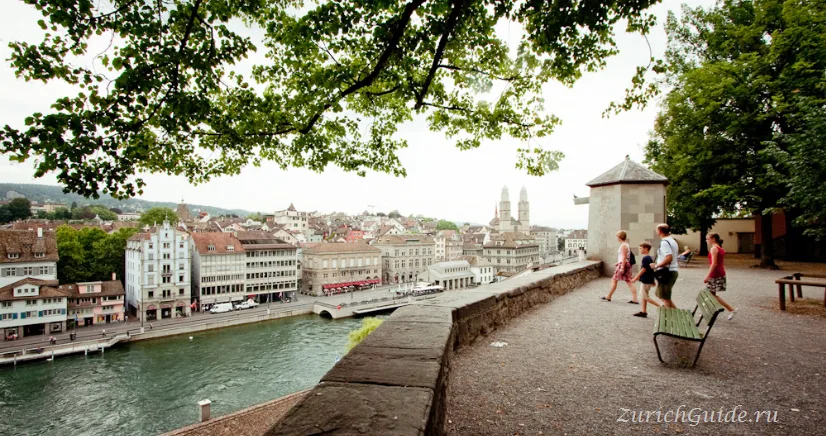
Lindenhof
The hill above the river, and the place to start. The Romans put a customs post here, the Carolingians a palace; now it is a gravelled terrace under lime trees with permanent chess games and the best free view in the city.
A local story attaches to it: in 1292, with the men away, the women of Zurich are said to have put on armour and lined the hill, and the besieging Habsburgs withdrew rather than face what they took for a garrison.
Augustinergasse
The lane below Lindenhof, and the prettiest street in the city — narrow, cobbled, and lined with painted oriel windows in blue, green and gold. It was the craftsmen’s street and is now boutiques.
Schipfe
The oldest working quarter of Zurich, on the riverbank under the Lindenhof: a lane of small workshops, a covered walkway along the water, and shade all afternoon. It was where boats unloaded and where silk was worked, and it is still full of craft businesses rather than shops.
The quietest five minutes in the old town.
Münsterhof
The square in front of the Fraumünster, and the largest in the old town. It was the pig market for five centuries, then a car park until 1996, and is now paved and empty in the way a good square should be. Two guild houses stand on it.
Niederdorf
The east bank, and the pedestrian half of the old town — usually just Dörfli. Narrow lanes running parallel to the river, bars and restaurants, and considerably more life after dark than the west side.
Rindermarkt and Neumarkt are the quieter squares off it, and Spiegelgasse is where Lenin lived at number 14 in 1916–17, a hundred metres from where the Dada movement was founded at the Cabaret Voltaire in the same year. The two facts sit on one short street and nobody at the time connected them.
Limmatquai
The riverfront on the east bank, with the guild houses along it and the Rathaus standing on piles in the water. The tram runs along part of it and the rest is pedestrian.
Bürkliplatz
Where Bahnhofstrasse meets the lake: the boat pier, a market on Tuesday and Friday mornings, and the view south to the Alps on a clear day.
Practical
All of the above is within a twenty-minute walk, and none of it needs a ticket. The one-day route links them in a loop; a few hours in Zurich does the short version.
Updated: