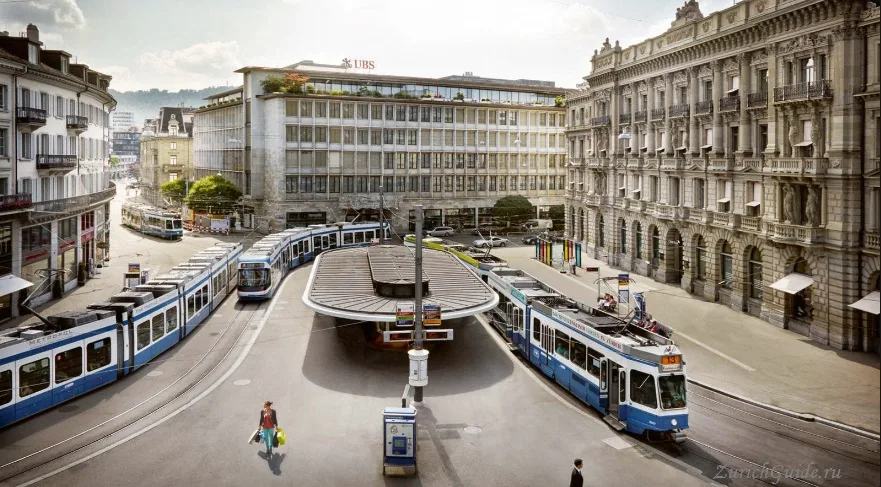
Getting around Zurich
One network, one ticket, and a tram every few minutes. What each mode is for, and when walking beats all of them.
Zurich’s transport is run as a single network — ZVV — covering trams, buses, suburban trains, lake boats and two funiculars, all on one ticket. For what to buy, see Zurich transport tickets.
This page is what each thing is actually for.
Walk first
The centre is small. Main station to the lake is fifteen minutes on foot, the old town is a twenty-minute square, and most visitors buy more tickets than they need.
The one-day route is entirely walkable except the hill at the end. Use transport for distance, not for the centre.
Trams
The backbone, and the thing Zurich is quietly famous for. Fifteen lines, every few minutes, on their own right of way for much of the network — which is why they are not stuck in traffic.
Paradeplatz and Bellevue are the two hubs where most lines meet. Stops have a display showing the next departures to the minute, and the minute is accurate.
Trams take priority at junctions, doors open on request by button, and the whole system is designed so that connections work rather than merely exist.
Buses
Fill the gaps, including trolleybuses on the main routes. Same tickets, same timetable logic.
The S-Bahn
The suburban rail network, and the part visitors underuse. It runs under the city and out in every direction, and several things a visitor wants are on it:
- Uetliberg — the S10 from the main station, 25 minutes, inside the city fare zone
- The airport — 10 minutes; see from the airport
- Winterthur, Rapperswil, Baden — all suburban journeys rather than expeditions
Platforms 21 and 22 at the main station, for Uetliberg, are at the far end and easy to miss.
The boats
Scheduled services on the lake from Bürkliplatz, and the short round trip of about an hour and a half is inside city zone 110 — which means a day pass covers it. This surprises nearly everyone and is the best value in Zurich.
Longer runs go down to Rapperswil. There are also small boats on the Limmat in summer, running between the main station and the lake through the middle of the old town.
See the lakes.
The two funiculars
Polybahn — a short, steep line from Central up to the ETH terrace, running since 1889. It is included in city tickets, it takes 100 seconds, and the terrace at the top has one of the best views over the old town. Students use it as a lift.
Rigiblick — up to a residential hillside in the north, with a restaurant and a view.
At night
Trams and buses stop around midnight. On Friday and Saturday nights the network runs an hourly night service with a supplement on top of the normal fare, which must be bought separately.
Bicycles
Zurich has a free bike-hire scheme, Züri rollt, with stations near the main station and Bellevue — deposit and ID, free for a few hours. The city is flat along the lake and river and steep everywhere else.
Bikes need their own ticket on trains.
Accessibility
Low-floor trams, level boarding at most stops, and lifts at S-Bahn stations. The old town’s lanes and stairs are the exception, and the Lindenhof and Schipfe involve steps.
And the car
Do not. See parking in Zurich for why, and for what to do if you have one anyway.
Updated: